0:00
Galambos sings a Yiddish song about yeshiva students.
From the machine transcript
Galambos sings the Yiddish song about the yeshiva student who does not want to go on suffering, repeating it slowly at Kerler's request.
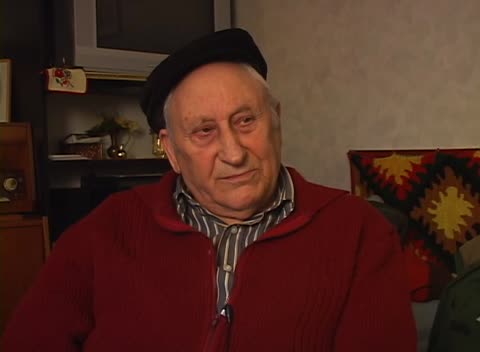
One conversation with Zoltan Galambos, continuing over MDV 109, MDV 119, MDV 311.
Galambos sings a Yiddish song about yeshiva students.
Galambos sings the Yiddish song about the yeshiva student who does not want to go on suffering, repeating it slowly at Kerler's request.
Galambos talks about the Vaja synagogue. He then talks about his life after World War II, before addressing prewar Jewish life in Vaja. Galambos returned with a sister and two brothers. Galambos recalls book peddlers.
Galambos says the Vaja synagogue was ruined, like the Temple. He recalls that after the war a sister and three brothers returned and began businesses. He describes poor Jewish peddlers from other towns selling religious items and books, and says he read Hebrew, Yiddish and a little German but not Hungarian literature. He remarks that the Holocaust cannot be portrayed in theater or books.
includes his remarks that the Holocaust cannot be portrayed in theater
Galambos shows the book "Journey to Vaja." He again provides the lyrics for the yeshiva student song.
Galambos shows a book in English about Vaja, given to him by the grandson of a Jew from Canada. Kerler says they will obtain a copy, and the book's publisher and Weinberger from Munkács are mentioned. A Russian term for a labor battalion comes up. Galambos then repeats the yeshiva-student song with Kerler, who asks about its grammar.
includes the book's possible purchase and the labor-battalion remark
Galambos remembers Sabbath songs (zemirot). He then addresses holiday food customs.
Galambos is asked about Sabbath table songs and recalls little. Asked about Hanukkah food, he says they made fried dough cakes and fish on Sabbath, and mentions gefilte fish prepared with sugar once in Klausenburg(?). He says his cheder songs are forgotten and doubts that anyone is interested in such memories.
adds the Sabbath gefilte-fish talk and his doubt that his memories matter
Galambos speaks about his life today and politics.
Galambos argues angrily about the Americans' failure to bomb the camps and save Hungarian Jews. He claims that Americans took a train of Jewish gold, for which Hungary later received compensation, and speaks about restitution. He says he gets a lifelong pension from Germany. Kerler then asks about yeshivas in the area.
adds the claims about Americans and the gold train, and a pension from Germany
Galambos speaks about prewar religious life, in particular yeshivot in the neighboring villages, such as Nyírmada, Vásárosnamény and Ópályi.
Asked about prewar yeshivas in the area, Galambos names places such as Nyírmada and Ópályi. He cannot say which had the best reputation. He then speaks of saying the Kaddish and prayers that bring back Auschwitz and the burning of children, and asks for a prayer book.
adds the turn to Kaddish and Auschwitz memories
Galambos reads from the prayer book and speaks about life before the war, which he compares to life today.
Galambos reads from the prayer book and says the verses recall Auschwitz, where children were thrown into the fire. He contrasts prewar life, when Jews lived peacefully with their neighbors, went to synagogue and cheder and walked freely day and night, with today.
adds the prayer-book reading and Auschwitz recollection
Galambos addresses prewar Jewish press, as well as his religious school (cheder) and yeshiva education. He also talks about the region.
Kerler asks about prewar newspapers. Galambos recalls a Jewish paper in Hungarian and no Yiddish one. He says cheder taught reading without translation and yeshiva taught Gemara. He lists towns he visited, including Debrecen and Munkács, and the group discusses travel to Košice. They also touch on the river and the word for ritual bath.
adds newspapers, languages, towns he visited and the river
Galambos speaks about religious and food customs, particularly challah. He then answers questions about cultural terminology.
Galambos speaks about Sabbath kiddush wine and bread, and the term for the braided loaf, and about burning the challah portion as a commandment. Kerler asks about theater, and about the terms dybbuk and golem. Galambos explains the golem as a figure from the Haggadah.
adds the dybbuk and golem terms and the theater question
Galambos speaks about Yiddish dialects and his life after liberation.
Galambos recalls the camps after liberation, where Polish Jews spoke Polish, Russian and Yiddish while Hungarian Jews mostly did not speak Yiddish. He names places in the area where Yiddish was spoken, mentions that American soldiers came with a Torah, and describes devout Polish Jews. Kerler then asks about the happiest time in his life.
adds Hungarian versus Polish Jews' Yiddish and the American soldiers' Torah
Galambos speaks about his family and the team concludes the formal part of the interview. The camera then records family photographs.
Asked for the happiest time, Galambos says his life was hard. He had some good life before the troubles came, and he names relatives who survived, his parents and sisters. Asked how Vaja's life should be remembered, he says he cannot say much. Kerler thanks him and the formal interview ends.
adds the surviving relatives and how to remember Vaja
Galambos chats with the team outside. He also discusses his childhood memories. Galambos's family moved to Vaja when he was three years old.
Outside, Galambos talks with the team and says he has found it hard to recall old things. He recalls that his family came to Vaja when he was three. He mentions cheder and games with other children, and the group discusses the number of streets in Vaja. Hungarian chat with others and a gift of apples follow, then a song and warm farewells.
adds the farewell chat and gifts outside
The camera records town footage in Košice.
Footage of Košice streets while Kerler and another man talk; the speech is largely unclear, with remarks about Slovak and a pleasant street.
The camera collects synagogue footage.
Footage in and around the Košice synagogue with several voices, including some Polish, Russian and English. Speech is mostly garbled; people discuss documentation, a found historical document and books, and something used in a camp.