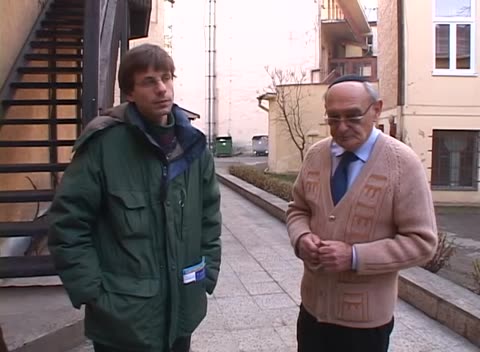
Informal chat outside with Rabbi Steiner and the other men present. They mention a museum director from a town whose name is unclear, and discuss the Slovak coloring of the speakers' Yiddish and whether a man speaks Yiddish at all. One man says he comes from Brooklyn. At the end Steiner turns to a Michalovce community and the information in its book about a rabbi, a dayan, a shoykhet and a melamed.
Adds the talk about Slovak coloring of Yiddish, a museum director, and the turn to Michalovce at the end.
Steiner reads from the Michalovce community book. It contains rules for the synagogue: no sermon where the bimah is not in the middle, no weddings in the synagogue, no innovations. He reads out the signatories and the community leaders, and Kerler comments. Steiner mentions a man from Veľké Kapušany, a miller's son. He then talks about the Michalovce cemetery with its ceramic tombstones and lists other small Jewish communities (Trebišov, Kráľovský Chlmec, Veľké Kapušany). Last he mentions a postwar pogrom in Kolbasov in Poland, with a second place in Poland.
Adds the Michalovce cemetery, other Slovak communities and a postwar pogrom in Poland.
Kerler notes swastikas carved on the wooden doors of the synagogue being excavated, and Steiner speaks about the cemetery. Gravestones were toppled some years ago and money was raised to repair it, and he describes the repair ceremony and good relations with local priests. He tells of a ten-day trip of priests to Israel, including Yad Vashem, and of the support of Rabbi Sher Yashuv Cohen. He says his family lives in Israel, and there is talk of phoning a man for the interviewers, and of plans to travel to Prešov and see the museum and synagogue from outside. He also discusses contemporary relations with the authorities and Jewish communities. He explains a memorial of the deportation route, with names of Košice Jews deported toward Auschwitz read at a ceremony. At the end he tells a cheder joke and there are languages questions, and car-travel talk partly in Hungarian.
Adds the priests' trip to Israel, the deportation memorial with names, a cheder joke and travel arrangements.
The team greets Weinberger and sets up. A short exchange mentions a father born in Poland in a place that is unclear (Karczyn (?)), and Kerler refers to Sholem Aleichem's Tevye the milkman, to which Weinberger relates that as a boy he carried milk.
Weinberger recalls carrying kosher milk to Jewish homes in the early morning as a boy for his uncle's cows. The date of the interview is stated as 18 December 2006, in Kislev, during Hanukkah, and there is a place-name exchange mentioning Mukachevo. He then begins his personal information: his name, father Leyzer, mother Gitl, sister Leah and brother Shmuel.
Adds the date of the recording, the Hanukkah and Kislev reference, and the names of his parents and siblings.
The formal interview begins. Weinberger provides personal information and talks about his family. He grew up with one sister and one brother. His father was born in Poland. Weinberger attended a religious school (cheder) in Stropkov and recalls how his grandmother cooked for him when he came home to Nižna Jedlova.
Weinberger describes his family and Nižná Jedľová, a small village near Svidník with about nineteen houses, a few of them Jewish families including his own and uncles. He recalls his grandmother Leah (?) who cooked for him when he came home from cheder in Stropkov. His uncles were taken in 1942 and his father died in 1943 (?), his mother and siblings were deported, and an uncle hid him so that he lived on false Christian papers. He also mentions an uncle with eight small children, married to a woman from Poland, and the nearby border and villages.
Adds the wartime deportation of his family, hiding on false papers, and the grandmother's cooking.
Weinberger shows a book about the Stropkov Jewish community. He remembers several of the photographed people, including the local tailor. Weinberger maintains that he was a forced laborer near Sered' during his military service.
Weinberger goes through a book on the Stropkov Jewish community and the many photographs. He remembers local people: a tailor, a shopkeeper he carried milk to, a bank manager, a man who was driven through town with non-kosher sausage, and a Gardist who was a Jewish coachman's son. He also shows wartime Slovak antisemitic publications and speaks of Jews being gathered in the synagogue before deportation, and of selection at Auschwitz. He says he was a forced laborer in Sereď, and that there was Yiddish among non-Jews of Stropkov. He regrets there is no one to speak Yiddish with at home. At the end he gives his birth date (18 November 1927) and says he lives in Košice.
Adds antisemitic propaganda, Yiddish-speaking non-Jews, wartime events and recollections of local people.
Weinberger gives personal details: that he lives in Košice and the address and spelling of his name for correspondence. The transcript has no lines of its own for this stretch.
Adds the address and name spelling for correspondence.
Weinberger talks about his life after the war. He worked in Presov for ten years and visited Israel for one week in 1969. Weinberger also addresses the contemporary Jewish community of the region and emigres in Israel.
Weinberger says no relatives remain, and that he visited Israel in 1969 for about five weeks (?), at a friend's invitation, and met Stropkov landsleit there. He then speaks about the contemporary Jewish community, including a woman from Breznica in Bratislava who knows Yiddish, an ethnographic project in Bratislava, other survivors of Auschwitz from the Stropkov area, and a book on Stropkov published by a woman in Be'er Sheva. He also mentions the Halberstam family and a Košice rabbi with an ohel in Košice.
Adds the Bratislava community, Stropkov natives and the Halberstam family; the transcript does not mention Prešov or a week-long Israel visit.