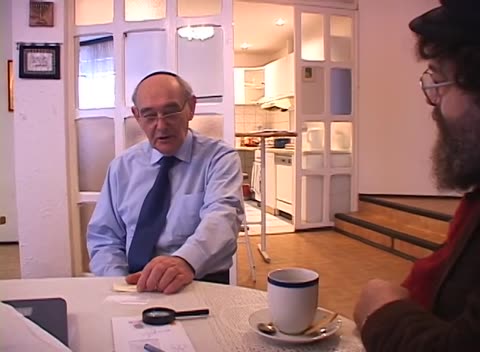
Opening introductions in the rabbi's apartment: Steiner and the interviewers exchange where they come from and where they grew up (Jerusalem, Canada, America), and some Hungarian is spoken with another person present. Kerler explains the project: interviews in Yiddish with elderly Jews born before the war, with a camera operator and a Hungarian-based colleague. Steiner remarks that they are too young for the project.
Mostly introductions and explanation of the project, with some Hungarian
Steiner talks about a very old man, the son of the cantor of the Neolog synagogue in Košice, who died half a year before at over ninety. He says his own Yiddish comes from Jerusalem and that he was born in Slovakia in Zlaté Moravce, a small town where about fifty Jewish families lived among a non-Jewish majority.
Also tells the story of the cantor's son and gives his birthplace
Steiner speaks about his hometown Zlaté Moravce and then his life in Israel. His father was also born in Zlaté Moravce. According to Steiner, fifty Jewish families lived there. He made aliyah in 1949. Steiner studied Yiddish and went to two yeshivot in Israel. Steiner has been the rabbi of the Košice community for five years.
Steiner speaks about Zlaté Moravce, where Hungarian was the main language and Yiddish was not spoken. He was born in 1936, lived through the war, and went to Palestine in 1949 from a religious family. In Jerusalem he learned Yiddish and Hebrew in yeshivas, including one in Petah Tikva, and he says his Yiddish is Jerusalem Yiddish. He has been in Košice about five and a half years, describes how the community feared a bearded rabbi, and mentions Hanukkah celebrations and the size of the community.
Also covers Yiddish learned in Jerusalem, and the community's Hanukkah events
Steiner speaks about contemporary communities in Košice and the region, as well as religious life. He also addresses his teachings and regional geography.
Steiner describes the present Košice community: its members and those outside it, Communist-era informers in the community, a plan to liquidate it, and how he met the community on arriving. He describes the prayer house, the club and his teaching, funerals and the burial society, and the economic situation of Slovakia. He lists Jewish communities in the region (Bratislava, Banská Bystrica, Nitra, Komárno and others), tells of small towns and cemeteries, and discusses whether anyone still speaks Yiddish, including a Slovak folk story about Finland.
Also covers funerals, other communities, the economy and a Slovak folk story
Steiner discusses Hasidic life in the Košice region before the war. He says there were few Hasidim and few tsadikim, speaks about Orthodox and Neolog Jews in the city, a Sephardic claim, old gravestones, and the religious scholar Akiva Yosef Schlesinger. He mentions the prewar yeshiva in Košice, a rabbi who died in 1943, and societies of pious Jews. Kerler asks about Hasidim, Sephardim, yeshivas and Prešov.
Steiner reads from and shows pictures in a book on the Košice community, speaking of the large Orthodox and Neolog synagogues, the talmud torah, and the present excavation for a memorial on the site. He explains inscriptions in the two kinds of synagogue, the history of Košice under Hungary and its role in the 1944 deportations, the cemetery, the Star of David of the destroyed synagogue, and the museum. Kerler asks about the buildings and his own travel plans.
Adds the excavation for a memorial and the deportations through Košice
Steiner and Kerler discuss the Hanukkah event planned for the next day and whether Yiddish speakers will be there. They look for a man from Finland who speaks Yiddish and recall a Purim custom of chocolate, a Hasid in Bardejov who has died, and others who might remember Yiddish. Much of the later part is a telephone call and talk in Slovak, so the content is unclear.
The conversation moves outside, where Steiner speaks with community members, one named Harry Weinberger (?), who knows a little Yiddish. The interviewers, mostly in English, explain that they are collecting Yiddish speech for a university archive and have travelled through Hungary, Moldova, Romania and Ukraine. Much of the passage is in Slovak and is garbled.