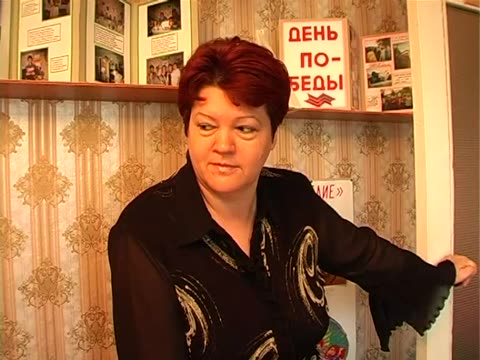
The team travels to the community center of Balta and then the camera pans around the small museum. In Russian, Tanya, who is the daughter of Liza Milchenko, talks about potential Yiddish interviewees in the region.
From the machine transcript
The team arrives at the Balta community center and the museum there. Tanya and a colleague discuss, mostly in Russian, which elderly Yiddish speakers might be interviewed in Balta and nearby towns such as Kotovsk. They mention an earlier visit by a group from Petersburg, Yiddish books, the Hesed, and plans to visit two women in their eighties.
The catalogue entry names Tanya as speaker; the transcript also shows the Petersburg visit, the Hesed branch and Kerler and Lemster's replies.
The second part of the tape is a formal interview with Rakhila Shmulevna Klimenko, born in Pervomayskiy in 1928. The team enters her apartment and sets up the formal interview.
From the machine transcript
The team goes into Klimenko's apartment and greets her. She says she is a Jewish woman who speaks only Yiddish, and they exchange names. She says she has forgotten much because she is old, and the interviewers reassure her.
Klimenko briefly talks about life during the war. She was imprisoned in the Balta ghetto. She provides personal information and talks about her family. Her sister Frume emigrated to America in the 1970s.
From the machine transcript
Klimenko says she spent four years in the Balta ghetto, where people were beaten. A second woman, a neighbour, joins in. Klimenko gives her patronymic and says her sister lives in America. Kerler asks about her family name, her parents, her street and her birth, but the answers are partly garbled. The women explain that she is hard of hearing and that few Jews remain to talk to.
The transcript also shows that this is an introduction scene with a neighbour and the interviewers asking for her personal details.
Klimenko discusses her childhood memories and talks about her family. Her father worked at the sewing factory in Balta. Klimenko, who did not go through formal schooling, worked as a cleaner for twenty-eight years. She then talks about prewar Jewish life, when she attended the synagogue with her parents regularly. Klimenko raised a son, who lives in the Odesa region.
From the machine transcript
Klimenko says she was brought to Balta as a small child. Her father worked at the pig-processing plant (?) and her mother was a housewife; their names are given. She cannot read or write and worked for twenty-eight years as a cleaner who heated stoves. Questions turn to the Jewish school and synagogue in town, and she mentions her sister in America and a son in the Odesa region.
The transcript adds her sister in America and her life today, and questions about the Jewish school.
Klimenko talks about her life during the war, when she was imprisoned in the Balta ghetto. Klimenko explains how the community was sent from the ghetto to a barn. She describes how she escaped from the village and walked to Bershad, before she returned to Balta. In Bershad, Klimenko entered the ghetto and hid in a bed in the basement. Her father was drafted in 1941 and died at the front.
From the machine transcript
Klimenko tells of the Balta ghetto and of being sent out to a village, where she was kept in a barn. She escaped at night and walked to Bershad, where people hid them in a basement bed, then went back to Balta in snow and frost. Her father was taken to the front in 1941 and never came back.
Klimenko briefly addresses her life after the war and talks about her family. She remembers how her father, born in Pervomayskiy, wanted to retain Yiddishkayt. Klimenko talks about food customs. After the war, Klimenko explains that her sister lived in an orphanage in Odesa.
From the machine transcript
Klimenko speaks of the end of the war and recalls that her parents spoke Yiddish at home. Her mother's parents were from Pervomaysk, and her father also wished to keep Yiddishkeit. Lemster asks about her mother's cooking and she gives little. She names her older sister Frume, who was sent to Odesa and later emigrated. She shows postcards from her sister's family.
The transcript adds that the interviewers ask about her parents' cooking and songs and the Yiddish spoken at home; the sister's orphanage stay is not clear.
Klimenko talks about holiday celebration, in particular Passover. She then talks about life today and during the war. She remembers how she begged for food and got beaten. Klimenko describes how since she had no passport after the war, she had to work in a school as a cleaner in the poor part of town. She worked there for ten years.
From the machine transcript
Klimenko answers questions about Passover, saying she does not remember it from before the war. She says she begged for bread from non-Jews in the ghetto and was beaten. After the war she had no passport and worked for ten years as a cleaner in the ninth school. She also talks about how neighbours help her today.
The transcript adds that she talks about how she is helped by others today.
Klimenko recalls Jewish life before the war, in particular Purim celebrations.
From the machine transcript
Klimenko says that Jews used to dance and sing in the street in the center of town before the war. Lemster and Kerler ask when they danced and what was done on Purim, but her answers drift to Passover baking. She says she has trouble standing and walking. The interviewers then decide to let the neighbour tell her own story.
The transcript shows that she does not really answer the Purim question and that the interviewers turn to the neighbour.
The third part of the tape includes a formal interview with Liza Lvovna Milchenko, nee Bondar. Milchenko, who was born in 1936 in Balta, talks about her life before the war and her family. Her father, born in Orël, worked at a furniture factory as a guard. Her mother was born in Rezina. She grew up with a brother and remembers her happy childhood. Milchenko then talks about her life during the war. Her father was drafted into the army in 1941. She explains how Jews were forced into the ghetto.
From the machine transcript
Milchenko tells of her childhood before the war, when she was six. Her father was a guard at a furniture factory, the family lived well, and she had a brother three years older. Her father was drafted in 1941 and disappeared at the front. The Germans beat them, and the Jews were put in the ghetto. Some talk about the language of the interview is mixed in.
The transcript adds the flow into the ghetto and her remark that she is understood only in Yiddish.
Milchenko talks about Jewish life after the war. She remembers how people danced on the street in the evenings in the 1950s/60s. Milchenko then talks about her life and the beatings in the Balta ghetto. Her mother was sent to forced labor. Her brother Fime frequently snuck out of the ghetto to beg for food in the town center. She then talks about her family.
From the machine transcript
Milchenko remembers that after the war people sat outside in the evenings, singing and dancing, in the 1950s. She says those years were better than today. She describes the beatings and the Balta ghetto: her mother was sent to work and her brother slipped out to beg bread and was beaten. She names her parents, her father from Orël, her mother from Rezina, and says they spoke Yiddish.
Milchenko talks about her life after World War II. She mopped floors and carried water in exchange for food. Milchenko explains that her brother enlisted in Horlivka and their mother moved with him, but she stayed in Balta and finished seven years of school. Milchenko continues that she was too young to work, but was able to help out at the orphanage. At the age of 17, she began working at the sewing factory and worked there for forty years.
From the machine transcript
Milchenko recalls the years just after the war. She carried water and washed floors for food, and her mother and brother went to Horlivka while she stayed in Balta and spent six years in the orphanage. She finished seven classes and then helped with the children for food. At seventeen she began work as a seamstress at the sewing factory, making jackets and uniforms.
The transcript adds the six years in the orphanage and that the Jewish children there spoke Russian among themselves.
Milchenko talks about life today and her family. Her brother lives in Balta. She raised two children. Her mother worked as a cleaner in a store after the war. She then talks about life during the war in the Balta ghetto, where thirty families were confined. She remembers that when the Germans came back near the end of the war, they executed twenty-seven of the families that had been confined in the ghetto; only three survived. Her mother told her about how when she was a child, the family managed to flee the massacre. She also remembers the story of how the Jewish men in town were gathered into a barn near the railway station and burned to death. She says that the blood of Jewish children was used for the German hospital.
From the machine transcript
Milchenko speaks of her life today, her brother in Balta who speaks Yiddish, and her children, a daughter and a son in Mykolaiv. She tells about the ghetto in Balta, with about thirty families: at the end of the war the Germans shot twenty-seven of them and three survived. She also tells of Jews burned at the railway station and of children's blood being taken for the German hospital. Her mother cleaned shops after the war and died of illness.
The transcript adds a Jewish wedding she attended in Israel and talk about the best years after the war.
Milchenko talks about food customs for holidays.
From the machine transcript
Milchenko talks about Jewish holiday food that her mother made, such as strudel and potato dishes, and what she herself makes for Passover. Kerler and Lemster ask about foods and their Yiddish names, such as pancakes and tatshiklekh (?).