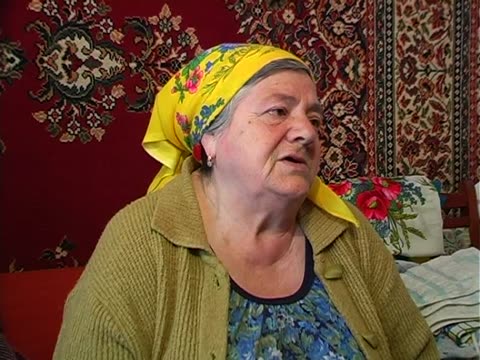
Milchenko speaks about her mother, who spoke Russian at markets and Yiddish at home. Lemster asks how certain words are said in Yiddish; she says she has forgotten some, and she names the cemetery. She describes asking her late mother in prayer for health for people and for her children. A second woman remarks on how few Jews remain. Milchenko says her mother attended a four-class Yiddish school before the war, and mentions the synagogue.
Includes Lemster's questions on individual Yiddish words and her mother's four-class Yiddish schooling.
Milchenko talks about postwar Jewish life, and about the closing of the synagogue after the war. According to her, the kosher butcher worked until the 1980s in Balta. He slaughtered chickens and would also circumcise children in the early years after the war. Milchenko then talks about life today and her family. She explains that she was afraid to arrange a circumcision for her son, who was born in 1957. Milchenko has family in Israel.
Milchenko says the synagogue was taken away after the war, while a shoykhet continued to work in Balta. The second woman adds that he slaughtered chickens and that boys were circumcised after the war. Milchenko cannot recall his name, and Lemster asks about Jewish teachers and doctors and about eating veal. She has grandchildren, and one grandchild lives in Beer Sheva in Israel. She says she was afraid to have her son circumcised, though others did so under the Soviets, and Kerler asks about relatives in Israel.
Adds the shoykhet's name being forgotten, the question about eating veal, and the grandchild in Beer Sheva.
The women speak about aging and the dwindling number of Jews in town. The second woman says she was given a room in a communal apartment at thirty, where she lived with her mother and son. Both thank Kerler and Lemster for visiting and for speaking Yiddish with them, and Kerler says they came because they were told Jews lived there.
Shows the housing story is told by the second woman and ends with thanks to the interviewers.