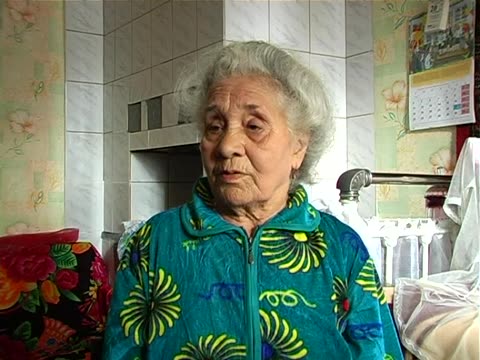
Khotenko answers Lemster's questions about who circumcised her son in Balta in 1952. It was not the ritual slaughterer but a Jewish surgeon, at his home, and it was done quietly and for payment. Kerler remarks that this was not permitted then. The passage ends with Kerler asking her to tell about the evacuation and her return to Balta.
Kerler's closing question about evacuation and return.
Khotenko talks about life after the war, when she returned to Balta from evacuation. Khotenko worked as a dishwasher in a kitchen at a military hospital. She then provides information about the lives of her relatives after the war. In particular, Khotenko mentions the hunger of 1947. She then recalls how a neighbor, medical doctor Iosip Viner, was unjustly imprisoned before the war in the late 1930s. Khotenko explains that Viner healed her from scarlet fever.
Khotenko describes her return from evacuation: she worked in a kitchen, her sister lived elsewhere with her husband, and her mother worked at a pig farm and later with the harvest. She mentions a relative hanged in Odessa and the hunger of 1947. She then recalls a neighbouring Jewish doctor named Viner (Iosif), arrested before the war in the late 1930s (the year is uncertain); he had cured her of scarlet fever. She also describes shortages and fear of arrests, and Lemster asks whether there was antisemitism.
Her sister and mother's wartime and postwar work and a relative killed or hanged in Odessa.
Khotenko talks about prewar Jewish life. She then talks about contemporary Jewish life and her different last names; before she talks about her family. She remembers her mother writing in Yiddish.
Khotenko says whether there were more Jews or sons-in-law in prewar Balta, and discusses the houses on the street and a Jewish invalid living in a nearby village. She answers questions about her house, privatised in her name, her two husbands, and the surnames Litnavetskii (maternal side) and Shvartsman (paternal side), plus Russian surnames of her husbands and sister's husband. She names a list of towns, and speaks of an acquaintance in America selling his house. She says her mother sang Yiddish songs and wrote Yiddish letters. Her son writes Yiddish using Russian words and speaks it well, and his travel route is discussed.
Surname explanations, her mother's Yiddish letters and her son's Yiddish.
Asked by Kerler about the best years, Khotenko says there were none, and the worst were the prewar and war years; now is somewhat better. Lemster asks about the years after her son's birth in 1952. She then talks about her son, who speaks Hebrew and Polish, works two jobs, and has an Israeli passport, and about his family and travel plans.