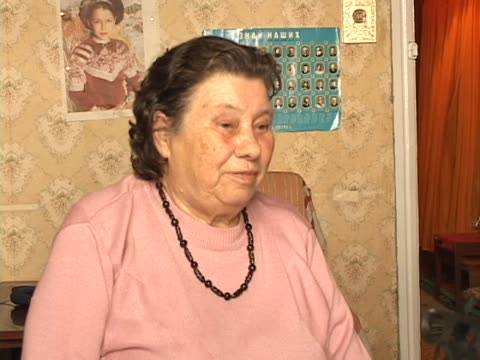
After providing biographical and family information. She grew up with three siblings. His parents were born in Bila Tserkva. Her father Meyshe was tailor. Her family lived there until the beginning of World War II. Her family evacuated to Russia, near Astrakhan.
Marmalevskaia gives personal and family information: her birth in Bila Tserkva in 1923, her father Moyshe, a tailor born in Bila Tserkva, and her mother Khane. She mentions that during the evacuation the family left, while her father and brother were at the front.
Gives her birth date (month) and her mother's name.
Her father and brother were drafted to fight at the front. Since she was already eighteen years old, she was responsible for feeding a family of five when they were in evacuation and brought them through this time full of hardship. Marmalevskaia worked as a fish farmer at a fishing kolkhoz located on the banks of the Volga for four and a half years. At the beginning of her time in evacuation, her mother also helped out at the fish farm, but she soon fell ill with malaria. She explained that all of the families from Bila Tserkva at the kolkhoz perished from famine except for her family and a few members of a second family. Her ten-year old sister Tanye walked twenty kilometers to get the fish from the kolkhoz in order to bring it to her family.
Marmalevskaia describes the evacuation to Russia near Astrakhan, with her mother and three siblings, while her father and brother were at the front. At eighteen she supported a family of five by catching fish for four and a half years in a fishing kolkhoz on the Volga. She says many evacuees there starved, and that her ten-year-old sister walked to fetch fish.
The details of the second family from Bila Tserkva and of the mother's malaria are only partly confirmed here.
The conversation moves to her return home to Bila Tserkva in October 1945. Her father returned from the front, seriously injured in 1944. Many of her family members perished during the war. They discovered after arrival at the railway station that their house was not standing anymore. Later on, her family purchased a ramshackle kitchen, where the six members of Marmalevskaia's family lived. Her brother Yankl returned home from the front in 1949.
Marmalevskaia tells of the return to Bila Tserkva in October 1945. Her father came back from the front disabled, and the family's half-house was gone. They bought a ruined kitchen in which six people lived, and her brother Yankl returned in 1949. She names her siblings Yankl and Tanye and says her mother worked at the fish farm and fell ill with malaria.
Names the little sister Tanye and a youngest sister, and says the mother was ill in hospital.
During the Great Hunger in 1932-33, two of her aunts died. She remembers eating potato peels mixed with oats. Marmelevskaia then discusses her childhood memories. Her family lived in one room with a kitchen. She returns to the topic of the Great Hunger. Her mother, originally a homemaker, worked as a weaver during the famine. Her body, however, was so swollen that she could hardly climb into the weaving machine. They survived because her father traveled to Moscow, sold his suit, and sent his family vouchers for bread.
Marmalevskaia recalls the famine of 1932–33: the family ate potato peelings mixed with oats, and two of her mother's sisters with their children died. Kerler then asks about her childhood, her family's one room with kitchen, her siblings' and parents' birth years, and her mother's work. She describes her mother weaving while swollen from hunger, and how her father sold his suit in Moscow and sent bread, which saved the family.
Also gives parents' and siblings' birth years and the mother's weaving work.
Marmalevskaia says the family was poor when she was nine, her father worked in a tailors' cooperative, and she and her brother attended a Yiddish school in Bila Tserkva for ten years, finishing in 1940. She cannot name the school or the subjects, says she can read but has forgotten how to write Yiddish, and still has Yiddish books. She mentions marrying in 1946 and that her husband's family was killed by the Germans.
Adds her ability to read but not write Yiddish and the fate of her husband's family.
She talks about life after the war. She got married in 1946. Her husband worked as a blacksmith in a factory, and participated in a Yiddish theater from 1989 through 2000 in Bila Tserkva. Among other roles, he played Tevye the Milkman. He passed away due to weak heart, which was due to the hunger of 1946. She has a son Naum works as a geologist in Kyiv and a daughter Vere who lives in Israel. The conversation returns to the postwar Yiddish theater. The director's name was Anatolii Klorfelt.
Marmalevskaia talks about her husband Marmalevskii, who worked at a factory as a smith, was a lifelong Yiddish speaker, and acted in the Yiddish theater in Bila Tserkva from 1989 until about 2000, playing Tevye the Milkman. She tells of her son in Kyiv, a geophysicist, and her daughter Vera in Petah Tikva, Israel, and grandchildren. Kerler asks about the theater, its director Anatolii Klorfeld (now in America), its repertoire and frequency of performances, and the video cassette she has.
Adds Kerler's request to copy her video cassette and details of the son's work and trips abroad.
Marmalevskaia shows her Yiddish books, including a Sholem Aleichem volume (Tevye the Milkman) and monologues that her husband knew by heart. She says she still reads Yiddish but has forgotten how to write it.
The conversation turns to religious life and synagogues in prewar Bila Tserkva. She explains that one of the synagogues was turned into a Yiddish school. Zedelkovsky was the director of her school. The conversation turns to prewar holiday celebration and food customs, as well as about non-Jews who spoke Yiddish. She also remembers itinerant Yiddish theater troupes from Dnepropetrovsk. One actor frequently stayed at their apartment during season. They then briefly address the Yiddish newspaper "Der Shtern" (The Star), before they discuss the actor of the Moscow State Jewish theater Solomon Mikhoels.
Kerler and Katz ask Marmalevskaia about weddings and food customs. She recalls klezmer music and the huppah but not the badkhn or songs, and she names her husband as the singer. Questions follow on food: gefilte fish, chicken broth with almonds, tsimmes made with dried fruit or carrots, and latkes for Hanukkah made from various flours, as well as the words for vodka.
Kerler asks Marmalevskaia about folk healing and beliefs. She does not remember old-women's remedies but recalls the term for an evil eye and its removal by incantation, and Kerler asks about the dybbuk and the golem.
Marmalevskaia answers questions about Jewish funerals and the cemetery in Bila Tserkva, which has an old and a new Jewish cemetery. Kerler asks for the Yiddish words for the cemetery and for burial, and for the expression used when remembering the dead.
Kerler asks Marmalevskaia about Yiddish after the war: she says she and her husband spoke Russian at home, spoke Yiddish only in the theater, and that her children understand but do not speak it. Kerler then asks, in Russian, for Yiddish equivalents of everyday phrases such as greetings and 'please', and she translates some and cannot recall others.