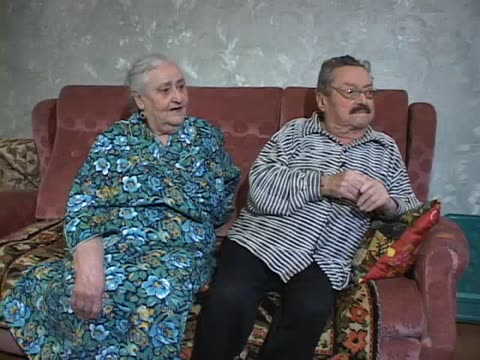
Before they begin the formal part of the interview, they discuss the team's travels and Sholem Aleichem's connection to Bila Tserkva.
From the machine transcript
Before the formal interview starts, the group talks about the team's travels in Ukraine and the next towns they will visit. Berman then explains that Sholem Aleichem lived in Bila Tserkva for several years and that his early stories describe the town's Jews. He says the town had nearly thirty thousand Jews before the war.
The catalogue sentence is accurate; the transcript adds the route of the expedition and Berman's remarks on the town's prewar Jewish population.
Berman talks about his involvement in Jewish cultural life in the late 1980s. Before the war, the town had a Jewish population of 30.000, of which 8000 returned. Berman set up the Sholem Aleichem Cultural Society in 1989 and supports local educational efforts. Moreover, he was one of the initiators of the Yiddish cultural society in Kyiv that was set up in 1988.
From the machine transcript
Berman talks about founding the Jewish cultural society in Bila Tserkva around 1989 and his part in the Kyiv republican society. He lists its departments, a school and a library with books sent from Australia, and the clubs and literary evenings, including one devoted to Peretz Markish. He says many of the town's Jews have since left and the society is smaller. He also says he was born in Rivne, which was in Poland before 1939, and attended a Polish gymnasium.
The transcript adds the library with books from Australia, the clubs and literary evenings, and that the wartime figures given by the catalogue are in the previous passage.
Berman then talks about his life before the war. He was born in Rivne (Rovne) and attended a Polish school. He encountered the writer Sholem Asch and Ben Gurion in his home town. His father was a successful leather merchant and was active in associational life. His mother was the chairwoman of the local Jewish Women's Organization, which regularly invited well-known figures, such as Ben Gurion, Sholem Asch, and Ze'ev Jabotinsky. She would entertain the visitors and, therefore gave Berman the opportunity to meet them. Berman then remembers the conversation with Ben Gurion, who encouraged him to immigrate to Palestine after graduating from school.
From the machine transcript
Berman recalls his Rivne youth. His father was a well-known leather merchant, and his mother led the Jewish women's organization and took him as a child to banquets where he met Ben-Gurion and others. He mentions Yiddish as spoken by Ben-Gurion, Jabotinsky and Sholem Asch, and an incident at Asch's play. He also speaks of his articles on Rivne's football team and its match against a Viennese club, and on Jewish partisan doctors, which brought letters from abroad.
The transcript adds his comments on the Yiddish of Jabotinsky and Asch, the football-match article, and the doctors' article with responses from America.
Berman then discusses his publications, such as a newspaper article in Yiddish about the soccer match between the local team and the Viennese team. He also published several articles in the Forverts. In particular, he mentions the article about a Jewish underground movement in Poland during World War II.
From the machine transcript
Berman and Katz discuss Berman's articles and the Yiddish press, including an article in the Forverts. They talk about the editor's death and about the Forverts's current circulation of several thousand copies. A further Yiddish paper is mentioned. Parts of the passage are disrupted by a recogniser loop.
The transcript shows an exchange between Katz and Berman about the Forverts's circulation and editor.
The conversation turns to life after the war. Due to his achievements as a cardiologist in Rivne, he was made honorary citizen as the only Jew among eight honorary citizens of the city . He still works as the chief cardiologist in Bila Tserkva. The camera briefly cuts to his wife Sonya, who was born in Bila Tserkva, and they discuss Yiddish dialects.
From the machine transcript
Kerler asks Berman for his biography from childhood on. He speaks of his mother's family, the Krzemieniec museum, and a Jewish communal leader from Rivne. He gives his age as eighty-one and describes the festivities for his jubilee on 7 November 2003, when he was made honorary citizen, the only Jew among eight. He says he is chief cardiologist of Bila Tserkva. His wife Sonia is asked where she is from, and they discuss Yiddish dialects, including Rivne-area Yiddish as Lithuanian-like and the Yiddish of Brody and Dubno.
The transcript adds the Krzemieniec museum, discussion of Rivne-area and Volhynian dialects, and Berman's jubilee celebration.
The conversation moves to Berman's childhood memories and family. His parents were killed in Rivne during World War II. He talks about his encounters with famous people, who socialized with his parents. Berman also wrote articles about the pogroms and talks about someone he interviewed for that purpose.
From the machine transcript
Berman says his father was a known merchant and a communal activist, his mother a beautiful woman, and that his parents were killed in Rivne. At Kerler's prompting he describes his parents' home as a kind of salon. He recalls a Jewish minister and personal autonomy under Petliura's Ukrainian People's Republic, a doctor he treated who told him of his own part in it, and the pogroms. He says he wrote about the pogroms and recalls his Yiddish being self-taught.
The transcript adds the salon in the family home, Berman's treatment of a doctor from Petliura's government, and the pogrom articles.
The conversation moves to Berman's childhood memories. He did not grow up speaking Yiddish, but learned the language reading Yiddish journalism and sports magazines. He studied at a Hebrew-language school, organized by the Tarbut movement, before he switched to a Polish school. In ninth and tenth grade, Berman studied at a Russian school. He then talks about the ceremony he attended commemorating the fifty year anniversary of the Warsaw uprising, where he gave a speech in Polish. The conversation returns to his childhood years and prewar Jewish life in Rivne. He mentions different Jewish institutions, which produced a lively Jewish community in Rivne. The institutions include Jewish parties, a Yiddish and a Hebrew school, and three Jewish sport clubs. Berman traveled to Kyiv to see his relatives in 1939, one week before the war broke out.
From the machine transcript
Berman explains that he learned Yiddish from newspapers, especially a Warsaw sports paper. He attended the Hebrew Tarbut gymnasium and then a Polish gymnasium, where there were few Jewish pupils, because it gave full university rights. He tells how he spoke in Polish at the fiftieth anniversary of the Warsaw ghetto uprising. He then describes Rivne's Jewish institutions: parties, a Hebrew and a Yiddish-Polish school, and three sports clubs. He mentions studying in a Russian school under Soviet rule and a trip to Kyiv shortly before the war.
The transcript adds that the Tarbut school preceded the Polish one and that the Warsaw ghetto anniversary speech was alongside Polyanker, and gives the Rivne sports clubs.
The interview is briefly interrupted by his daughter-in-law's arrival. Like many others in his family, she works as a doctor.
From the machine transcript
Berman and his daughter-in-law talk about the family. He says his son is a gynecologist and his daughter-in-law an infectious-disease doctor, and one grandson is a doctor in Israel. His other grandchild and her husband are dentists. He calls it a dynasty of doctors. He then begins on the war years in Kyiv.
The transcript shows a daughter-in-law, a son and grandchildren who are doctors, one in Israel, which the catalogue does not mention.
Berman then talks about life during the war. He published material about the fate of his family during the war. His parents were executed along with their fellow Jews from Rivne during German mass killings on November 6th and 7th in the pine woods near Rivne. They set up a memorial in Yiddish. Most Jews of Rivne were murdered early on. Berman left Kyiv and went to Stalingrad in order to study at the medical institute. However, he had to interrupt his studies in 1942 due to the arrival of the Germans, and he volunteered for the Red Army. He served in the 64th division, defending Stalingrad. He was taken out of his division because of the German language skills he had acquired at the Polish school. He was favored by a Soviet commander to German writers like Wilhelm Pieck. He worked as a translator for German officers. He reached the rank of a lieutenant and saved German army officers from execution.
From the machine transcript
After a stretch of toasting and chat with Katz about books and the correspondence of a Polish visitor, Berman recalls the war years: his parents were taken to the Sosonki forest near Rivne and killed with other Jews, and the Yiddish inscriptions there. He describes studying at the medical institute in Stalingrad, Red Army service and the role his fluent German gave him: addressing German troops by loudspeaker and interrogating prisoners, with commanders such as General Chuikov. He recalls a young Jewish lieutenant and German thanks. Some stretches of Polish and Russian also appear, along with a question about Bila Tserkva's Hebrew name.
The transcript adds the toasting and chat, the Sosonki memorial inscriptions in Yiddish, and the explanation of the Hebrew name for Bila Tserkva.
Berman talks about the two films in which he is mentioned as a Jewish German-speaking lieutenant.
From the machine transcript
Berman describes two German film studios that came to Bila Tserkva to make films about him, using wartime newsreel footage of his German-language work. He says the films were shown in Germany. He also says he went with the army from Stalingrad to Prague.
The transcript adds his route from Stalingrad to Prague and the German studios.
Berman returns to discussing his military service in the Red Army. His division moved from Stalingrad to Prague. He helped liberate ghettos in Budapest and Vienna. Berman tells about how during the war, he was able to correspond by mail with his mother as well as with the actor Solomon Mikhoels and the writer Ilya Ehrenburg. After the war, during a surge of antisemitism, his wife burned the entire correspondence with Mikhoels.
From the machine transcript
Berman continues on the army's advance to Prague, saying he reported on the liberation of ghettos such as Budapest. He describes his wartime exchange of letters with Solomon Mikhoels, who asked him what was happening to Jews in Hungary, Romania and Czechoslovakia. His wife burned the whole correspondence after the war, when antisemitism rose and she was afraid.
Berman discusses life after the war. After he graduated from the medical institute in Kyiv, he returned to BilaTserkva in 1953, where he was actively involved in promoting Yiddish culture. He published articles in the Birobidzhaner Shtern and Sovietish Heymland in the 1950s. Berman supported the publication of previously unpublished letters by Ilya Ehrenburg.
From the machine transcript
Berman recounts postwar work: a post as district health head in the Bila Tserkva region and suspicion over his Jewish colleagues, then return to Bila Tserkva as a famous doctor. He describes writing in Yiddish for Birobidzhaner Shtern and Sovetish Heymland, and his article on Ehrenburg's unpublished letters. Kerler and Berman compare their debuts in print around 1958. They also discuss a folklorist friend, Shlomo (?) Kuper (?), Berman's patient, with whom he corresponded.
The transcript adds his experience as the only Jewish district health head, accusations about Jewish colleagues, and the folklorist friend.
Berman addresses his connection to the Jewish cultural organization in Kyiv. He remembers the first meetings and he was part of the organization committee, as well as part of the community. In 1989, he initiated a Yiddish cultural organization with a Yiddish theater in Bila Tserkva. He talks about how he promoted the idea of founding a Yiddish theater among his friends and colleagues. He shows a copy of a Yiddish-Polish journal, which includes a copy of Berman's article about his experience in Stalingrad.
From the machine transcript
Berman talks about the 1980s revival of Jewish cultural life in Kyiv: his friendship with writers such as Hersh Polyanker and Yosef Burg (?), the first meeting, the organizing committee and his membership of the community. He says in 1989 he conceived the idea of a Yiddish theater to draw people, and describes recruiting a theater figure from Kyiv. He shows a Polish-Yiddish journal containing his Stalingrad memoir, whose editor is a woman from Vilnius.
The transcript adds friendships with Polyanker and others and the editor of the Polish-Yiddish journal.