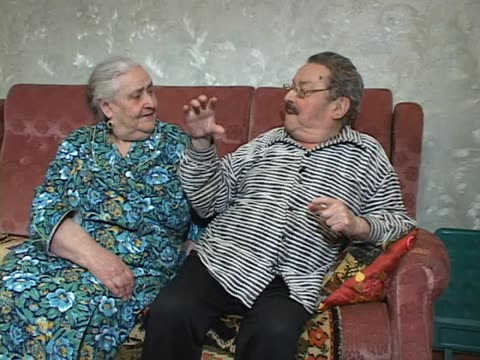
Khariton Berman discusses the local Yiddish theater he established in 1989. The theater group traveled to different places, such as Kyiv and Crimea.
From the machine transcript
Berman talks about the Yiddish amateur theater he was involved in, which performed Sholem Aleichem pieces and took them to Kyiv and elsewhere (a Crimean place is possible but unclear). Kerler explains how the team had just met the widow of a local actor, who lent them a videocassette of Yiddish theater. The group discusses copying the tape, and Berman promises to search out and send his many films and photographs of the theater. Kerler then starts to ask his birth year.
Adds the widow of an actor, the videocassette copying and Berman's promise to send films.
The formal interview is briefly interrupted because Berman looks for recordings of various shows performed by the Yiddish theater.
From the machine transcript
Berman gives his birth date as 7 November 1923, and the interview pauses while he looks for something among his materials. Kerler then asks his wife for her maiden name from home, which she gives as Pritske.
Adds his birth date and the question to his wife about her maiden name.
The team begins to interview Berman’s wife Sonya (Shlime) Berman, nee Britske, born in 1923 in Bila Tserkva. She talks about life and family before the war. Her father, Meyer, was also born in Bila Tserkva and was a white collar worker. She grew up with a brother. Sonya attended a Ukrainian school.
From the machine transcript
Berman's wife Sonya, whose maiden name was Pritske, answers Kerler's questions about her origins. She was born in Bila Tserkva, and she describes the old town. Her father Meir was a very pious man and worked as an office employee, her mother Leah was a housewife, and she had an older brother Mordkhe, who is mentioned in connection with the war. She attended a Ukrainian school.
Adds her mother's name and her older brother, and a description of the old part of town.
She briefly mentions her evacuation to the Urals during the war, where she studied at a medical institute. She then talks about life after the war, before returning to discussing her family and life before the war. She finished her studies in Kyiv after the war. She grew up in a religious household.
From the machine transcript
Sonya briefly says she studied at an institute in the Urals during the war and then in Kyiv. She recalls her father's strict religious observance, including laying tefillin and praying, and that the synagogue was taken and closed. Kerler asks why she went to a Ukrainian rather than a Yiddish school. Berman then interjects about the director of the Yiddish theater.
Adds Kerler's question about the choice of a Ukrainian school and Berman's interjection about the theater director.
Berman returns and shows photographs from the opening of the Yiddish theater, as well as pictures from before the war and of himself in his army uniform as a lieutenant.
From the machine transcript
Berman and Kerler look at photographs. Kerler mentions that someone from the theater is now in America. Berman shows old pictures, including one of himself in the army during the war years as a young lieutenant and then a colonel, and mentions Rivne. Kerler asks him to tell more.
Adds the colonel's rank and the mention of Rivne.
Both discuss religious life after the war. They closed the synagogue in Bila Tsirkov in the 1950s. Sonya remembers how the police closed down the synagogue and boarded it up.
From the machine transcript
Sonya and Berman talk about the closing of the synagogue, which Sonya places on Yom Kippur in the 1950s (the exact year is unclear). A militia truck came and the prayer books were taken. They also speak of the Jewish cemetery memorial to murdered Jews. Then Katz and Kerler ask for their address and telephone number, and Berman gives his street, Pobedy boulevard, and flat number.
Adds the address and telephone details and the cemetery memorial.
The conversation turns to life today and the interview gets interrupted by a visit from their son, Abram. Berman shows one photograph of a memorial. Then everyone gets together for a group photograph, showing Berman’s diploma. The camera records more footage of their apartment after the conclusion of the interview.
From the machine transcript
Berman speaks of an editor of a Yiddish journal in Vilnius and shows a photograph of the memorial to murdered Jews in Bila Tserkva. Katz and Berman arrange to send each other videos, and Berman looks for photographs from Rivne. Kerler explains that the team is building a collection of Yiddish materials. The group gets ready for a closing photograph and the camera records the flat.
Adds the Vilnius journal editor and the arrangements for sending videos. The transcript does not clearly show the son's visit.
The team travels to the next interview with Chara Yakovlevna Bublitskaia. The camera collects town footage.
From the machine transcript
The team drives to the next interview. The people in the car speak Russian and Yiddish, looking for the right street (Vokzalna) and house number. At the end Kerler records the date, place and interviewee, Chara Yakovlevna Bublitskaia, and starts to ask for her address.
This is the beginning of the formal interview with Bublitskaia, born in Chişinău. She provides personal information, before talking about her family. She remembers religious activities among her family, especially with her grandparents. Her father Yankl worked as an accountant. She grew up with her brother Moyshe.
From the machine transcript
The interview with Bublitskaia begins with her address and telephone number. She says she was called Chara at home and was born in Chisinau, then in Romania, and she left for the Urals when the war began. She remembers her grandparents Motl and Itl praying and keeping Passover and the New Year. Her father Yankl was a bookkeeper, her mother Sara was a housewife, and she had a brother Moyshe.
She discusses childhood memories, in particular her recollections of prewar religious life. She describes how visiting rabbis would come from neighboring countries and pray. She lived in Chişinău for fifty years.
From the machine transcript
Bublitskaia remembers a large choral synagogue in Chisinau, where cantors came from America and Paris to lead the prayers. She says she lived in Chisinau for many years and names the street where the family lived, a street whose name is only approximately heard (Kharlampovskaya (?)).
Adds the street name and the cantors from abroad.
Bublitskaia talks about postwar life. She moved to Kyiv and studied an institute, before moving to Bila Tserkva, where she worked in a shoe factory for forty years.
From the machine transcript
Bublitskaia talks about her life after the war. She studied at an institute in Kyiv and married a man from Kyiv. They then came to Bila Tserkva, where she worked for forty years at a shoe factory.
Bublitskaia discusses her education at a Yiddish school and lists different subjects.
From the machine transcript
Bublitskaia answers Kerler's questions about her schooling in Chisinau. She attended a four-class Yiddish primary school and then a Yiddish gymnasium. Teaching was in Romanian and Yiddish: Yiddish reading, writing and Jewish history were taught in Yiddish, geography, literature and French in Romanian. Hebrew was not taught, although her father knew it.
Bublitskaia discusses prewar religious life, in particular holiday celebrations and food customs for Shabbat, and prayers.
From the machine transcript
Bublitskaia describes how her mother prepared for the Sabbath on Friday. She cooked chicken, beans, noodles, sweet carrot dishes, kugel and gefilte fish, not too sweet. Her mother blessed two candles and the children were not taught the blessing. She mentions her brother's bar mitzvah at thirteen with tefillin, and says she was not taught morning prayers.
Bubilitskaia briefly talks about the local Zionist organization, which her brother frequently attended, before she continues to discuss religious holidays, such as Passover. She played with her childhood friends in Romanian, although they attended a Yiddish school. Her mother was born in Calara?i and Bublitskaia remembers holiday celebrations with many relatives. Her mother would prepare plenty of pastry for Hanukkah for her brother’s birthday celebration as well. She remembers learning about Jewish holidays at the Yiddish school. She then talks about Yom Kippur when the adults fasted. The children left the house of her uncle and ate outside during that time.
From the machine transcript
Bublitskaia briefly mentions a Zionist organization her brother attended. She then answers Kerler's questions about the holidays: Passover seder and the four questions, Purim pastries with poppy seed and jam, Hanukkah dreidel, latkes, doughnuts and gelt, and the Yom Kippur fast, when the children left her great-uncle's house to eat. She says she played with her friends in Romanian, and recalls big family gatherings on holidays; her mother was from Calarasi. She says she learned about the holidays at school.
Adds the Zionist organization, the food of each holiday and the children's games.
She talks about elderly Romanians who spoke Yiddish before the war before she returns to her education at the Yiddish school and childhood memories in general.
From the machine transcript
Bublitskaia says old Romanians in Chisinau could speak Yiddish and that there was no antisemitism in her street, where many Jews lived. She recalls reading in Romanian at school. Her brother was interested in Zionism, and a rebbe's son from Calarasi lived with the family and studied with him. Her friends, both Jewish and Romanian girls, spoke Romanian with her.
Bublitskaia discusses itinerant Yiddish theater groups from Chernivtsi before and after the war. During her childhood, she was friends with the son of the Hasidic rebbe Averbukh. Her grandfather lived in Zhytomyr. She then mentions her husband Ilya, who had Hasidic relatives.
From the machine transcript
Bublitskaia recalls that Yiddish theater came only as a touring group, with some mention of Chernivtsi. She says she cannot remember the names of the visiting cantors. The rebbe's family that lived with her family were called Averbukh. Her husband Ilya came from Zhytomyr, and his grandfather was a Lithuanian-type (Litvak) rabbi buried in Latvia. She says she knew little about Hasidim in Chisinau and learned of those in Zhytomyr and Uman later.
Adds Averbukh as the name of the Calarasi rebbe's family, her husband's Zhytomyr grandfather and Hasidim in Zhytomyr and Uman.
Bublitskaia answers questions about religious terminology.
From the machine transcript
Bublitskaia answers Kerler's questions about the difference between a rav and a rebbe, the plural forms of both, and the expression a good Jew (a person who shares what he has).
She talks about weddings before the war, as well as food customs and recipes. According to Bubilitskaia, the local custom used to be to drink wine, but when the Soviets occupied Romania in 1940, they introduced vodka as the drink of choice.
From the machine transcript
Bublitskaia describes Jewish weddings in Chisinau, with a chuppah, dancing and a fiddle and drum. She answers questions about food terms (gefilte fish, corn mush, cornmeal dishes, tsimes, meat dishes) and about drink: wine was drunk locally, and vodka came with the Soviets. She does not recognize several of the terms Kerler asks about.
Adds the wedding music, food terminology and the drink-habit remark about the Soviets.
She answers questions about cultural and food terminology.
From the machine transcript
Bublitskaia answers questions about words for a possessing spirit, a golem or fool, the cemetery, potatoes, and food items such as corn mush, tomatoes and peppers. She often says she does not know the Yiddish word, and some terms she calls Ukrainian or Belarusian. Kerler then begins a series of Russian prompts to be rendered into Yiddish.
The team asks Bublitskaia a number of dialectological questions from the AHEYM Yiddish questionnaire.
From the machine transcript
Kerler works through a questionnaire of Russian prompts with Bublitskaia, who gives the Yiddish she remembers or says she does not know it. The items include a greeting, give me the book, thank you, a mouse, a woman, quiet, gray, the sky and other everyday words.
She talks about life during the war. In 1940 she evacuated to Siberia with her parents and brother. They worked hard for years and she remembers how ten people had to share one bucket of potatoes. Her brother married the daughter of the chief engineer of the factory her family worked at. They left Siberia for Kyiv in 1943. In 1945 her brother wrote Bublitskaia a letter to invite her to study at an institute in Kyiv. It was there that Bublitskaia met her husband in 1948.
From the machine transcript
Bublitskaia talks about the war years. The Soviets arrived in 1940, and with the German advance her family fled to Siberia, leaving behind relatives who were shot. They worked, got a piece of bread a day, and shared one bucket of potatoes among ten. Her brother married the chief engineer's daughter, and they went to Kyiv in 1943. In 1945 they wrote inviting her to study there, and at the institute she met her husband in 1948.
Adds the relatives who were shot and the brother's marriage to the engineer's daughter.