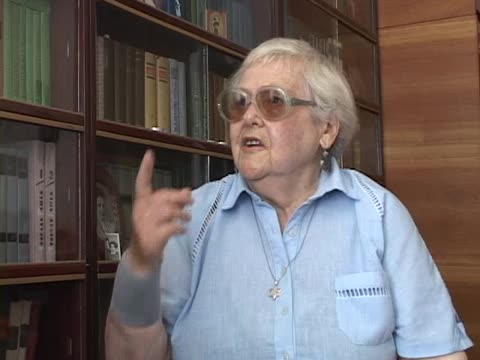
She talks about the immediate postwar years, when she studied at an institute in Kyiv and met her husband there in 1948. They were sent on a work assignment to Bila Tserkva. Bublitskaia then talks about her family. She was married for 55 years. Her daughter is a surgeon at the hospital in Bila Tserkva. Her son lives in Russia. His daughter works as an endocrinologist.
From the machine transcript
Bublitskaia says she and her husband were sent in 1948 on a work assignment to Bila Tserkva and that she was married for 55 years. She speaks about her children: a daughter who is a surgeon in the local hospital and a son who stayed in Russia near Moscow, and a granddaughter who is a doctor. She mentions the son's yearly visits.
The transcript confirms the details of the daughter and son and mentions a granddaughter's wedding in August.
Bublitskaia talks about life today, making ends meet.
From the machine transcript
Bublitskaia talks about her housing, exchanging a large apartment for a smaller one, and says she lives alone. She says she turns eighty in August, on the 24th, and mentions that her husband died. Kerler then asks about the Yiddish theater.
The transcript shows talk of her birthday, the house exchange and her husband's death; the catalogue's phrase on making ends meet is not clearly heard.
She discusses the local Yiddish theater with director Anatolii Efimovich Klorfeld after World War II. It put on a mixture of Yiddish and Russian plays with local actors.
From the machine transcript
Bublitskaia describes the Yiddish theater in Bila Tserkva led by the director Klorfeld (Anatolii Efimovich), who had studied theater in Kyiv before the war, organized a collective and later left for America. Local Jewish amateurs performed, partly in Yiddish and partly in Russian, including Tevye the Dairyman and Sholem Aleichem pieces. Her husband, a tenor, sang in the company.
The transcript indicates that Klorfeld later emigrated to America to a brother, and that her husband was a tenor in the troupe.
She discusses other interviewees like Khariton Berman, as well as her family. Similarly to the Berman family, her family consists of several medical doctors. Her maternal uncle made aliyah from Romania in 1970.
From the machine transcript
Bublitskaia says she wanted to speak about Dr. Berman, who knows Yiddish, Hebrew, German and French and is a known doctor whose whole family are doctors. She then describes her own family of doctors: her late husband, her daughter and her granddaughter. Katz asks whether she remembers songs.
The transcript shows her recommending Berman as a person to interview; the catalogue's note on an uncle's aliyah appears in the next passage.
She remembers the Yiddish song “Afn pripetchik.”
From the machine transcript
Bublitskaia recalls a few lines of the song Afn pripetchik and 'Mayn shtetele Belts', and says she has not spoken Yiddish for 65 years since leaving Beltsy because her husband knew none. She speaks about her brother in Kyiv, who died years ago and who was a Zionist before the war, and about her maternal uncle who left Romania for Israel in 1970 and whose family she writes to. She says her mother could not travel in Soviet times.
The transcript adds that her husband spoke no Yiddish and her brother was a prewar Zionist.
The team concludes the interview and the camera collects footage of the apartment and shows photographs. Bublitsakaia’s reveals that her favorite writer is Pushkin.
From the machine transcript
Kerler closes the interview and gives her a copy of his address. She shows photographs of her father and mother, her brother's late wife and herself at twenty. Asked about favorite books, she names the classics and Pushkin.
The transcript shows the photographs identified as her parents and her brother's wife.
The second part of the tape includes another formal interview with Khariton (Khaske) Abramovich Berman. He talks about childhood memories of the prewar Yiddish theater in Rivne in the 1930s. In Rivne there was a private Yiddish theater called Safran, as well as a folk theater, organized by the community. Itinerant theater groups from Warsaw and Vilna came to Rivne and Berman went to see plays with his parents. Berman remembers various actors, among them, Solomon Mikhoels; whom he heard on the Moscow radio for the first time.
From the machine transcript
Berman begins a second interview, in his home, answering Katz's question about his first childhood encounters with Yiddish theater. He recalls seeing the best Yiddish actors in Rivne in the 1930s, among them the Vilna Troupe and actors from Warsaw, in the community's Yiddish folk theater (the gallery) and in a private theater. He describes the crowds around the singer Bentsion (?) Witler and how he heard Mikhoels on Moscow and Kyiv Yiddish radio, which led to his wartime correspondence.
The transcript adds the singer Witler's visit and radio broadcasts from Kyiv and Moscow.
Berman talks about the mail correspondence he began with Mikhoels in 1944, who served as the chairman of the Jewish Anti-Fascist Committee during World War II. Berman was at the Stalingrad front during that time.
From the machine transcript
Berman says that after Stalingrad, in 1944, he wrote a letter to Mikhoels at the Jewish Anti-Fascist Committee in Moscow, describing the tragedy of the Jewish people as he saw it, and received a printed Yiddish postcard in reply asking him to keep writing. He continued to write, including about the rescue of Jews in the Budapest ghetto.
The transcript adds his reports from Budapest and the rescue of Jews in the ghetto.
He discusses his life during World War II in the Red Army. He helped liberate a number of ghettos and concentration camps, such as the Budapest and Vienna ghetto and Theresienstadt. He reported the atrocities he witnessed upon liberation to Mikhoels.
From the machine transcript
Berman tells how, as a Red Army man, he took part in a delegation to Theresienstadt after liberation, where he spoke Yiddish with survivors and became a witness, and he reports on the Budapest ghetto and on Jews he met in Vienna. He recalls hearing President Beneš on the radio, and says he reported all of this to Mikhoels in his letters.
He talks about his first name “Khariton.” His original name was Khaske Abramovich and when he received the promotion as doctor in charge of the entire region after the war, they encouraged him to change his name in order to make it sound less Jewish.
From the machine transcript
Berman explains the origin of his name Khariton: after finishing medical institute in Kyiv he was nominated head of a health department in a large district in the Kirovohrad region in 1949. Officials told him to change his Jewish-sounding name Khaske to a more neutral one, and the matter surprised them given the antisemitism of the time. He mentions that at home he was called by a pet name and that he was named for his grandfather.
The transcript puts the events in 1949 in the Kirovohrad region and adds the home nickname and the grandfather's name.
Berman talks about prewar Hasidism and lively religious life in Rivne, as well as about his parents. They were killed in Rivne during the German occupation. He remembers a number of cantors who would visit Rivne regularly like Yossele Rosenblatt.
From the machine transcript
Berman discusses prewar Rivne: there were few Hasidim there, mostly Stolin (?) and Vizhnitz (?), the Jewish population was largely secular intelligentsia with two Jewish gymnasiums, and the great synagogue had famous cantors such as Moshe Koussevitzky, whom he heard. He also tells of Yossele Rosenblatt, born in Bila Tserkva, and of his own parents Avrom and Sheyne Roze (?) Berman, who were killed. Kerler then asks about Jewish places in Bila Tserkva.
The transcript adds Zionist visitors, the cantors Koussevitzky and Rosenblatt, and a few words on Bila Tserkva being a Jewish cultural center.
He discusses the history of Yiddish cultural life in Bila Tserkva, with reference to the Bund and Poale Zion.
From the machine transcript
Berman describes Bila Tserkva as a Jewish city and cultural center with many Jewish parties, the Bund having nearly a thousand members, and the Zionists led by Dr. Moshe Zilberfarb, with party conferences held there rather than in Kyiv. He mentions eighteen Jewish schools before the First World War.
The transcript adds the Zionist leader Zilberfarb and the claim that party conferences were held in Bila Tserkva.
Berman talks about prewar religious life in Bila Tserkva, which had at the time eighteen synagogues. Berman talks about the Rebbe of Skvyra. He then discusses the meaning of “shvartstime,” the Yiddish nickname for Bila Tserkva.
From the machine transcript
Berman speaks about religious life in Bila Tserkva, where there were Hasidim of the Skvyra rebbe, whose carriage with six horses was met by Jewish men dressed as Cossacks. Katz and Kerler then ask about the Yiddish nickname 'shvartsetime' (?) for the town and how ordinary Jews said the town's name, with discussion of the word for a church or cloister and a Hebrew form 'sadeh lavan' (white field), and of the town's name in old documents.
The transcript shows the discussion of the town's names, Hebrew 'white field', and attempts to explain the Yiddish nickname.
Berman talks about life before the war in Rivne. His family was well-informed about the Stalinist show trials of the 1930s, through the local Yiddish press. He mentions the papers Volhyner Nayes and Volhyner Yidisher Kuryer in particular.
From the machine transcript
Berman says that in the 1930s he and his family knew from the Yiddish press about the Soviet show trials. He names the Yiddish papers Volhyner Nayes (weekly) and Volhyner Yidisher Kuryer (daily) in Rivne. S4 asks about the actor Michl Weichert, and Berman recalls Maurice Schwartz's visit to Rivne.
The transcript adds a question about Weichert and Berman's recollection of Maurice Schwartz's tour.
Berman talks about prewar cultural life in Rivne, in particular the struggle between Yiddishists and Hebraists. He refers to Hayim Nahman Bialik.
From the machine transcript
Berman talks about the relationship between Yiddishists and Hebraists in prewar Rivne, saying there was no real conflict in the 1930s since each knew the other's language. He describes his article about meeting Bialik, whom he saw at a literary banquet and who told Volhynian Jews not to forget their Yiddish, and he discusses Bialik's attitude to Yiddish and Hebrew literature. Kerler then asks for a route for the next day's visit.
Berman provides information about Jewish buildings and streets, such as the former Great Synagogue in Bila Tserkva, which the team will visit with Berman’s son. He then provides information about religious life today in the Lubavitcher community. According to Berman, there were two Jewish streets and one street was called Peretz Street until World War II.
From the machine transcript
Berman describes what he wants to show the team in Bila Tserkva: the house where Sholem Aleichem lived and its memorial plaque, the former great synagogue that he is trying to have returned, and the Sakhrishe (?) synagogue, built by the philanthropist Brodsky (?), later a yeshiva and gymnasium. He says there is a minyan today under a Lubavitcher rabbi, with thirty to forty people on Sabbath, and mentions Peretz Street, the name used until the war.
The transcript adds Sholem Aleichem's house, the second synagogue and yeshiva, and the present Lubavitcher minyan.
He discusses religious issues of today. After the war, Berman was asked by the rabbinate in Israel to fix up the graves from the Royver Rebbe and his followers at the cemetery of Bila Tserkva. He was a student of the Baal Shem Tov. Berman’s wife was able to help out because she remembered the location of the cemetery from her childhood as her father would pray in the same synagogue as the rebbe. The cemetery, however, was barricaded as part of a military zone, and he successfully asked a Soviet official for help. The military commander of Ukraine wrote an order that they were allowed to isolate the area around the graves of the tzaddik (righteous) and his followers. He and Meyer Gabai fixed up the grave for three months.
From the machine transcript
Berman tells how the rabbinate in Jerusalem asked him to find and restore the graves of the Royver rebbe (a disciple of the Baal Shem Tov) and other tsadikim in the old Bila Tserkva cemetery, which had been closed and built over with a military garrison. A woman (probably his wife) recalls the closed cemetery near her childhood synagogue. He appealed for three years to a deputy of Ukraine's Supreme Soviet, a general, and the defence minister's order released the area, after which Meyer Gabai (?) restored the graves within months.
The transcript shows the woman's testimony and the role of the Ukrainian general and defence minister.
The team concludes the interview with Berman.
From the machine transcript
The interviewers wind up the interview with Berman, talking about email addresses and his son's use of a computer. Berman and the interviewers recall an article he wrote about a shtetl, and Kerler asks about a Lutheran guesthouse name.