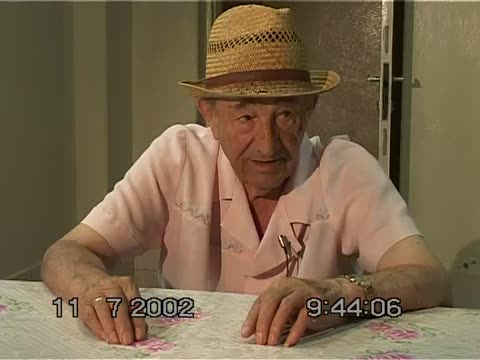
Skobilitskii provides personal information and speaks about his family. He then speaks about his life before the war, when he was drafted into the Red Army in 1939 to train as officer. He served for two years and achieved the rank of lieutenant. Instead of being demobilized, Skobilitskii explains, the was sent to the front as commander of a battalion of tanks in an artillery division. He then describes his army service during World War II.
Skobilitskii gives his Hebrew name Tsvi and his father's name, and says he was born in Berdychiv in 1919 and lived there until 1939. He was then drafted, trained as an officer and became a lieutenant. At the outbreak of the war he was sent toward Stalingrad as commander of an artillery battery with four guns drawn by horses.
Gives the Hebrew name Tsvi and the father's name, and adds the horse-drawn battery at Stalingrad.
Skobilitskii talks about his family. His mother was born in Chervone and his father was born Poland, near Warsaw. His father was a metalworker. Skobilitskii grew up with four brothers. He also addresses his family's fate during World War II.
Skobilitskii names his mother as Khane, daughter of Nakhmen, and speaks of the Kalushner rebbe in Chervone, where there was a sugar factory. His father came from Poland near Warsaw and was a metalworker. His mother did not work and there were five sons, whose names he gives; the youngest, Motele, was killed by the Germans.
Adds the sugar factory in Chervone, the brothers' names and the killing of the youngest brother.
Skobilitskii speaks about his army service for ten years. He finished ten years of schooling. Skobilitskii then speaks about his childhood, as well as education at a cheder (religious school) and Yiddish school, which he attended for four years. He explains how he studied in both schools every day. Skobilitskii then addresses his religious education and prayer customs.
Skobilitskii says he was an officer, having finished ten classes of school. He describes his early education: cheder from age eight, mornings from nine to twelve, then Yiddish school number four in the building of a rich man named Magazanik. He says what he learned in cheder, namely two chumashim and prayers, and recites some prayers from memory. Katz and Kerler ask about the chumash portions and he looks for glasses and a prayer book.
Skobilitskii talks about his cheder education. He then briefly talks about prewar religious life in Berdychiv, particularly remembering cantors visiting. According to Skobilitskii, the community collected money in order to invite a cantor from Kyiv for holiday celebrations after World War II. He then speaks about the synagogue building.
Skobilitskii names his cheder teacher as Leybl and says there were about twenty children, in the later 1920s. Every synagogue had a cheder. He recalls that cantors used to come, and that after the war the community collected money to bring a cantor from Kyiv for holidays. Katz asks what the synagogue building was called before the war, since it stood for over a hundred years.
Adds the teacher's name, the class size and the question about the building's prewar name.
Skobilitskii discusses his cheder education, before he talks about his life and work after the war. Skobilitskii was an agronomist and worked at a warehouse for thirty-five years. He was demobilized in 1949 and return to his hometown Berdychiv.
Skobilitskii says children in cheder learned to pray, and that his teacher was a good man. He then speaks of his work after the war as an agronomist, and of his demobilization in 1949 and return to Berdychiv. He worked for over thirty years at a warehouse, under several directors, and says who the best was.
The camera is elsewhere in the synagogue; the passage is mostly Russian and background talk among people present, with some Yiddish. The transcript does not show the slaughtering of chickens clearly. Kerler's earlier thread is not continued.
The transcript shows mainly Russian chatter and no clear slaughtering scene.
Skobilitskii addresses his schooling routine before the war. He also recalls a non-Jewish friend who spoke Yiddish with him after the war. Skobilitskii then discusses Yiddish spelling.
Skobilitskii describes his school routine: cheder from nine to twelve, then the four-class Yiddish school from twelve to three. Some non-Jewish pupils spoke Yiddish well, and one later became a director and still spoke Yiddish with him after the war. He talks about the Yiddish alphabet and spelling and recites the letters when asked. Katz and Kerler ask about the "good and bad tsadik" letter forms, and he turns to the killing of his parents and the mass grave at the airfield.
Adds the Yiddish friend who became a director, the alphabet recitation and the airfield mass grave.
Skobilitskii speaks of the killing of Jews at the airfield, where many thousands lie buried, and says visitors to Berdychiv should go to the memorial there. His son visits it. Katz and Kerler ask him to read the memorial prayer, and he looks in the prayer book, with spelling questions along the way, before beginning to say the prayer for his mother.
Adds the memorial at the mass grave and the start of a prayer for his mother.
Skobilitskii recites the funeral prayer "El moley rachamim." He then talks about his Yiddish school education, including addressing Yiddish writers. He then remembers the well-known Yiddish song "Belz, mayn shtetele Belz."
Skobilitskii recites the prayer for the dead. Kerler returns to the Yiddish school and asks about textbooks; he names Peretz and Sholem Aleichem and recognises other writers such as Markish, Kvitko and Halkin. He remembers hearing the song about the town of Belz and some Yiddish songs, but has forgotten most of it.
Skobilitskii addresses contemporary religious life, including Sabbath celebrations. He then returns to his Yiddish school education, including subjects.
Skobilitskii speaks of the present-day yeshiva in Berdychiv, where Yiddish songs are sung, the Torah is read and Jews are invited for cholent on Sabbath. He mentions American support of five dollars a month and Kerler asks whether it is Chabad; he says it is Skvira. He then returns to the Yiddish school, where subjects such as physics, geometry and botany were taught in Yiddish. The books were destroyed by the Germans, and he still has some prewar Yiddish books.
Skobilitskii recalls prewar holiday celebrations, particularly Hanukkah and Passover. Skobilitskii recalls snippets of the Four Questions, before he returns to his school and cheder education. Skobilitskii states that he attended a cheder and a Yiddish school every day until 1928.
Skobilitskii recalls that on Hanukkah his father gave each child money, and that nuts were played with outdoors. He does not remember the song Khad gadya. Asked about the four questions, he says the children asked them at the seder while the father sat on a cushion, among four brothers, and he gives the first question. He repeats that he attended cheder until 1928 and then moved to the Yiddish school, where everything was taught in Yiddish.
Adds Hanukkah money and games and the seder with four brothers, besides the Four Questions.