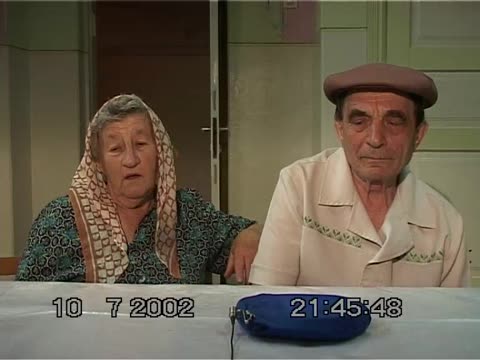
Bella and Isaak speak their life today and relations to their non-Jewish neighbors. According to them, they lived in a Jewish apartment complex after the war. Isaak sells soda water on the market during the day, which he began after his retirement.
The Vaismans talk about life today in Berdychiv. They mention the few remaining Jews and the neighbours' attitude toward them. One of them sells soda water at the market, and there is talk of working despite age and poor health. Kerler comments on their names.
also covers the neighbours' attitude and Kerler's remarks on their names
Isaak provides personal information. Bella then talks about their lives after the war. She also discusses her family, as well as contemporary Jewish life. The team then concludes the formal interview with Bella and Isaak.
Isaak's name and his marriage are discussed. He recalls living in Kharkiv after the war before returning to Berdychiv. The talk turns to a grandchild or relatives who went to America, and to the lack of Jewish children and a Jewish school in Berdychiv today. The interview ends with thanks and good wishes, with a mention of the rabbi.
adds the return from Kharkiv, relatives in America and the absence of a Jewish school
A prayer service in the synagogue is recorded. The transcript has almost no intelligible speech there, with only music noted and a few fragments. Near the end Kerler says in Yiddish that a colleague is a professor in America and that they work together.
Kerler begins an informal interview with Fania in Yiddish. She is a native of Berdychiv and speaks Yiddish at home. Her father was imprisoned under Stalin, in the 1930s (?), leaving her mother with four children. She says non-Jews, including a friend whose father was also imprisoned, spoke Yiddish before the war, and that Jews did not marry non-Jews. Her husband is an invalid.
adds Fania's Yiddish speech, her friend and mixed marriages
Fania speaks about Israel and the Arab conflict, then gives personal information. Kerler asks for her name and the names of her parents (father Hershl, mother Hinde). She was named Feyge Leye and her documents were altered.
Fania speaks about her life today, as well as her family. Her mother was born in Pidhorodne and her father was born in Berdychiv. Fania grew up with three siblings. Fania raised two daughters. She also speaks about her aunt, a Yiddish singer.
Fania talks about her husband's illness and the poor medical care he receives. She says her mother was born in a village (Pidhorodne?) and her father in Berdychiv, and that she has two children, one named Rosa. She speaks of her aunt Roze Gopiner, a Yiddish singer who performed in Berdychiv and on the radio and was killed by the Germans. Her brother Semyon went to a Jewish school but she did not.
Fania describes how her mother observed Jewish holidays such as Passover and kept to tradition. Her father was jailed as a party man. She went to the synagogue with her mother, who said such observance would die out with the older generation, and contrasts this with the young today.
adds the father's imprisonment as a party man and the mother's view that observance would die out
The team chats with other people in the courtyard. Fania says she has already been interviewed. People talk about the rabbi and kosher food. Some Russian is heard, and Kerler introduces himself as coming from Israel or America. Kerler asks about the Yiddish for 'thank you' and the speakers' family names.
The team meets Skobilitskii and chats with him informally. He provides personal information and talks about his family. Skobilitskii raised a son and his grandchild lives in Israel.
Kerler meets Skobilitskii and chats with him informally. Skobilitskii says he is 83 and was born in Berdychiv. His father was born near Warsaw and his mother in Berdychiv. His son is an architect, and a grandchild lives in Israel. He attended cheder as a child.
adds father's birthplace near Warsaw and the cheder
Skobilitskii speaks about his education before the war. He also addresses prewar Jewish life in Berdychiv, before talking about his career in the Red Army during World War II. His division went all the way to Berlin.
Skobilitskii speaks about his schooling before the war, including Polish and Russian schools. He then describes serving as an officer from 1939 for ten years, the whole war, from Stalingrad to Berlin. He was an artillery battery commander whose division helped liberate Berlin, Austria, Hungary and Czechoslovakia. He gives his surname for the record.
adds schooling, battery command and the liberated countries
Skobilitskii recalls that his parents spoke Hebrew (the holy tongue) so the children would not understand, and that he spoke it with his mother. The group then moves to sit down. He mentions a book of Yiddish stories by Berdychiv Jews that can be bought.
The formal interview with Skobilitskii begins. Skobilitskii mentions a book about Jews of Berdychiv, which includes an article about him. He then mentions Yiddish writers.
The formal interview begins. Skobilitskii mentions a Russian-language book on the Jews of Berdychiv that includes an article about him. They discuss where to buy it. He names Yiddish writers he has read (Sholem Aleichem, Mendele, Peretz and others). Sholem Aleichem is his favourite, and he talks about Mendele's character Motl. He reads Israeli newspapers in Russian.
adds the named Yiddish writers and his reading of Israeli papers
Skobilitskii speaks about his army service, as well as his family. In particular, he talks about his mother's observance and prewar religious life. Skobilitskii's maternal grandfather was a rabbi.
Skobilitskii says he can read and write Yiddish and wrote to his mother in Yiddish from the army. His mother Khane was the prayer leader (zogerin) in the women's synagogue of Berdychiv, where women repeated after her. She was a rabbi's daughter and had studied in a women's yeshiva. His maternal grandfather was a rabbi in Chudniv (?). Only Yiddish was spoken at home. He says there were twenty synagogues in Berdychiv.
Skobilitskii discusses his childhood, including education. He recalls non-Jewish students studying at a Yiddish school. He then provides personal information.
Skobilitskii recalls attending a Yiddish school where eight to ten Russian pupils also studied, and that Yiddish was spoken better than Russian. Kerler gives the date as 11 July 2002 and the place as Berdychiv and begins recording personal details. Skobilitskii gives his Russian surname and says his Yiddish name is Khayim.