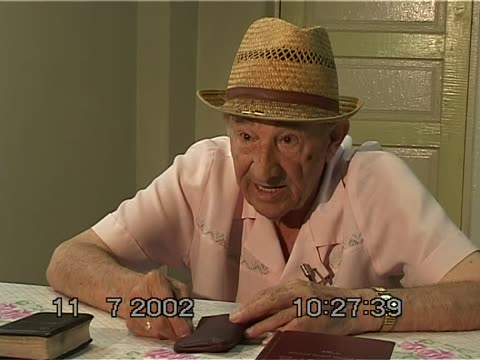
Skobilitskii continues to speak about his childhood, including the local school system. He recalls how he attended synagouge with his father on Sabbath.
Skobilitskii says that the cheder was not closed. On Sabbath he went to synagogue with his father, since Sabbath was a day off from the Yiddish school and Sunday was a school day. He and Kerler discuss the schools in Berdychiv: thirteen in all, eight of them Yiddish, plus Polish, Ukrainian and Russian ones. Exams and certificates were in Russian. Kerler then announces some word questions.
The catalogue entry does not mention the count and types of Berdychiv schools or the Sunday schooling.
Skobilitskii answers Kerler's questionnaire items, including words for a head or tumour and for a Jewish versus non-Jewish cemetery, and an illness name he links to Bila Tserkva. Katz and Kerler then ask him to recite from the prayer book. He recalls that in cheder they washed their hands and said Modeh ani.
The transcript shows the word questions, the cemetery terms, and the request to recite prayers.
Skobilitskii briefly addresses his religious school education, before he recites the morning prayer "Modeh ani," as well as other prayers and blessings.
Skobilitskii recites Modeh ani and other morning prayers and blessings, including the blessing over tefillin. Katz and Kerler ask for Aleinu and other prayers, but he declines and says that is enough. The recitation is garbled in the transcript.
Skobilitskii describes preparing for Sabbath at his parents' home. His mother lit the candles and put the cholent in the oven, sealing it with clay. She baked large round loaves herself, and there was white Sabbath bread (challah) alongside the dark weekday bread. He mentions that bread was also sold in shops.
Skobilitskii recites the prayer "Aleinu leshabei'ach," which is recited at the end of each prayer service. He then continues to answer dialectological questions from the AHEYM Yiddish linguistic questionnaire, as well as recalls terms in "loshn-koydesh" (mix of Hebrew and Aramaic).
Skobilitskii answers questionnaire items on words for 'to make', street, washing and a ball. He explains words in loshn-koydesh that his parents used so the children would not understand, such as one for apples, for a watchman and for a non-Jewish woman. Kerler asks for the Yiddish for the cup of Elijah and for the afikoymen, and mentions a break.
The Aleinu recitation is not clearly heard here; the transcript shows the loshn-koydesh terms and the Passover questions.
Skobilitskii speaks about his Red Army career and fighting at the front. He also mentions fellow Jews in his artillery division, as well as his injuries and military awards. He explains how he advanced from the Stalingrad front, through Bryansk, Sandomierz, Austria, Hungary, Germany, all the way to Berlin. After he helped to liberate Berlin, he became the senior lieutenant of the German town Tiefenbach. Skobilitskii continues that he was in charge for two years and his wife joined him there.
Skobilitskii recounts his ten years of army service. He finished an artillery officers' school, fought at Stalingrad, and was wounded in 1942, spending two months in hospital in Saratov. He went back to his division and entered Bryansk, where he received decorations. His route took him through Sandomierz, Austria, Hungary and Germany to Berlin. He then served as commandant of a town named Tiefenbach (?) on the Austrian border, where his wife joined him for two years. He mentions Jewish colleagues in the unit.
The transcript specifies the route and the commandant post, and notes the wound in 1942 and the hospital stay.
Skobilitskii says his wife Rive, born in Berdychiv, died in Germany at 54 and is buried in Berdychiv, where he made her a large monument paid for by their son. He then describes his artillery duties: calculating fire, using a map and compass, and correcting aim. Kerler asks about a Russian word for a compass, and then starts further word questions.
The transcript names the wife and her monument, and covers the artillery work.
Skobilitskii answers dialectological questions from the AHEYM Yiddish linguistic questionnaire. He also speaks about his family, including his relatives' occupations (21:00).
Skobilitskii answers many questionnaire items: words for a Jewish street, 'to count', pulse, to knock, to ask or request, and a board. He tells of his mother's brother, a cantor in a Moscow synagogue, and of his grandfather Nakhmen, a rabbi with eight children, including his mother Khane and her siblings. The grandfather's family kept shops and sold goods in villages. Katz notes words he recalls from Skobilitskii's mother.
The transcript shows the grandfather rabbi's eight children and their names, and a cantor uncle in Moscow.
Skobilitskii shows a book by Viktor Korzhuk who writes about Skobilitskii's military service. He then continues to answer dialectological questions from the AHEYM Yiddish linguistic questionnaire.
Skobilitskii shows a book by a writer (the catalogue names Korzhuk) that mentions him as a battery commander. He also says that he bought copies and sent them abroad. Kerler and Katz then return to questionnaire items, such as words for a child's loud crying and for a non-Jew who converts to Judaism, as well as 'a good name'.
Skobilitskii says that small children in cheder were not taught tales of the Baal Shem. He discusses the shrine built over the site connected with the tsadik Levi Yitskhok of Berdychiv, with Katz and Kerler asking what it was called. They discuss words for a pious grave-site building and for 'going to the tsadik', and continue the questionnaire with items such as ears, book, mouse, luck, and pigeon.
The transcript shows the discussion of the tsadik Levi Yitskhok's site and its name.