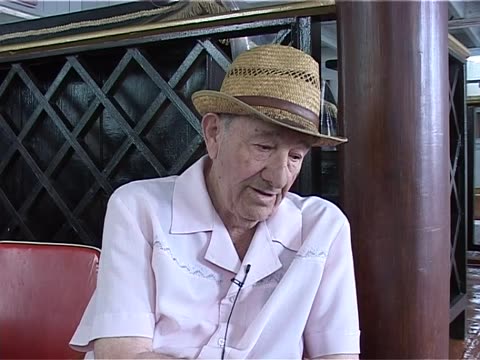
Skobilitskii gives details on his family: his father came from near Warsaw and was a rabbi in a village near Andrushivka in the Zhytomyr region. The names of his paternal grandparents, his mother and his brothers are given, and one brother was killed by the Germans. Kerler also briefly arranges a further interview in town.
Also covers a brief arrangement for another interview with someone at the town centre.
Skobilitskii says he studied before the war but worked in a museum, writing picture captions in Yiddish and Russian, and also retouched glass photographic plates. He attended cheder for about three and a half years and then Yiddish school no. 9, on a street now named after Sverdlov, formerly Makhlevka (?). He begins to speak of anti-religious agitation at factories.
Skobilitskii recalls anti-religious propaganda that called religion an opiate, and that school subjects were taught in Yiddish. He remembers mocking plays about Jews staged at school, with Yiddish songs. He also mentions a Jewish theatre troupe that performed Sholem Aleichem, cantors in the Koch shul, and the Jewish owner of the fire brigade with white horses.
Also covers Yiddish theatre, cantors in the Koch shul and the Jewish-owned fire brigade.
Skobilitskii names the Yiddish newspapers and magazines read in Berdychiv in his youth, including papers from Birobidzhan. He says a photo and a story of his war service were printed in one. He mentions a booklet of Berdychiv stories that contains an article of his and refers to him as a battery commander.
Skobilitskii explains what Hasidim were and how they differed from ordinary people. He says that Hasidim travelled to a rebbe and that a Hasidic rebbe was called 'a good Jew'. He talks about the grave of Levi Yitskhak, which before was only a mound of earth with a brick border and no monument, and about money for its rebuilding.
Skobilitskii describes his part in the rebuilding of the tsadik's site, a small wall. At a factory, he used a bucket and wooden sticks to hammer out the letters on the fence. He then says he liked physics and history best in the Yiddish school.
Skobilitskii says that good teachers of physics and history helped him become an artilleryman, and is asked the Yiddish word for north, east and so on. There are elicitation items such as 'a good place' for a grave, a Galitsianer and a Litvak, and the word misnaged. He then recalls Jewish weddings with a badkhn.
The catalogue entry mentions a secular school, but the passage also covers the army, word-list items and the badkhn at weddings.
Skobilitskii recalls the wedding jester (badkhn), who made the women cry and the guests laugh. He speaks in rhymes and has a melody. He then answers a question about the dybbuk, said of a bad person.
Questionnaire on Yiddish words and expressions: golem, 'a clay goat', phrases about the dead praying for the living, greetings and good-day phrases, thanks, mouse, luck and schlemazl, book, house, window pane, colours, and words for building and living. At the end Kerler asks about the yeshiva in Berdychiv.
Skobilitskii describes the new yeshiva building in Berdychiv, with a Jewish space and a mikveh, and says the group will drive on to show it. Kerler then asks for a Yiddish word for a clean person.
A long dialectological word-list: stones, ear, cold, high, late, near, sleep and sick, and the difference between 'honest' and 'religious'. There are discussions of Belaya Tserkov in Yiddish, converts, mixed marriages and Yiddish expressions for 'I ask', 'young' and 'right'. Other items include the midwife, 'to pray', the word for a shop and its wares, potatoes and flowers, and sentence-translation items. Berdychiv usage is compared with Litvak usage, and a Haifa anecdote is mentioned. The passage includes a few Russian prompts.
Besides dialect items, the passage touches converts to Judaism, mixed marriages and a Haifa anecdote.
The team is in the van, with a Russian remark that there were eight Jewish schools in town before the war and a comment that the town was largely Jewish. Skobilitskii speaks about the old synagogue and the school building no. 9. The passage then turns to the difference between 'honest' and 'pious' in Yiddish and an anecdote about being asked about his beard. Someone says he is a professor of Yiddish, and then a speaker begins to tell of a family wedding.
A speaker recalls a Jewish wedding in a Hungarian town, Pápa, in 1948. The speaker's mother had been there, and Hungarian and Hebrew were spoken. The passage mentions a stay in Austria in Tiefenbach (?), where Jews who spoke Yiddish lived. It ends with Jewish dishes such as gefilte fish from carp. It is unclear whether the speaker is Skobilitskii or an interviewer.
The catalogue speaks of Red Army service, but the transcript shows a wedding in Hungary and Jews in Austria.
Tour of Berdychiv by van with Skobilitskii: Makhlevka (now Sverdlov street), signs in English and Hebrew, a hotel building bought by Menlovich (?) for visitors from America, Chabad and its relations with the Skver rebbe, a monastery, and the ghetto monument. Jewish houses and the Lubavitch house are pointed out, and the group says it will return to see the synagogue of Feygele Magazanik (?).