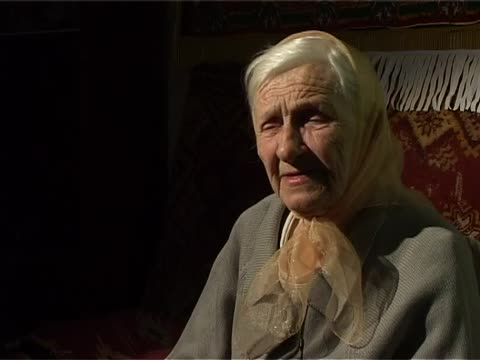
Chukh answers dialectological questions put by Kerler: Yiddish equivalents for Russian words and short sentences to translate. Items include words for 'honest', 'believer' and 'cross', vodka, numbers, bed, 'where from', 'shop', 'flowers', 'each' and 'three persons', and pronunciation variants such as 'fun vanen'. He also asks about the word 'mame' and the older word for a midwife, 'bobe'.
Chukh speaks about her family, particularly her second husband's life and military service during World War II. She also addresses his religious education. Chukh raised two children.
Chukh tells about her late second husband Itzik. He was at the front, was captured by the Germans and escaped from camps, and worked as an electrician at a factory in Berdychiv. He had a traditional Jewish education and knew prayer. He had been married earlier, and she and he had a daughter together. He died at about ninety, and she describes how she spoke to him at the end.
Adds the husband's escapes from German camps, his earlier marriage and child in Leningrad, and his death.
The camera cuts to a scene outside in front of the Jewish community, where the team chats about the project in Yiddish and Hebrew. They also chat with Skobilitskii.
Outside the Jewish community building the team chats about the project with a woman and with Skobilitskii. Kerler explains the video interviewing of elderly Yiddish speakers and the Oxford background, and a woman did not want to be recorded for fear for her husband's reputation. Skobilitskii says he knows where the synagogues stood and that he attended cheder as a boy. The conversation touches on his mother's father, a rabbi in Chervone.
Adds the explanation of the project and the talk about the cheder and the rabbi grandfather.
The team enters the synagogue with Skobilitskii. He describes prewar religious life in Berdychiv, as well as his career in the Red Army during World War II. Skobilitskii then gives a tour of the synagogue and provides historical background of the more than hundred-year old building.
In the synagogue Skobilitskii says his mother was a prayer-leader in the women's section and his grandfather a rabbi in Chervone, and that the Germans killed his father. He was an artillery battery commander at the front. The talk turns to the synagogue building, which was once a beis-medresh of rich men with an organ and where cantors were brought. Money from Moscow and Leningrad helped to rebuild it in 1946–47 under Soviet permission.
Adds his grandfather the rabbi and his father killed by the Germans, and the funding from Moscow and Leningrad.
Skobilitskii talks about his family. He raised a son, who was born in 1949 and circumcised in the community. Skobilitskii then addresses the rebuilding of the synagogue after the war, before he returns to his family.
Skobilitskii talks about his architect son, who lives in Rostov and has travelled abroad, and about the son's visits to Berdychiv. He mentions his daughter's family in Netanya and his plans to go to Israel via Rostov. He returns to the destruction of the synagogue by the Germans and its rebuilding after the war with money from rich Jews, and to his grandmother's Yiddish.
Adds the son in Rostov and family in Netanya, and the rebuilding after the war.
Skobilitskii speaks about contemporary religious life, as well as religious education. He then speaks about the fate of local Jews in 1943. Skobilitskii then addresses his childhood, including education at a Yiddish school. He finished eight years.
Skobilitskii describes the German round-up of Jews in 1943 from the synagogue. He recounts his own education and says he completed eight classes in a Yiddish school, one of eight Yiddish schools in prewar Berdychiv. About eighty percent of the inhabitants were Jewish, and Yiddish was spoken in the streets. He recalls a non-Jewish classmate who later spoke Yiddish with him.
Adds the round-up of Jews in 1943, the eight Yiddish schools and the non-Jewish classmate.
Skobilitskii talks about his life during World War II. He served in the Red Army and fought at the front. Skobilitskii lists the different countries he passed through toward Berlin, before he addresses his childhood education. He also briefly addresses memorialization.
Skobilitskii recalls his war service in an artillery unit from Stalingrad to Berlin, with the countries he passed through, and his rank as officer. Kerler asks about his cheder years in Kachynivka. He offers to take the team to the memorial for the thousands of people killed in Berdychiv and to the old synagogue buildings.
Adds the route from Stalingrad to Berlin and the memorial to the thousands killed.
Skobilitskii speaks about his religious school (cheder) education. He then describes prewar holiday celebrations, specifically Passover, before talking about his family.
Skobilitskii talks about cheder, prewar Passover customs and children's games with nuts. He describes the Passover seder at home, with the four questions. He tells about his brothers, one a senior engineer who died years ago, one a pilot killed at the front and the youngest killed by the Germans. He mentions his father's work for a count.
Adds his brothers, their deaths in the war, and the seder.
Skobilitskii explains how to play nuts on Passover. He then recalls how his family celebrated Sukkot, before he addresses his life today. Skobilitskii then talks about Sholem Aleichem's family, as well as Yiddish writers.
Skobilitskii explains how the children's game with nuts was played, by throwing them into a hole in the ground, and says Sukkot was marked by a balcony. He talks about his housing and about his son and wife, with visits to Israel. He says Sholem Aleichem's brother, a bookbinder, lived in Berdychiv, and names Yiddish writers he read, including Peretz and Mendele. He says he is soon eighty-five.
Adds the nut game, Sukkot, the housing and Sholem Aleichem's brother.
Skobilitskii talks about his life after the war and his family. He then addresses his life today. Skobilitskii worked at a tranfer station for land farms (kolkhozi and zavkhozi).
Skobilitskii tells about his son, an architect who runs an institute organization, and his son's wife, who tutors students for entrance exams. He explains that his own postwar job was at a Soviet transfer point where produce was delivered from collective farms, including apples. Kerler talks about the team's travel across Ukraine.
Skobilitskii speaks about his family, particularly his father's observance. He also addresses his childhood memories, including education. Skobilitskii attended cheder for approximately four years.
Skobilitskii talks about his father, a locksmith whose work left little time for observance, and about tefillin. His grandmother earned more than his father, and he names his grandmother Sarah and a maternal grandfather who was a rabbi in Chervone. He has a relative in Canada. He describes cheder, which he attended for about four years in the synagogue on Kachynivka, with the teacher Srul (?) and the sexton Leibele.
Adds the father's work, the grandmothers' trade, relatives in Canada and the cheder teacher.
Skobilitskii describes food before Yom Kippur and the cholent kept in the oven, sealed with clay. He says the family was very poor before the war, with bread and butter and milk in the kitchen for four hungry boys, and herring was cheap. Kerler also asks about smoked fish.
Adds the Sabbath cholent, herring and smoked-fish terms.
Skobilitskii addresses prewar Jewish life, including occupations and alcohol consumption. He then recalls prewar Purim celebrations and cultural life. Skobilitskii also describes a Yiddish singer from Kyiv in postwar Berdychiv. He then returns to prewar Jewish life and recalls Polish Jewish migrants.
Skobilitskii describes prewar drinking customs, including Berdychiv's seltzer water, and remembers a Purim theatre and visiting artists from Kyiv and Moscow. He recalls a cantor from the Kyiv opera hired for Yom Kippur and a singer in postwar Berdychiv, whose name he cannot remember. He talks about learned Polish Jews who had settled in the town, including his father, who came from Poland. The talk ends with how their Yiddish differed.
Adds the Kyiv cantor, the Polish Jewish settlers and their Yiddish.