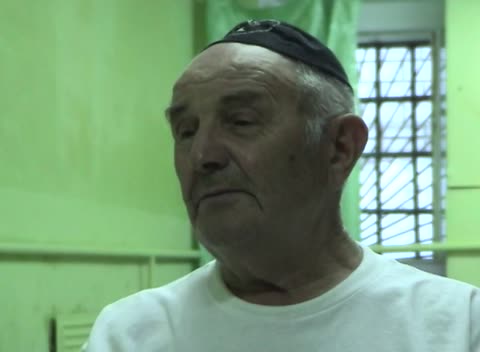
Vainshelboim gives his age before the war and his first name, and names his father Arn and his mother Feyge. He gives the family name and, in answer to Lemster, the street where he lives.
Vainshelboim provides personal information and speaks about his family. He grew up with four siblings, two brothers and two sisters. His parents were also born in Berdychiv and his father worked as painter. He then recalls his grandmothers' observance during his childhood.
Vainshelboim states that he was born in Berdychiv, and gives the birth years of his parents and siblings with some difficulty. His father was a painter. His mother was a housewife who bore six children, one of whom died of scarlet fever. He recalls his two grandmothers, Treysl and Trane, and their piety, and gives the names of his two grandfathers. He knows little about the grandfathers, who died before he was born.
gives the grandparents' names and the siblings' birth years
Vainshelboim discusses his childhood memories of his family life. He explains his father's playing of musical instruments and lists the songs his father would sing. He also recites a song in Russian.
Vainshelboim recalls his father's love of flowers and his playing of mandolin, balalaika and violin, including for the neighbourhood young people's dancing. He tries to recall songs his father sang, in Russian and in Yiddish, and sings or says a Russian verse. He then says that he began school at six or seven.
Vainshelboim talks about his education before the war. He attended a Yiddish school for four years and then switched to a Russian school. Vainshelboim remembers cultural activities at the Yiddish school's auditorium.
Vainshelboim describes four years at a Yiddish school, where Yiddish was the language of instruction, followed by two years in Russian classes after the Yiddish schools were closed in 1939 (?). He names a strict director, Nirman (?), who taught mathematics and physics. He recalls the school hall, where students sang Yiddish songs, recited Sholem Aleichem stories and put on plays such as 'The Gold Diggers'. He also begins to speak of a communal soup kitchen.
Vainshelboim speaks about prewar Jewish life, including the synagogue structure and occupations. He explains how his father was a prisoner of war during World War I. Vainshelboim then talks about his family.
Vainshelboim describes the soup kitchen, which fed the poor, and prewar Jewish occupations in Berdychiv. Asked about his father, he says that he was a prisoner of war in Austria in the First World War. He lists his siblings, including his brother Shloyme and two sisters, one of whom died of scarlet fever. Another sister, Polye, finished ten Yiddish classes at eighteen and was killed in 1941. He then begins to introduce the start of the war.
Vainshelboim addresses his life during World War II. He describes his family's evacuation, which ended with their return to Berdychiv a month later, due to crowded trains. He then explains how his parents and siblings were taken to forced labor in December 1941. He then describes his escape from the police and subsequent hiding in Rizhkovtsi (17:23). Vainshelboim then describes their daily life and labor in the Berdychiv ghetto, before speaking about a three-day long massacre. Vainshelboim continues with describing his second escape and following return to Berdychiv, as well as his third escape in August 1942.
Vainshelboim tells of the first days of the German occupation, an attempt to flee that was abandoned, and the September roundup of the family to a camp. His mother hid him in a baking oven, and he escaped from two policemen and hid in a straw shed. He tells of the family's separation, of being held in a cellar before the shootings, and of an escape naked through fields. A Russian woman helped him, and he was then hidden by an old woman in a village. He recounts his escapes from the Germans, from the police and from his father's group, the killing of his mother, sisters and brother in 1941, and the fate of his aunt and her child in 1942.
adds the oven hiding and the killing of his family
Vainshelboim speaks about his encounter with Ukrainian policemen, which resulted in his third escape. He then describes his escape toward Tsherekhovoy (30:17), as well as the help he received. After staying in Tsherekhovoy for one year, he moved on to Petrivka (30:47). He then continues to talk about his odd jobs there and then fourth escape to the Ruzhyn region. There he worked on a collective farm for one year until December 1943 and then escaped again with a horse and wagon to Pohrebyshche and further. Vainshelboim explains how he worked at a mill from 1944, for six years.
Vainshelboim tells of being caught by Ukrainian policemen in a village and of his escape by swimming under a bridge, hiding, and a Ukrainian family feeding him. He then went on to Tereshkivka (?) and Petrivka (?), where he worked for a man tending pigs and horses and lied about his origins. He moved on to the Ruzhyn district, where he worked for about a year until December 1943. He then took a horse to a woman in a village and worked at a mill for six years from 1944.
adds the details of the swim and the later farm and mill work
Vainshelboim talks about his life after the war. He was drafted for his military service in 1950 and served for four and a half years. He worked at a mill for twenty-five years and then at a beer factory for five years. Vainshelboim states that he was the only from his family who survived the war. He then returns to his life during the war, especially addressing the massacre.
Vainshelboim recalls his service in military aviation in the mid-1950s, lasting four and a half years. After marriage he worked at a flour mill for about twenty-five years, becoming a foreman, and then at a brewery for five. He says no one from his family survived the war except himself. He then describes how a large crowd of Jews, some hundreds, was held for days in a cellar without food, and mentions the pits and a Jewish camp.
adds the cellar detention where Jews were held for days, the pits and the Jewish camp, which the catalogue's 'massacre' does not specify
Vainshelboim addresses his childhood memories, including games. He also talks about prewar religious life, before briefly addressing his contemporary religious observance. He then talks about his family.
Answering Lemster, Vainshelboim recalls childhood games such as hide-and-seek, which Jewish children played together. He says his father went to synagogue on Sabbath because he had to work on weekdays, and that he himself now prays morning and evening. He says he reads Yiddish but not Hebrew, and that life before the war was happy but for the Germans. He adds a few words about his parents' marriage and schooling.
adds his reading in Yiddish, including Sholem Aleichem, and his father's age at marriage
Vainshelboim speaks about his education before and after the war. He finished six years of schooling before the war. He attended an evening school in 1961, for five years. Vainshelboim then returns to his childhood memories of family life. He also addresses antisemitism during the prewar Soviet period, before recalling the Great Hunger in 1932/33. Vainshelboim then speaks about his family.
Vainshelboim speaks about his schooling, six classes before the war and evening classes after it, and about wanting to study at an institute. He says that before the war the Soviet constitution punished anti-Jewish name-calling, and he tells of a sugar-maker who hid in a cellar. He recalls the hunger of 1933, when the family shared a half loaf of black bread. He says his brother was drafted in 1941 and killed at the front.
adds his brother's fate at the front and the story of a man hiding in a cellar
Vainshelboim remembers Yiddish songs and sings one stanza of a tailor song. He then recalls how his father played during Sabbath and speaks about prewar cultural life.
Asked about Yiddish songs, Vainshelboim recalls a song about a Jew with seven daughters and sings a few lines of a tailor's song. He says his father played violin, mandolin and similar instruments and sang with young people on Sabbath. He mentions a Yiddish theater near the building of a former factory.
Vainshelboim describes weddings where a local fiddler (name unclear) played and sang Yiddish songs. Asked for Jewish anecdotes, he says he no longer remembers them. He reflects that he survived by belief in God and by escaping three times, and says believers fared better under the Soviets, who promoted atheism.
Vainshelboim speaks about his family and holiday celebration, including food customs, before the war. He recalls how the community baked matzos before and after the war. Vainshelboim then speaks about his life , after the war, including his education.
Asked what survived from his grandparents, Vainshelboim recalls small silver spoons and little prayer books. He describes his father at holidays, matzo baked locally at Passover before and after the war, and the seder with the four questions. He mentions Purim pastries and children's Purim play. He says he took no part in these, and he speaks of school prizes and his love of literature.
Vainshelboim speaks about prewar Jewish life and remembers locals in Berdychiv. He then addresses prewar religious life and speaks about his own observance.
Asked about well-known Berdychiv Jews, Vainshelboim names doctors, butchers and writers, among them Ilya Ehrenburg's Black Book. He mentions a tsadik buried in the Jewish cemetery near Berdychiv, whom people visit. He then explains his return to belief: during his wife's illness he vowed to go to synagogue, and he describes praying and asking God for her health.
adds the tsadik's grave near Berdychiv and his vow to attend synagogue during his wife's illness
Vainshelboim speaks about his family, particularly his wife. He was married in 1954. He raised two children and two of his grandsons live in Canada and Israel. Vainshelboim then speaks about contemporary religious life.
Vainshelboim speaks about his wife, who is two years younger and speaks Yiddish. She wrote to him during his army service, and they married in December 1954. He praises her as a faithful housewife and describes her family's craftsmen, a clockmaker and the Katz family. He has two children, with grandsons in Israel and in Canada (?). He says that belief in God has grown since the war.
Vainshelboim returns to talking about his life in the 1930s in Berdychiv, before addressing prewar cultural life. He remembers a Yiddish theater, before talking about historical studies on Jewish life in Berdychiv. Vainshelboim then briefly recalls his mother's traditional cooking.
Asked about prewar Jewish life, Vainshelboim recalls hard times in the early 1930s, easier ones by the later 1930s, and playing sports. He describes Yiddish performances and artists at a park near the church. He says he loved literature and once wanted to write a book. He mentions a local historian, Dr. Zabarko (?), who published books on the Jews of Ukraine. Lemster then asks about his mother's Jewish cooking.
adds the park performances and a historian's books