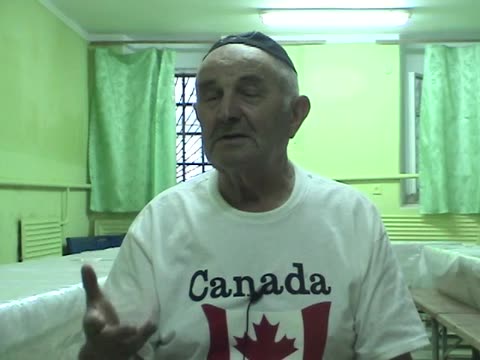
Vanshelboim discusses food customs, particularly how to kosher meat and prepare gefilte fish. He also remembers the local kosher butcher from his childhood, as well as his mother's cooking and baking.
Asked by Lemster who made the meat kosher, Vainshelboim describes the shoykhet who slaughtered chickens, and the home procedure of salting, resting and washing the meat. He then explains how fish was cleaned, salted and cooked, naming kinds of fish, and how gefilte fish was prepared with ground fish and onion and cooked for a long time. He also describes Sabbath cooking done on Friday, bread dishes with preserves, and what his mother baked and cooked, such as pancakes and potato latkes made with buckwheat flour.
Also covers the shoykhet and the interviewee's mother's everyday baking beyond gefilte fish.
Vanshelboim talks about his childhood memories, including alcohol consumption and non-Jews, who spoke Yiddish. Vanshelboim also recalls individuals who converted to Christianity.
Short passage after a stretch of recogniser loop in Russian; Vainshelboim says someone drank only on holidays and, when he did, a little vodka. The rest is unclear.
The transcript shows only a brief remark on drinking; no converts are heard in this stretch.
Lemster asks about non-Jews who spoke Yiddish and about Jews who converted to Christianity. Vainshelboim recalls a Christian who worked for a Jew and lived among Jews and spoke Yiddish, and says he knows of no converts, apart from vague talk about a woman who lived with Germans. He also mentions reading a book of religious law.
Vainshelboim speaks about a school director who understood Yiddish and says that before the war Berdychiv was a Jewish town with many Jewish schools and many children. Lemster asks whether he remembers Sholem Aleichem having visited Berdychiv; Vainshelboim says the writer was loved and comments on his philosophical view of God and the Jews. He adds that there was no antisemitism before the war.
Includes Sholem Aleichem's visit to Berdychiv and the number of Jewish schools.
Vainshelboim shows and describes a family photograph with his parents, older brother and two sisters, and says his mother was very beautiful. An aunt of his mother's went to America in 1961 (?), and he mentions that his mother had many sisters. Asked by Lemster about Jews who farmed, he says there was a Jewish kolkhoz at the Berdychiv station, and that few Jews lived in the villages.
Adds the photograph and the Jewish farmers' presence in villages.