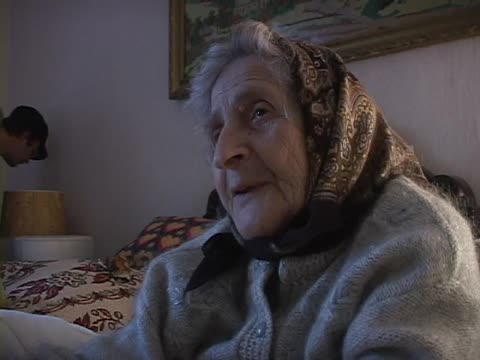
The team is let into Snook's house by her daughter-in-law, who speaks Russian. Kerler greets Snook and recalls their visit two years earlier. Lemster asks where she was born, and she says it was a village about sixty km away. She mentions that her son is in hospital.
Snook talks about her son, who is in hospital after an operation, and about her daughter-in-law and grandchildren, who live in Israel. She says she has two daughters and eight grandchildren and that her son keeps Jewish tradition. Lemster asks whether a mohel was available when he was circumcised. Snook mentions that her husband died fifteen years ago, that her parents lived in the village, and that she was in Auschwitz.
also covers her children and grandchildren in Israel and Auschwitz
Snook says she was about twenty when she was taken before the war. She tells how a relative's wife, after her brother-in-law's death, asked her to take one of two children when Jews were being taken to the camps. The transcript is garbled about who exactly the relative was.
Snook describes arriving at Auschwitz. A German snatched the child from her and sent it to one side while she was sent to the other. She says Jews were killed in the camps, and Lemster says he was born after the war. He then steers her back to prewar life.
Snook says the village had about a hundred Jewish families and a synagogue, and that people went to pray. She compares observance then and now, mentioning her grandchildren in Israel and her daughter-in-law's synagogue-going. Lemster asks how she herself studied.
Snook says she was able to study little and attended a Czech school, which cost money. Her father was a middle-class man who kept a cow and a pair of horses. She also mentions a rebbe's grave in a nearby place where people go (the name is unclear), where a building has gone up.
Kerler and Lemster ask Snook about the 'gut vort', the Saturday-night greeting, and about the blessings that began it, starting with the God of Abraham. She remembers only parts and says she has forgotten much. Lemster then asks what the village Jews did for a living.
Snook lists the village Jews' trades, including a shoemaker, a tailor and a glass cutter. She says the Jews did not dance in the Gentile manner. At weddings there was a 'gramer', a rhymester who was rewarded with thrown coins, but she cannot name one. Kerler asks who taught her to read Yiddish.
Snook says her son was taught by a melamed. She herself went to a lame teacher for lessons so as to be able to pray. She did not read Yiddish newspapers, which came from Israel. The village had a library with various books, and her daughter-in-law knows Yiddish.
Snook says there was no Yiddish theater in the village and going to town cost money. Jews who farmed had fields, hay, a cow and sheep and made cheese. She explains how cheese was made kosher with rennet from a slaughtered calf. She says there were few Jewish shepherds.
Snook says there were few rich people in the village; they made money from land and orchards and sold the produce. Lemster asks about the fruits that grew there, and she mentions apples and a hailstorm that damaged the crop. Kerler then brings up singing.
Snook says she sang songs at Purim and at weddings. When asked, she cannot immediately recall a song about a wife who eats too much, and she worries about her son in hospital. Kerler passes on greetings from a colleague who could not come.
Snook says her son has two daughters who live in Israel. She recalls Passover baking and the fast of Tisha b'Av. She says she married in 1939, before the war. Lemster asks about the return home, and she says the house was found wrecked.
Snook says her belongings were stolen, though the wartime losses are only briefly described. Her husband's parents were taken to a camp in the 1940s and did not return. She has lived in Khust for twenty years and says young people there no longer speak Yiddish but understand it. Lemster asks about Christians who spoke Yiddish.
Snook says some local Christians learned Yiddish and spoke it. She talks about Jews and Christians living side by side. She notes good and bad people in both groups, and that Christian neighbors help her today.
Snook talks about the 'good Jews' and rebbes whom people consulted in Khust and nearby places. She says what was said to them was secret. She explains remedies against the evil eye: extinguishing coals and using challah blessed by the rebbe. She says that Jews did not play cards, that spirits were hardly drunk, and that wine was for kiddush and celebrations.
Snook says she went to the village synagogue with her parents, and that her father prayed at length. Her parents kept a cow and horses and worked the land. She describes cheese made kosher with rennet and meat salted at home, with a shoykhet. Kerler then works with her to reconstruct a childhood song about a girl who marries and eats up the household.
Kerler and Snook talk about when her son will leave hospital. Lemster asks how she made gefilte fish, and she describes it using carp and chopped fish with pepper but no sugar. Kerler says the team will leave in a day or two. Lemster asks whether she still speaks Yiddish with people in Khust.
Outside, Kerler and Snook's daughter-in-law talk about a man named Misha Berger (?), who held the key to the holy place, and about her brother, who died long ago. She says her siblings and children are in Israel. They speak of the children phoning daily and of her husband.
The team arrives at the synagogue in Berehove and greets two men. The talk is brief and garbled and touches on a woman from America who asked that her telephone number be passed on, and on going into the synagogue.
Tour of synagogue. The team enters the synagogue and Hodinger gives them a tour. He provides personal information on himself and Berkovich. Berkovich was born in Berehove and Hodinger, born in Vynohradiv, moved there fifty years ago.
Inside the synagogue the men talk about the many former synagogues in Berehove and say they are Orthodox Ashkenazi. One says he is from Seliš (Vynohradiv) and has lived in Berehove for about fifty years, while the other is a Berehove native. They discuss how few Jews remain, the minyan, and the absence of women singers. Kerler and Lemster ask about languages spoken (Yiddish, Hungarian, Russian, Czech, English), about nearby Jewish villages and Yiddish speakers, and about the Hesed.
adds the discussion of languages spoken, nearby Yiddish speakers and the Hesed
Berkovich's family and potential interviewees. Berkovich lived in America for thirty-five years. His son lives there. He returned to Berehove because his wife fell ill three years ago. In America, he worked as a carpenter. They also discuss potential interviewees, and potential Yiddish-speakers in the region.
A man in the synagogue says he lived about thirty-five years in New Jersey, where he worked as a carpenter, and has been back in Berehove for three years. He has a son in America and says his wife was ill. Kerler suggests setting up two cameras to interview each man separately. They also discuss a woman in Seliš who might be found.
adds the carpenter's work, his son in America and the plan for two interviews
The camera cuts to the beginning of a formal interview with Hodinger. Hodinger provides information on potential interviewees and some personal information in Russian. Hodinger was born in Vynohradiv and spent his childhood years there until the beginning of World War II.
Kerler and the others discuss a possible Yiddish-speaking interviewee, a Mrs. Neiman (?), and phone numbers for her and for Perele. Hodinger recalls a film made in Berehove. In Russian, Hodinger gives personal information: his name Vilk Shimonovich, his birth in Vynohradiv in 1928, and his address and phone number in Berehove.
Interview begins. Hodinger was born in Vynohradiv and spent his childhood years there until the beginning of World War II. He then briefly describes the arrival of the Germans and Hungarians. He was imprisoned in the Vynohradiv ghetto for two months before he was sent to Auschwitz in 1944. He was 16 years old at the time.
Hodinger says he is from Vynohradiv (Seliš) and lived there until 1944, when the Germans and Hungarians came. He was in the ghetto for two months, from Passover to Shavuot, at age sixteen, and then taken to Auschwitz. He recalls Mengele at the selection and how he narrowly escaped death twice, and describes his fear and his heart pounding at night.