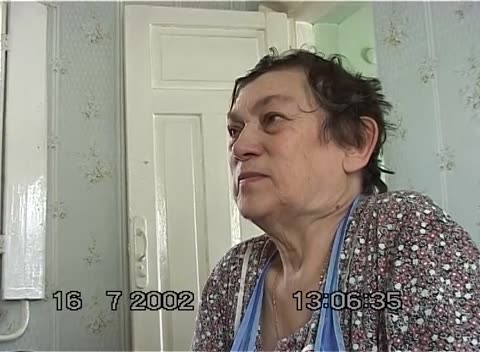
Informal talk at the start, partly in Russian, about common acquaintances, travel plans and the team's arrival. Kerler asks whether there is a Hesed in town. The visitors are described as a rabbi from Canada, a university historian in America, and a colleague; a grandchild or others offer food, and the kitchen and flat are shown. Kerler asks to call her 'Aunt Mira' and then asks how she makes gefilte fish.
The transcript shows mostly small talk about visitors, food and the flat; charity is only touched by a question about the Hesed.
Murovanaia explains how she makes gefilte fish: onions, ground fish, matzo meal, sugar and salt. She mentions American relatives who visited from Detroit or Boston and were served it, and that a son-in-law is about to come.
Also mentions American visitors and a coming son-in-law.
Formal interview begins. Murovanaia says she can hardly speak Yiddish now for lack of people to speak it with, and that she was taught it from childhood. Her grandson introduces himself; Kerler states the date and place of the recording and begins collecting her details.
Murovanaia provides personal information and speaks about her family. Murovanaia's family moved to Haysyn shortly after her birth. Her father was born in Kiblych and separated from her family. He was a colonel in the Red Army and taught at the military institute for electronics near Moscow. Murovanaia's mother was born in Haysyn and was the president of a tailor artel, before the war. Murovanaia grew up as an only child.
Murovanaia gives personal information and speaks of her family: born in Nikolaev in 1926 and taken to Haysyn as a baby. She learned fish-making from her mother-in-law from Haysyn. Her father Mordkhe, born in Kiblych, was a military officer who taught at a military school in Moscow; her mother Golde, daughter of Tevye, was born in Haysyn and headed a tailors' artel. She mentions a half-sister who died young and a Russian-language remark about the proportion of Jews in Haysyn.
Includes her mother-in-law teaching her, a half-sister, and a remark on Jews in Haysyn.
Murovanaia addresses her childhood memories of Haysyn. She finished seven grades at a Russian school, before her evacuation to Central Asia. She then addresses her return to Haysyn in 1944, when she worked as statistician. Murovanaia continues that she studied pharmacy between 1945 and 1947 and became an assistant pharmacist. She worked in the same pharmacy for fourty-five years. Murovanaia's daughter also worked in the same pharmacy, before her immigration to Germany.
Murovanaia recalls finishing seven grades before the war and being evacuated; she was seventeen on returning to Haysyn at liberation and worked briefly as a statistician. She studied pharmacy in 1945–47 and worked in the same pharmacy until 1990. Her daughter worked there and then left for Germany. Kerler asks her to explain terms in Yiddish.
Details Kerler's requests for Yiddish equivalents of terms.
Murovanaia discusses food customs for Passover, as well as other dishes. She then speaks about a childhood friend from before the war, before talking about her family. Murovanaia raised two daughters.
Murovanaia speaks about Passover dishes (kneidlach, stuffed fish, kugel) and a childhood Jewish friend, now in Moscow, with whom she spoke Russian. Her two daughters' ages are given, along with a silver wedding in August. Murovanaia says her mother was a Communist yet believed in God; she compares Yiddish speaking in the family with Russian schooling.
Includes her daughters' ages and the language used with her friend and relatives.
Murovanaia addresses postwar holiday celebration at her in-law's house. Murovanaia states that she went to celebrate Jewish holidays at her in-law's house and they came to visit on Soviet holidays. Murovanaia mentions that she learned Jewish cooking from her mother-in-law. She then addresses postwar Passover celebrations, including food customs.
Murovanaia says that after her marriage she celebrated Jewish holidays at her in-laws', whose father was a Communist but whose mother observed the holidays, without prayer, while Soviet holidays were kept at her own home. She learned cooking from her mother-in-law and describes the Passover foods. Later she mentions a grandson's seder in Moscow, and that her family is secular; Kerler asks about the Yiddish word for religious.
Answers Kerler's dialectological questionnaire, translating Russian words and descriptions into Yiddish: greetings, please, crying, hunger, cold and warm, the verb 'to do', mountain, bed, numbers of people, luck, high, late, later, gravestone, thanks, and a non-Jew. The interviewer also explains why he wants everyday speech rather than literary Yiddish.