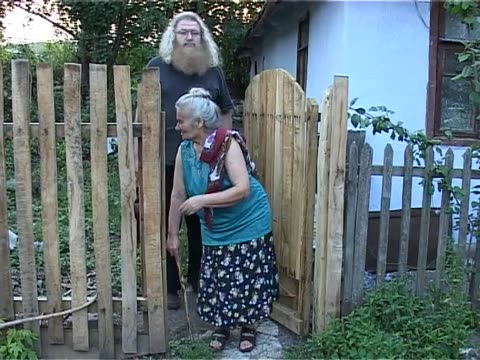
Krasner says a few words about the seder in the late 1940s (?) and before the war. She says the family house stood nearby and was ruined and plundered by Romanians. Kerler and Katz then arrange the trip to the cemetery.
Adds the plundering of the family house and the arranging of the cemetery trip.
Footage from the van and the street in Shpykiv. Krasner points out the former ghetto and houses where Jews once lived, some now occupied by non-Jews, and says only a handful of Jews remain in town. Katz asks about this and about the number of people in Shpykiv. Kerler has a long exchange with her about how a mother counted guests, and she describes the former synagogue. The stretch is full of Russian chatter, banter about the camera and Americans, and speech that is hard to follow.
Adds the ghetto site, the count of Jews in town today and the counting question.
The team arrives at the cemetery in the dusk and walks over a bad path. Krasner shows the graves of her mother and aunt. Katz reads the inscriptions with her and says kaddish for her mother and aunt, whose names are only partly clear. Krasner says the aunt was cremated and buried elsewhere. The speech is partly garbled.
Adds the reading of the inscriptions and the aunt's name.
At the cemetery Krasner speaks about graves and burials: a tombstone, her brother who made it, relatives who died in camps, and a neighbor. Katz and Kerler read gravestone inscriptions, including a rebbe's tomb, with a death date in the early 1920s (?), and ask about word forms, such as the plural of tsadik.
The tape changes to a kitchen in Haysyn with Murovanaia. She and Kerler talk about making vareniki, and she tells how she makes the dough and filling by hand. The talk is interrupted by Russian talk about calling the head of the community.
While making vareniki, Murovanaia talks about people she knows in America and Cleveland, and about the Kerler family, who were neighbors in Haysyn. Kerler says he lives in Bloomington, Indiana. She mentions a daughter in Nuremberg and a grandson in Moscow. They discuss the similarity of Yiddish and German and its place in the world as an international language.
Adds Murovanaia's family in Nuremberg and Moscow and the talk about Yiddish as an international language.
Murovanaia talks about the Soviet Yiddish school in Haysyn and some of its teachers, though she herself attended a Russian school. She recalls that there were three synagogues, which stood until the Germans came. After the war a shoykhet and a minyan existed, and the family held memorials for grandparents.