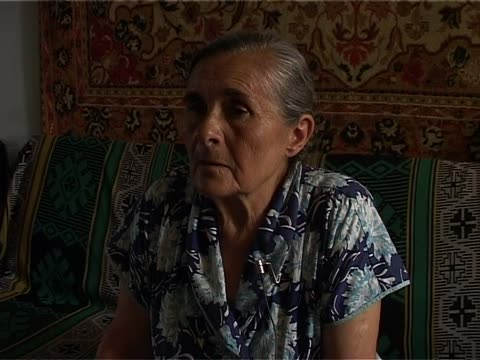
Bershad', Ukraine7 May 1903 (the catalogue's date for this tape is a placeholder)Interviewed by Dov-Ber Kerler, Jeffrey VeidlingerPart 3 of 339 min · 11 passages
Kerler asks about Sabbath food: the fish the mother prepared (gefilte fish) and how it was seasoned. The passage then moves to dialectological questions on words such as outsider/from another town, attic, bouillon, a rich man, tsadik and plural forms; the informant often cannot recall a word.
The catalogue names Sabbath food; the transcript also shows questions on words for wealth and tsadikim.
Bershadskaya talks about prewar Purim celebrations. She also addresses prewar Yiddish cultural life. She then continues to answer dialectological questions from the AHEYM Yiddish linguistic questionnaire.
Kerler asks about sending Purim gifts and whether Purim plays or klezmer musicians were known in Bershad'; the informant remembers little. The rest is questionnaire work on words and phrases, the difference between rav and rebbe and plural forms. S4 asks whether a rav could be Hasidic.
The transcript also shows klezmer musicians and the rav/rebbe distinction.
Bershadskaya speaks about prewar Jewish life in her home village. The team then concludes the formal part of the interview with Bershadskaya and the camera records footage of her apartment.
Kerler invites the informant to tell something or sing a song, but she says she has forgotten. He asks which languages Jews spoke and whether some wanted to speak only Hebrew; she says everyone spoke Yiddish. The interview is concluded with thanks, and other people mention a scholar and an archive. Vygodner (?) says he will show the apartment.
The catalogue says she speaks about her home village; the transcript shows mostly a question about Hebrew versus Yiddish and a phrase about a mythical town.
A guide drives the team through Bershad' and points out the former Jewish street, houses where named people lived, and small old Jewish prayer houses. Two old Jews still live in one. Kerler asks about a street name (Red Street).
The transcript adds the named houses and the old prayer houses.
The interview with Shor begins. He and Kerler talk about the heat and his sleepless night, and Kerler notes that it is Tisha b'Av. Kerler then starts collecting biographical data, asking for his name and patronymic.
Shor provides personal information and speaks about his family. Shor's father was also born in Bershad and was a leather and fur worker. His mother was also born in Bershad. Shor grew up with two brothers, one of whom moved to Australia and one sister, who made aliyah.
Shor gives biographical data: born in Bershad' in 1922 and lived there up to the war. His father, Pinkhes, was born in Bershad' in 1890 and was a furrier sewing felt. His mother, Reyze, was born there in 1893 (?) and was a housewife. Of the three siblings, Shmuel died in Australia, Hershl worked as a lecturer at a medical institute, and the sister Khayke died in Israel.
The transcript adds the siblings' names and fates, the father's trade and the parents' years of birth.
Shor discusses his life and education before the war. He attended a Yiddish school for four years and finished his school education at a Ukrainian school. Shor then speaks about his Yiddish school education. He also writes Yiddish words on a piece of paper.
Shor says he attended a Yiddish school for four years before moving to a Ukrainian school, and that he can read and write Yiddish. He recalls a teacher, Khirge (?), and writing wall slogans and posters in Yiddish. Kerler asks about subjects such as grammar and about writing the words for Sabbath and friend; Shor writes or spells them.
The transcript adds teachers, wall slogans and posters, and how the words Sabbath and friend were written.
Kerler asks Shor about terminology from the Soviet period (the words kulak and kolkhoz), and about what he read in the Yiddish school. He asks whether a line of a Yiddish poem sounds familiar, and the answers are unclear.
Asked about Soviet Yiddish writers, Shor names Itsik Fefer; Kerler suggests Markish, Dovid Bergelson and others. Kerler urges him to answer in Yiddish rather than Russian. Shor then recites Hebrew prayers (Shema and a Passover section) from memory or from his prayer book.
Asked how his mother kept the Sabbath, Shor lists Sabbath food: fish, meat, bean dishes and cold jellied dishes. The fish was carp (?), and he and Kerler discuss the names for gefilte fish and chopped fish. The end is interrupted by Russian and side remarks.