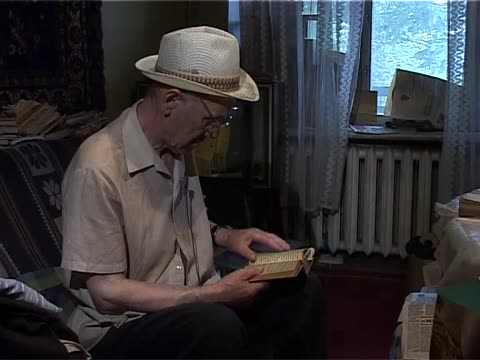
Bershad', Ukraine8 May 1903 (the catalogue's date for this tape is a placeholder)Interviewed by Dov-Ber Kerler, Jeffrey VeidlingerPart 2 of 338 min · 10 passages
Brief exchange about cooking utensils that Shor has shown. Kerler asks whether a frying pan is called by a certain Russian-Ukrainian name in Shor's Yiddish and asks about the words for a chopping knife and a pan.
Shor addresses religious customs and prayers before the war. He recites the morning prayer "Modeh ani." Shor then addresses his religious school (cheder) education at the age of six.
Kerler asks Shor about morning prayers and who taught them to him. Shor says he went to cheder at the age of six and stayed there three or four years. He recalls studying Genesis (Bereshit), Humash and Rashi.
The transcript does not clearly show the recitation of Modeh ani; it shows the cheder studies of Humash and Rashi.
Shor recites the Shemoneh Esrei prayer from memory, as learned in cheder. Kerler praises his praying and remarks that cheder taught better than the school. Shor says he can write Yiddish and knows many songs, and Kerler asks for Yiddish folk songs and children's rhymes.
Shor recites cheder rhymes and ditties, including a macaronic Hebrew-Yiddish verse about meat (basar) and humorous nonsense rhymes. He mentions that many songs existed in the ghetto-era (?) setting. Kerler then turns to photographs, and Shor shows pictures of himself and his wife at a resort and of his family, including a brother.
The photographs include resort pictures of Shor and his wife and a brother.
Shor recites the Four Questions of Passover with his Yiddish translation, as well as other parts of the Haggadah. He then shows his father's machzor (prayer book used on the High Holidays).
Kerler asks Shor to say the Four Questions as he asked his father, and Shor recites them in Hebrew with Yiddish translation and other Haggadah passages. A second voice asks when he got his prayer book. Shor shows his father's books, including a book of Selihot printed in Poland (Przemyśl is named), and Kerler asks about a word for mixing up the prayer book.
Shor says someone gave him a prayer book; his father's Selihot volume from Przemyśl is examined.
Kerler asks for the Yiddish word for a section or line of the prayer book (ray) and its meaning. Shor reads aloud from the book in Hebrew and Yiddish, a passage about visiting graves of the righteous before Rosh Hashanah and Yom Kippur.
Shor sings Yiddish songs about love and leaving home from his childhood. He then sings the Passover songs "Echad mi yodea" (who knows one) and "Chad gadya" (one little goat).
Shor sings Yiddish songs from his youth, including a humorous school song and love songs about heartache. He then sings Passover songs, Echad mi yodea and Chad gadya, partly in Hebrew and partly in Yiddish. He explains that people said them on the following days. A Russian interruption briefly breaks in.
Kerler asks about singing at home at Passover and about Soviet-era parodies; Shor mentions Russian songs but little else clear. He sings a few lines of the Yiddish song asking where the seven good years have gone. Kerler then asks about Yiddish theater.
Kerler also asks about songs mixing Russian and Yiddish.
Shor touches upon prewar cultural life, before speaking about Yom Kippur celebrations. Vyogdner also addresses postwar religious life during the High Holidays in Bershad.
Kerler asks about Yiddish theater and Yiddish artists who visited, and about the Kol Nidre melody. Shor says one does not sing on Yom Kippur but only prays. Kerler recalls cantors brought to Bershad' for the holidays in the 1960s (?) and the fees paid.
Cantors engaged for the High Holidays in Bershad' are discussed along with the postwar visiting Yiddish artists.
Kerler asks Shor about Hanukkah foods, latkes (tatshiklekh), and what they were made from. He then asks questionnaire items: how to say a Russian phrase meaning "there is no money", "my head hurts", "tasty", "I am going on the road", and the words for sour, sweet and building a house.
The transcript shows Hanukkah latkes followed by a questionnaire of Russian phrases to translate into Yiddish.