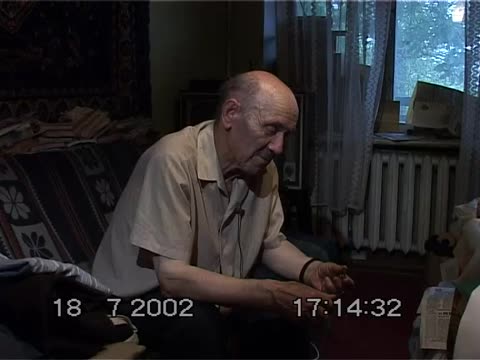
Bershad', Ukraine9 May 1903 (the catalogue's date for this tape is a placeholder)Interviewed by Dov-Ber Kerler, Jeffrey VeidlingerPart 3 of 339 min · 10 passages
Shor speaks about religious life after the collapse of the Soviet Union. He then answers dialectological questions from the AHEYM Yiddish linguistic questionnaire.
Opens with a remark that the first seder in Bershad' after Soviet rule took place in 1991 (?). Kerler then runs through dialectological questionnaire items, asking how words and phrases are said in Yiddish. These include words for hunger and tiredness, forms of address and politeness, kinds of vessels, flour, colours, a deaf person, a healthy person, the verb 'to breathe', and 'from another town'. Answers come mainly from a second voice, with Russian words used as prompts.
The transcript shows a remark about the first seder after Soviet rule at the start, not discussion of religious life after the Soviet collapse.
They talk about the contemporary community in the region, before the team returns with Vygodner to the van and drives to the Bershad synagogue. The camera collects footage of the former Jewish neighborhood.
Brief talk with a community member about the present community and who still speaks Yiddish, including a woman in her seventies. Mostly in Russian, the group drives toward the synagogue, and the guide mentions the synagogue's caretaker, a man from Tomashpil. At the end Kerler is introduced to a woman, Zhenia Sheindl.
The transcript names a caretaker from Tomashpil and the introduction to a woman called Zhenia Sheindl.
Outside the synagogue the guide, speaking Russian, points out broken windows and rubbish, and notes that Kozak has arrived. Kerler asks about Jews who are still connected to the place.
Inside the synagogue the team meets community members and Kerler is introduced. They speak of a Passover supported by Chabad and of a man from Tomashpil. They also talk about the age of the synagogue, a memorial connected with a young man killed in the war (?), the women's section upstairs, and religious books. Much of the speech is garbled and includes a recogniser loop.
The transcript adds a Chabad-supported Passover, a man from Tomashpil, and the women's section.
Vygodner talks about prewar religious life and prayer books. The camera then continues to collect synagogue footage, before Vygodner addresses contemporary religious life.
Vygodner talks about prayer books and holy books from the old synagogues of the town. He then discusses how many Torah scrolls are kosher in Bershad' and nearby, and mentions a visit to Zhytomyr. The surrounding speech is garbled or in Russian.
The transcript shows talk about Torah scrolls and where they are kept, which the catalogue does not mention.
An unidentified community member talks about prewar Jewish life in Tomashpil. He was born 1945 in Tomashpil. They also discuss Yiddish sayings. The camera then continues to collect synagogue footage and they discuss contemporary religious life.
Questions about Tomashpil: a man there, born in 1944 (?), recalls a Jewish community of about three hundred (?), with prayer in a private house and no synagogue. Kerler asks about the idiom of standing like a candle in prayer. Others mention a visit from an Israeli ambassador or secretary, and the passage ends with Simchat Torah in the synagogue in the 1950s.
The transcript shows an idiom about standing in prayer and the Israeli visitor's question.
Vygodner speaks about postwar religious life in Bershad, particularly Simchat Torah in 1958. Kozak then talks about prewar religious life, particularly Yom Kippur.
Vygodner recalls the large Simchat Torah celebration in the synagogue in the late 1950s, carrying the small Torah scroll with his grandfather while people kissed it. Kozak is then asked what she remembers of the synagogue before the war and starts to tell of Yom Kippur and donations of money.
Kozak talks about her life after the war, after returning from evacuation in Central Asia. She recalls how the community wanted to support her family; but states that her mother refused. Kozak then addresses prewar and postwar religious life, particularly the High Holiday celebrations at the Bershad synagogue.
Kozak recalls coming back from evacuation poor and barefoot, and being offered money by the community at Yom Kippur, which her family did not want to take. She describes the women's section and its separate door, fasting before and after the war, and the weekly Sabbath gatherings. Kerler remarks on the synagogue's survival through Soviet times, and Vygodner says it was the tailors' synagogue.
The transcript adds the women's section, fasting, and the tailors' synagogue remark.
Vygodner talks about the history of the synagogue, particularly its restoration and use after the war. It was the tailor's synagogue. He also recalls his grandfather's attending of services.
Vygodner discusses the history of the synagogue: its closure and reopening, the Jewish community in wartime Romanian rule (?), and the Soviet authorities' wish to close it. He recalls his grandfather and the ten men needed for a minyan, and mentions a book on the shtetls of the Khmelnytskyi region which says the building is about two hundred years old.
The transcript adds the Soviet attitude to closure, the minyan and the shtetl book.
The camera collects synagogue footage, while Vygodner gives a tour. They then move the conversation outside. Kozak and Vygodner speak about prewar Jewish life.
Vygodner explains the layout of the synagogue interior, including the central platform, the ark and the old door, mostly in Hebrew terms and Russian. They then speak outside about the old Jewish street, a fire, and the streets of Bershad' where several thousand Jews lived. Family names tied to trades such as weavers, found in the cemetery, are mentioned.