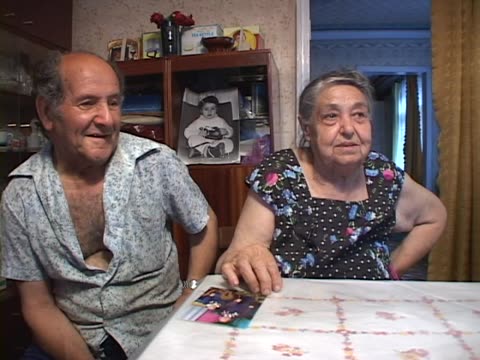
Gvinter continues to share her recipe for strudel. She then talks about Hanukkah celebrations before the war, including food customs. Gvinter also addresses Shavuot baking customs, as well as other dishes.
Gvinter explains how she makes a baked pastry, with details of the dough, the filling and the oven. She then answers Kerler's questions about what was eaten at Hanukkah, including latkes made from potatoes, and about dishes made for Shavuot with cheese and potatoes. The talk then moves to salads, pickled vegetables (sauerkraut) and other food, with S2 and S3 chiming in.
Also covers Shavuot dishes, salads and pickled cabbage, and S2's and S3's comments.
Gvinter addresses Passover dishes and matzo ingredients. She then speaks about other holiday dishes, as well as her contemporary cooking. Gvinter then discusses food terminology.
Gvinter describes Passover dishes made from matzo, with details of the ingredients, and says what was eaten before the Yom Kippur fast. Kerler and others talk over a food offer, and she discusses preparing salad in Bershad' today. Kerler then asks for the Yiddish words for green onions, potatoes and eggplant, and how she cooks eggplant.
Includes food terminology (green onions, potatoes, eggplant) and a Yom Kippur fast meal.
Asked about Jewish holidays after the war, Gvinter says she was always at work, and that her mother was still alive and kept them for her until her death. She says her mother did not sing but wept; the year of her mother's death is given in the transcript. The passage ends as Kerler asks about Jewish weddings after the war.
Gives her mother's death and family details (mother as a young widow with children).
Gvinter speaks about her wedding celebrations in 1955 and 1959. She also speaks about her family in Israel. Gvinter's daughters made aliyah. Gvinter also mentions why she decided not to move to Israel.
Gvinter says she had a large wedding of about three hundred guests and a second one a few years later, and mentions a grandchild's name. She explains why she did not emigrate to Israel: her husband's parents, her own parents and a brother are buried in Bershad'. She also describes her daughters' lives and work in Israel, and a grandson working in a restaurant there.
Gvinter talks about her family, particularly her mother. Gvinter also states that her sibling died of black pox, before she was born. She then answers questions about cultural terminology.
Kerler asks whether her mother taught her folk remedies; Gvinter says her mother was a housewife who did not know such things. She mentions a child of her parents who died of smallpox before she was born. Kerler then asks the meanings of a series of words and phrases (such as a dybbuk, a golem and the Yiddish for a cemetery) and sayings used when speaking of the dead.
Starts with her mother and the child who died of smallpox before turning to the word questions.
Gvinter answers Kerler's dialectological questionnaire: greetings and polite phrases, words for house, window, colors and household objects. It also covers words for adverbs of time and comparison, verbs, and grammatical forms with pronouns and prepositions, with sentences to translate. S2 and S3 sometimes help. Briefly she speaks about an American interview and videocassettes of her daughter's wedding. Kerler also asks about words for Jewish religious and everyday life, such as the cemetery, a convert, a midwife, a shop and the prayer leader.