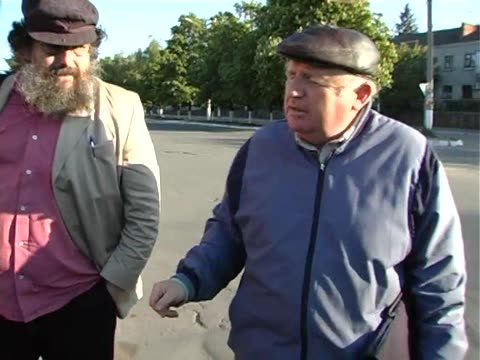
The second man opens by explaining that the synagogues were closed before the war and that after the war only a few were allowed. He recalls that a synagogue building stood on a spot in Bershad', and points out the main street, which became Lenin Street. Sklyarskiy then gives his name and patronymic and says he was orphaned young (his mother died when he was three, his father when he was seven) and brought up by an aunt and uncle in the shtetl Zhornysche, where about two thousand Jews lived. He tells how in 1942 the Jews were driven out by police, he was shot at and wounded, and the family hid in a dugout in a field. His sisters and their children were killed when he went out for food; he then joined the partisans and was wounded again. He describes his father as a carpenter, his sisters, and his schooling: a four-year Yiddish school, then a Russian one. He talks about the shtetl before the war, a rabbi, holidays in the synagogue and the postwar murder of a Jewish man. Kerler asks about the length of the hiding and the number of people in the dugout, and asks him to retell the first shooting and the forced labor under the Germans, including burying dead soldiers.
The catalogue label says only 'Interview'; the transcript shows the street talk on synagogues, then Sklyarskiy's family, school, wartime survival and repeated account.