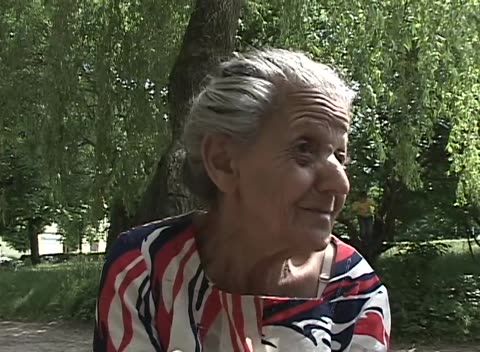
The recording is a formal interview with Polina (Keyle-Shprintse) Ruvinovna Miaskovskaia, born 1930 in Dzegovka. The research team greets Pintsye Miaskovskaia in front of her home and sets up the interview with her. Miaskovskaia, Polina Ruvinovna; Pustilnik, Frida Moiseyevna. Interviewed by Dov-Ber Kerler, Moisei Lemster. 6/8/2007. Ukraine, L'vivs'ka Oblast', Boryslav.
From the machine transcript
Kerler and Lemster greet the woman in front of her home and introduce themselves. She gives her Yiddish name and he gives his, and they sit down and settle in. Kerler then asks where she is from.
The greeting includes talk about names and about whether she dances or sings.
The formal part of the interview begins. Miaskovskaia provides personal information and talks about her family. Her father was born in Kleyn-Czernowitz! and her mother was born in Yampil. She moved to Boryslav in the 1970s. Miaskovskaia, Polina Ruvinovna; Pustilnik, Frida Moiseyevna. Interviewed by Dov-Ber Kerler, Moisei Lemster. 6/8/2007. Ukraine, L'vivs'ka Oblast', Boryslav.
From the machine transcript
The interview proper begins. She says her mother came from Yampil and her father from Chernivtsi (Kleyn-Chernovits?), that she herself was born and lived in Zigivke, and that she has lived in Boryslav for some thirty years. She names her father Ruvn, her mother Khayke and a grandfather David. Kerler and Lemster ask about her birth and about Jewish life in the shtetl.
The catalogue says she moved to Boryslav in the 1970s; the transcript supports about thirty years' residence there, and her birth in the shtetl is clearer than any year.
Miaskovskaia speaks about her life during the war. She was imprisoned in the Dzegovka ghetto. In particular, she recalls assemblies and describes where her family lived. Miaskovskaia, Polina Ruvinovna; Pustilnik, Frida Moiseyevna. Interviewed by Dov-Ber Kerler, Moisei Lemster. 6/8/2007. Ukraine, L'vivs'ka Oblast', Boryslav.
From the machine transcript
She talks about the war years in the shtetl. A gathering of Jews at the market square and where the family lived near the monastery and the market are mentioned, together with the dreadful life there. Lemster steers her back to Jewish life before the war and away from the non-Jews.
The ghetto itself is not clearly stated in the transcript; the passage turns on the street layout and a square.
Miaskovskaia discusses her childhood memories of Dzegovka. She also talks about her family and prewar Jewish life. She attended a Ukrainian school. Miaskovskaia, Polina Ruvinovna; Pustilnik, Frida Moiseyevna. Interviewed by Dov-Ber Kerler, Moisei Lemster. 6/8/2007. Ukraine, L'vivs'ka Oblast', Boryslav.
From the machine transcript
She recalls going with her mother to the shoykhet for a chicken and running away as a child. She describes the long street of the shtetl, says she spoke Yiddish at home with her mother and father, and that she attended a Ukrainian rather than a Yiddish school. She names her parents' birthplaces again as Klein-Chernovits (?) and Yampil.
The shoykhet episode is not in the catalogue entry.
Miaskovskaia talks about life today. She then speaks about Purim celebrations at home. Miaskovskaia, Polina Ruvinovna; Pustilnik, Frida Moiseyevna. Interviewed by Dov-Ber Kerler, Moisei Lemster. 6/8/2007. Ukraine, L'vivs'ka Oblast', Boryslav.
From the machine transcript
She comments on guests who speak Yiddish and on Jewishness shown in the face, and says she speaks Russian, Ukrainian and Yiddish. Asked about Purim, she remembers her mother baking hamentashn and that people sang Yiddish songs and danced in the synagogue; Lemster asks whether a Purim play was performed.
Includes the Purim play question and the song talk.
Miaskovskaia provides personal information and talks about life today. Miaskovskaia, Polina Ruvinovna; Pustilnik, Frida Moiseyevna. Interviewed by Dov-Ber Kerler, Moisei Lemster. 6/8/2007. Ukraine, L'vivs'ka Oblast', Boryslav.
From the machine transcript
Asked for her official name, she says her mother gave her a Yiddish name (Pintse) while her passport name is Polina, and that her patronymic is derived from her father Ruvn. Kerler and Lemster ask for a Yiddish song, and she hesitates.
Adds the request for a song.
Miaskovskaia discusses food customs and shares a meat recipe. She then provides personal information and talks about her family. Her father worked as a tailor in artel. Miaskovskaia, Polina Ruvinovna; Pustilnik, Frida Moiseyevna. Interviewed by Dov-Ber Kerler, Moisei Lemster. 6/8/2007. Ukraine, L'vivs'ka Oblast', Boryslav.
From the machine transcript
She explains a way her family prepared meat before the Sabbath, with washing, onions and a little vinegar. She gives her date of birth as 16 March 1930, and names her parents Ruvn and Khayke and her grandfathers David and Leyzer. She says her father was a tailor working in an artel who later went blind, and her mother also a tailor; she finished seven classes of a Ukrainian school.
Adds the grandparents' names and her schooling.
Miaskovskaia speaks about prewar life in Dzegovka and her life during the war. Miaskovskaia, Polina Ruvinovna; Pustilnik, Frida Moiseyevna. Interviewed by Dov-Ber Kerler, Moisei Lemster. 6/8/2007. Ukraine, L'vivs'ka Oblast', Boryslav.
From the machine transcript
She describes the Jewish street near the monastery and a prayer house in the shtetl after the war, and thanks the interviewers for coming. She says she knows no Jewish story but recalls a song, and speaks about living among non-Jews and about killings of Jews at a place near the shtetl.
The catalogue's 'life during the war' rests on a few garbled lines about killings.
Miaskovskaia answers questions about cultural terminology and addresses folk customs. Miaskovskaia, Polina Ruvinovna; Pustilnik, Frida Moiseyevna. Interviewed by Dov-Ber Kerler, Moisei Lemster. 6/8/2007. Ukraine, L'vivs'ka Oblast', Boryslav.
From the machine transcript
Kerler and Lemster put cultural-terminology questions and she answers some, including words for a golem and a fool and a sentence about a farmer. She gives blessings and wishes for long life, recalls an expression about growing older, and answers questions about spells and folk sayings. She replies that she knows no Yiddish way to say some of them, and mentions a woman who sold dreams.
Miaskovskaia speaks about Hershl Ostropoler and life today. Miaskovskaia, Polina Ruvinovna; Pustilnik, Frida Moiseyevna. Interviewed by Dov-Ber Kerler, Moisei Lemster. 6/8/2007. Ukraine, L'vivs'ka Oblast', Boryslav.
From the machine transcript
Lemster asks about Hershl Ostropoler, and she says he was a merry man who made fun of people, adding that one should not mock anyone. She then speaks of a good Jew and of her shtetl as a Jewish town, and Lemster asks what her father sang.
The catalogue's 'life today' is only loosely supported.
Miaskovskaia talks about her family and shares sayings. She then briefly addresses her life before the war. Miaskovskaia grew up with two brothers and one sister. Miaskovskaia, Polina Ruvinovna; Pustilnik, Frida Moiseyevna. Interviewed by Dov-Ber Kerler, Moisei Lemster. 6/8/2007. Ukraine, L'vivs'ka Oblast', Boryslav.
From the machine transcript
She says her father the tailor sang while sewing, and Kerler and Lemster ask about the words of the song. She says Yiddish was understood by Ukrainian neighbours and tells how her father went blind and worked in an artel. She has two brothers and a sister, and mentions a husband Pavel and a daughter Adelke, and ends by saying she loves Jews.
Adds Pavel and Adelke, and talk about Yiddish among non-Jews.
Miaskovskaia talks about her family and life today. Miaskovskaia, Polina Ruvinovna; Pustilnik, Frida Moiseyevna. Interviewed by Dov-Ber Kerler, Moisei Lemster. 6/8/2007. Ukraine, L'vivs'ka Oblast', Boryslav.
From the machine transcript
She speaks about her marriage and a relative who lived with a non-Jew, and says how glad she is that the interviewers came. Kerler mentions a large cemetery in Łódź, and she repeats that she loves Jews.
Miaskovskaia answers dialectological questions from the AHEYM Yiddish linguistic questionnaire. Miaskovskaia, Polina Ruvinovna; Pustilnik, Frida Moiseyevna. Interviewed by Dov-Ber Kerler, Moisei Lemster. 6/8/2007. Ukraine, L'vivs'ka Oblast', Boryslav.
From the machine transcript
Kerler and Lemster put questions from the dialectological questionnaire, asking for Yiddish equivalents of phrases and words such as greetings, honest person, peasant, to run away, quickly, tall, a well and a spring. She answers and mentions that her mother did not send her to a Yiddish school, so she was never taught to read Yiddish letters.
Miaskovskaia speaks about prewar Jewish life in her hometown. She also talks about her life today and her family. Miaskovskaia, Polina Ruvinovna; Pustilnik, Frida Moiseyevna. Interviewed by Dov-Ber Kerler, Moisei Lemster. 6/8/2007. Ukraine, L'vivs'ka Oblast', Boryslav.
From the machine transcript
She recalls a small prayer house in her street before the war, and says she was a child and knew little of Jewish life. She names her father Ruvn, her mother Khayke and grandfathers David and Leyzer, and talks about a cat. Her companion INF2 speaks Russian and they drink a toast.
Adds the grandparents' names and the cat.