0:00
The camera collects outside footage of Geller's home.
The division was proposed from the catalogue's descriptions and the machine transcript, not stated by the catalogue (how).
The camera collects outside footage of Geller's home.
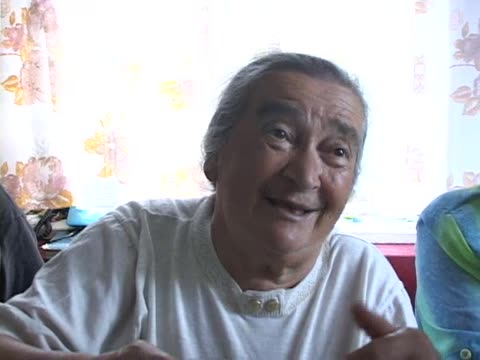
The camera cuts to the Geller's interview. David speaks about his life before the war and describes his circumcision ceremony. He states that his father was excluded from the Party.
David Geller tells about his own circumcision, held when he was eight days old, with his mother and grandmother carrying him to the synagogue. His father, a Communist, was excluded from the Party over it. Kerler comments on his fine Yiddish and asks about his brother.
The catalogue gives no detail on the Party expulsion beyond a short mention; the transcript also shows Kerler asking about the brother's burial or death.
Sofia talks about her brother's circumcision, including food customs for the "Kriyat-Sh'ma" reading (a prayer that must be recited every evening before bed the night before).
Sofia Geller describes the special small cakes baked before the war for the night before a bris, when the children came to a Krishme-leyenen (Kriyat Shema) gathering. Kerler asks how they looked and when they were baked. The passage ends with toasts and a joke about drinking, in which Kerler says he drinks only symbolically.
The transcript also shows toasts and a short exchange about who drinks.
Sofia points out her photograph and the camera records more family photographs. They then chat.
The hosts and Kerler chat over the family photographs, with wishes for good health. They thank the visitors for coming and talk about Jews and about speaking Yiddish.
Sofia and David sing well-known Yiddish songs. Sofia also sings a song in Russian, as well as nigunim (Hasidic tunes).
The Gellers drink toasts and sing together, including a wedding-related song. Kerler explains that he can speak Russian but does not understand it. The passage includes a Russian song and a Yiddish folk song about a peasant and a balalaika, with Kerler's thanks. Singing is mixed with chat.
The transcript shows toasts and chat about languages around the songs; the nigunim named in the catalogue are not clear.
The team travels with David Geller to the next interview with Kupershmidt. The camera collects town footage. They then arrive and greet Kupershmidt in his house and set up the interview with him.
The team goes by car to the next visit. After a short exchange about a deceased wife, Kerler and Kupershmidt greet each other. They recall their earlier meeting in Bratslav and the cemetery, and Kupershmidt asks where they come from. They explain how many travelled and that the car came from Kyiv.
The transcript shows greetings and reminiscence of an earlier visit as well as the drive.
The interview with Kupershmidt begins. He talks about prewar Jewish life in Bratslav, including the synagogue and occupational structure. He also addresses local charity.
Kupershmidt begins the interview by describing prewar Jewish Bratslav, including its prayer houses and the synagogue and the Hasidim there. He lists the trades (smiths, carpenters, shoemakers, tailors, hatmakers), says the Jews were poor and helped each other, and mentions the town's charity. Kerler also asks him about the Yiddish word for the pack frames used for carrying loads.
Kupershmidt's birth year is given, and Kerler asks for a Yiddish term for a carrying tool.
Kupershmidt speaks about his family. He grew up with two brothers and one sister. Kupershmidt's father was a coach man and was born in Bratslav. He then describes his father's work. Kupershmidt's mother was born in a near-by village. He also describes his childhood home, where his parents kept a cow.
Kupershmidt speaks about his parents and siblings: his father Aharon, a Bratslav native with a horse and cart who carried loads to the mill, and his mother, from a village about twelve kilometers away. He says his mother's father, a miller there, and the grandparents were observant. The family later bought a cow, and he tells how the milk was kosher.
The names of the grandfather and parents are given in the transcript, along with the kosher milk.
Kupershmidt speaks about well-off locals in Bratslav, as well as prewar religious life. Kupershmidt remembers the local religious school teacher and Hasidim. He also describes the socio-economic structure in prewar Jewish Bratslav.
Kupershmidt describes the melamed, called rebbe in Bratslav, and recalls a rabbi named Chaim and the Hasidim, perhaps eight, who were poor tinsmiths and shoemakers. He tells of the Sukkot gathering with dancing, of the honesty of the poor, and of his father selling a horse and how the sale was done. He also mentions his mother's home practices.
Kupershmidt talks about holiday celebrations at home before the war. He in particular addresses Sabbath preparations and food customs.
Kupershmidt talks about Sabbath preparations before the war, including how food was kept warm in the oven (the shunt, and pechor), and the poverty alongside honesty. In answer to Kerler he names the Sabbath fish as chopped fish. The passage ends with a comment on the Soviet Union and an exchange about where the team has come from.
The transcript includes the exchange about the team's origins in Moscow, Israel and America.
Kupershmidt talks about his life during World War II. He studied to become a driver until 1940. Kupershmidt explains that he was not able to follow through his evacuation plans and ended up in prison instead. After the German invasion, Kupershmidt continues, he changed his name and spent three and a half months in the Rivne ghetto. Kupershmidt was also imprisoned in the Zhytomyr ghetto beforehand.
Kupershmidt talks about his wartime experiences. He trained as a driver and worked for a Soviet official, and says he was exempted from army service when the war started. He describes his plan to flee with his wife and child, and the false name he took under the Germans. He mentions earlier service in Finland and time in Zhytomyr (?) and Rivne ghetto, though many details are garbled.
The transcript shows Kupershmidt's earlier army service in Finland and a name change, but the catalogue's order of imprisonments is not clear.
Kupershmidt speaks about his return after the war. His wife and child were imprisoned in the Uman ghetto during the war. He also addresses the Bratslav ghetto and its liquidation. Kupershmidt then returns to his life and work during the war. He was a chauffeur for the Germans, frequently driving to Nemyriv, for approximately one year. Kupershmidt speaks about the encounter with a benevolent German, who saved him from mass collection for forced labor in 1941.
Kupershmidt recalls working as a driver for a German in Nemyriv for about a year, and travelling on a pass between the ghettos of Nemyriv and Bratslav to see his wife and child. He found houses emptied and learned that people had been taken to the camp at Pechora. A benevolent German officer helped him, and he explains Russian and German terms for the permit. The passage ends with local families, including Dardik (?).
The transcript includes the pass terminology and a mention of the Pechora camp.
Kupershmidt talks about local families, who perished during the war, before he continues to speak about his work during World War II. He then recalls a German officer who was married to a Jewish woman and and his interactions with him. Kupershmidt also shares an episode when he went to Mohyliv-Podilskyy to make a delivery.
Kupershmidt recalls local families who perished and continues with his driving work for Germans and Romanians. He tells how he wore a Star of David, of a German officer living with a Jewish woman, and of a letter about him that he offers to show. He also recounts a trip to Mohyliv-Podilskyy, where he made a delivery, and the car trouble on the road.
The transcript names the German officer's circle and the road trip, and mentions a letter.
Kupershmidt talks about his family's life during World War II.
Kupershmidt continues the war narrative with his brother in Mohyliv-Podilskyy, where the family lived in the ghetto, and a labor levy of three hundred people for building a bridge. Kerler asks how the brother was called, and about seeing Jews drowned in the Bug.