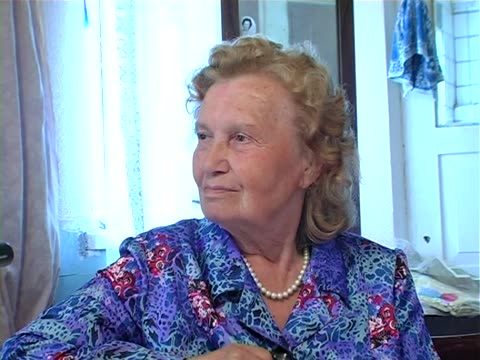
Kelmenson briefly speaks about Bratslav locals and life today. She then addresses her family. Kelmenson has family in Israel. She then speaks about her life after the war, specifically her wedding. Kelmenson states that the local kosher butcher gave the blessing. Kelmenson also explains why her son was not circumcised.
Kelmenson says Yiddish was spoken in Bratslav by locals such as the coppersmith but that few speakers remain. She names her brother, who died young, and her son, a doctor named Mischa, whose daughter lives in Israel. She also discusses her wedding and why the husband, a Party member, avoided a circumcision, and the role of the ritual slaughterer or a similar figure in the ceremony.
names her son and brother and adds that few Yiddish speakers remain
Kelmenson speaks about her father's arrest in 1937. She recalls the moment when her father was taken. He reunited with his family in Bratslav sixteen years later.
Kelmenson recounts her father's arrest, the troika and the interrogation. He refused to sign and later came back after years away. She describes seeing him taken away in a vehicle outside the militia building and not seeing him again for sixteen years. She also describes how her mother raised the children with her grandfather's help.
adds the troika, refusal to sign and the grandfather's help
Kelmenson speaks about her life and work after the war. She also speaks about her family. Kelmenson then talks about her work, as well as the use of the school building as Yiddish school before the war.
Kelmenson explains the education of her children and brother, one a doctor and one in trade economics, and says she worked at a school. Many teachers were Jewish, and former pupils call her. She mentions a Yiddish school in the building before the war and a teacher who taught history.
adds her children's professions and the former Yiddish school teacher
The interviewers ask whether Jews used to visit Bratslav for a sacred site, and Kelmenson says she did not know of visits before. The conversation turns to people they have already met in town, including a coppersmith's grave and an older woman who speaks Yiddish.
Kelmenson names other remaining Bratslav residents who still speak Yiddish, mostly older people, and mentions one man and his family. Lemster and Kerler ask for names and for whether the speakers are older or younger.
Asked about her parents and grandparents, Kelmenson says her mother read and wrote in Yiddish and copied out Yiddish journals. She does not remember songs, and she says both grandfathers came from Proskurov. Her mother was twenty-eight when her father was arrested in 1937 (?), and she brought the children to her own father.
adds the Yiddish journals and the grandfather's help
Kelmenson answers questions about Yiddish entertainment and weddings. She mentions a klezmer musician in Tulchyn and says weddings had Yiddish songs and dancing, though hers was modest. Kerler and Lemster ask about wedding customs and cake.
Kelmenson remembers food customs at home. She then describes Passover celebrations at home before the war. Kelmenson then talks about her family's career and encounters of antisemitism.
Kelmenson recalls her mother's Sabbath food of stuffed fish, soup and challah, and the Passover seder in the attic, where her grandfather asked the questions. She then describes antisemitism in university admission, with her brother and son rejected despite good marks, and says the family worked and lived modestly.
adds antisemitism in admission and her son's and brother's attempts
Kelmenson describes the house divided between her family and her parents, and says her children live in Tulchyn and she has grandchildren. Kerler and Lemster ask how important Yiddish is to being Jewish, and she answers it is a duty of the nation. She also mentions her sons' travel to Israel.
adds her view on whether knowing Yiddish matters for being Jewish
Kelmenson briefly addresses the return of locals from Israel. She then talks about postwar antisemitism in Bratslav. Kelmenson also speaks about her family and co-workers who emigrated.
The talk begins with whether someone returned from Israel, then Kerler asks about antisemitism after the war. Kelmenson says she did not feel it herself or at the school or her husband's institute. Others describe easier admission in Moldova and difficulty elsewhere, and she says she was the only Jew at her school and mentions colleagues who left for America.
adds the comparison with Moldova and colleagues who emigrated
Kelmenson answers questions about cultural terminology. She also speaks about her mother's work as writer, as well as prewar Jewish buildings in Bratslav.
Lemster and Kerler ask Kelmenson about words such as dybbuk, a convert and a golem, and she recognises some. She says her mother read Yiddish but she cannot, and returns to her mother's Yiddish journals. She describes the old gymnasium that held a Yiddish and a Ukrainian school, the synagogue that was gone after the war, and prayers at Passover and shofar blowing in a private house.
adds the terminology questions and the postwar private prayers
Kelmenson talks about her family, particularly her father. She then answers dialectological questions from the AHEYM Yiddish linguistic questionnaire. They then chat.
Kelmenson talks about her father, who was in Vorkuta for sixteen years and questioned God though he was a pious man, and about her grandfathers, one of whom lost his plantation and died in the Crimea. Kerler then asks dialect questions about words such as magazine, bucket, sick, come, pious and honest. Kerler explains his own origins, and they discuss relatives in Israel, Bratslav surnames and a woman who gave a short interview, before thanks.
adds the dialectological questionnaire and the grandfathers' fates
Kerler and Lemster thank Kelmenson and say that the visit was worthwhile. They discuss the pronunciation of the town name Bratslav and how she says father and mother, with Kelmenson commenting on the language she uses.