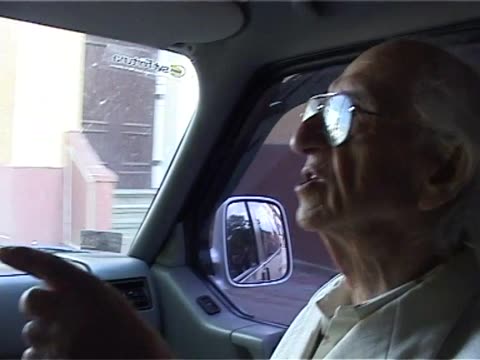
On a drive through Chernivtsi, the guide points out the former Jewish quarter and where the ghetto began. Kerler and the guide discuss which streets were rich or middle-class, a monument to Bukovinian victims of Jewish murder put up by Ukrainian nationalists, and street names such as Russian Street, Shalom Aleichem Street and Karl Marx Street. Kerler also asks about the non-Jewish population, converts and a Yiddish plural form; much of the talk is in Russian directions to the driver.
The transcript also shows a monument to murdered Jews and short questions about plural forms, besides the neighborhood tour.
The team arrives at the hesed building and the guide introduces them to staff members. The talk is garbled, partly in Yiddish and partly in Russian, with remarks about speaking Yiddish with Jews and a place to sit for the discussion.
Transcript is too garbled to show more than the arrival and introductions.
The second part of the tape includes a brief formal discussion about contemporary Jewish life in Chernivtsi with Iosif Burg and the head of the hesed, Isaak Yakovlevich Beznos and his assistant Shaiia Davidovich Kleiman. Shaiia Davidovich Kleiman talks about postwar Jewish life in Chernivtsi. In particular, he mentions the Yiddish writer Moyshe Altman. They then talk about contemporary Jewish life.
Hesed staff speak with Kerler about his Yiddish project of interviewing elderly speakers and about Kerler's background, partly in Russian. They discuss Yiddish in Chernivtsi after the war, including the writer Moyshe Altman, the Soviet-era pressure on him to sign a statement, and the fading of Yiddish. They talk about the hesed's newspaper and Joint support, and about attitudes toward Yiddish, Chabad and Israel, and the project's aim of studying prewar Yiddish speech, not the Holocaust.
Besides postwar Jewish life and Altman, the discussion covers Kerler's project, the hesed newspaper and views on Yiddish, Chabad and Israel.
Concert footage at the hesed. A staff member introduces visiting researchers from Israel and America, including Professor Kerler, who studies Yiddish and the speech of the people. Kerler thanks the audience and says the project is not about studying the Holocaust.
The transcript shows mainly speeches introducing Kerler and his project, not a Sabbath concert.
The fourth part of the tape includes a formal interview with Sara (Henye-Sure) Bishevna Geinik, born 1927 in Chernivtsi. Geinik talks about her family and provides personal information. Her father, a chauffeur and delivery man, was born in Dorohoi, Romania. Her mother, a tailor from home, was born in Chernivtsi. Geinik grew up with two sisters.
Interview begins. Geinik gives her birth year as 1927 in Chernivtsi, where she lived before and during the war. Her father was a Romanian from Dorohoi who worked as a driver and forwarding agent; her mother, Berta (Beyle), was a home seamstress from Chernivtsi. She says there were three children but does not want to discuss her sisters.
Names her mother Berta (Beyle) and says she did not want to name her sisters.
Geinik talks about life during World War II, when her family was imprisoned in the Chernivtsi ghetto in 1941. Her father was drafted into the Red Army shortly beforehand. Her sisters made aliyah in 1958.
Geinik recalls being taken to the Chernivtsi ghetto, where the Germans and local Jews beat people, and that her father went into the army. Her two sisters left for Israel in 1958 and she has lost contact with them.
Geinik discusses childhood memories from prewar Chernivtsi. According to Geinik, life under prewar Romanian rule was prosperous. Geinik attended a Romanian school for seven years. She then talks about holiday celebrations at home and childhood friends. She then talks about her family, before returning to holiday celebrations.
Geinik describes the good life under Romanian rule and the seven classes she attended at a Romanian school. She recalls speaking Yiddish with friends, playing with dolls, her grandparents, her Yiddish name Henye-Sure, and her mother's Sabbath baking and fish. She talks about holidays at home, including Sukkot, Yom Kippur, Hanukkah, Passover and Shavuot, and the dishes made.
Also covers Sabbath and holiday food, her grandparents' names and her Yiddish name.
Geinik answers Kerler's dialectological questionnaire, translating Russian and Ukrainian prompts into Yiddish. Items include body parts, animals and colours, house and building words, adverbs of time, speed and nearness, thousand and twenty, potatoes and onions, food terms, flowers, and sentences to translate. She says she has forgotten much Yiddish, and the sentence translations give her difficulty.