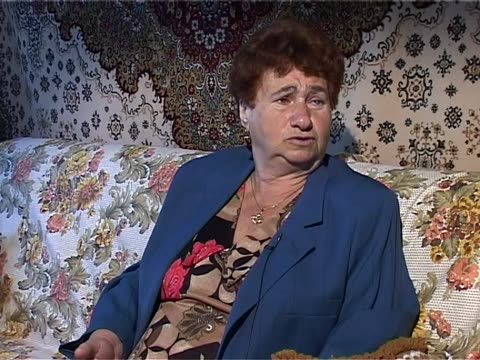
Gimelbrandt talks about her life in the Slidy ghetto in Transnistria during World War II. She describes how the two Romanians, Valentin and Stefan, in charge of the camp where killed by partisans. Gimelbrandt sings a song people composed upon the beginnings of the liberation of the ghetto. Gimelbrandt’s family was liberated by the Red Army in 1944. After the liberation, Gimelbrandt’s recalls anon-Jewish men killing Jewish children, who begged for food. According to her, he killed half of the children who were imprisoned in the ghetto.
Gimelbrandt recalls the end of the Slidy ghetto. Partisans killed two camp overseers, whose names are given as Valentin and Stefan. Children then danced in joy and a song was composed, which she gives in part. After the Red Army came in 1944, survivors were freed and many Chernivtsi people went to Mohyliv. She tells of a non-Jewish man who killed Jewish children who ran out begging for food, and of a monument placed at the camp. Kerler asks whether he was tried.
adds Kerler's question about postwar trial and the monument, and the departure for Mohyliv
Gimelbrandt talks about her family’s life after the liberation. Her mother lived with her children in a barn for ten days. The head of the community brought her mother a certificate to denote Chernivtsi as the family’s place of residence and served as identification; which enabled them to return. Gimelbrandt talks about her life after the war. At the age of thirteen, she was sent to work in a factory. Since Gimelbrandt was visually impaired, she was sent to a color factory in Sadgora and worked there for 42 years.
Gimelbrandt tells how her mother, with small children, waited in a barn after liberation. The village head brought a certificate that let the family go back to Chernivtsi. She recalls a cellar room there and a sister's later request from Israel for a copy of the paper. Half-blind after an eye injury, she could not study and began work at thirteen. She spent 42 years at a dye factory, where she later received a flat and married.
adds the sister in Israel asking for a copy of the certificate
Gimelbrandt talks about her family. She raised three children, a daughter and two sons. Her daughter died of a heart problem at 14. Her husband, a tailor, passed away at 56, three years after her daughter’s death. Gimelbrandt then mentions that her sons were circumcised in secret and that she evaded persecution when her non-Jewish doctor asked her about it.
Gimelbrandt speaks of her husband, a tailor, who died at 56. She first says she had three children, then corrects herself to two sons. Her daughter, who was ill, died at fourteen, and her husband died a few years later. She raised the sons alone and walked to the Sadgora paint factory at night. She tells of having them circumcised, and of a non-Jewish doctor who asked about it.
adds that the Sadgora factory is reached by bus from Chernivtsi and has few Jews
Gimelbrandt talks about life after the collapse of the Soviet Union. Her sister moved to Israel and suggested to Gimelbrandt and her two sons to make aliyah. Her sons, who were raised in Yiddish, made aliyah, but Gimelbrandt only went to visit twice. She talks about the good relations to her non-Jewish neighbors.
Gimelbrandt talks about life after her sons left. Her sister in Israel urged her to come, but she stayed and has visited twice. Her younger son, an officer, lives with his family; the elder has a daughter in the army. She feels lonely at home, says the children telephone, and tells of a Latvian neighbour who advises her to stay. Her sons speak Yiddish on the phone; she mentions Dr Barsiak at the Hesed. Kerler promises another interview.
adds the sons' use of Yiddish on the telephone and the Hesed doctor Barsiak
Kerler asks about the taste of her mother's gefilte fish. Gimelbrandt says she makes it the same way, with a little sugar, and bakes a Sabbath loaf for the Hesed group. She names the dumpling she calls kezelekh against the Bessarabian name (?), and discusses brandy at kidesh and yortsayt. She then recalls her grandmother's remedy for the evil eye and agrees to give the wording.
adds dialect food terms and the Hesed celebrations
Gimelbrandt answers Kerler's questionnaire. He gives words and sentences in Russian and she translates them into Yiddish. Items include terms for a dybbuk and a convert, greetings and politeness, body parts, colours, adjectives, adverbs and numbers. They also cover cholent and kugel types, pronoun and case forms, the midwife, and several short sentences. She compares Chernivtsi usage with the Bessarabians'.
Gimelbrandt recites in Yiddish the charm for removing an evil eye. She also describes the practice that goes with it, in which the speaker wipes the face with a cloth or damp rag. She adds a remedy for warts using the yellow juice of celandine, which grows in the old Jewish cemetery. Kerler listens and thanks her.