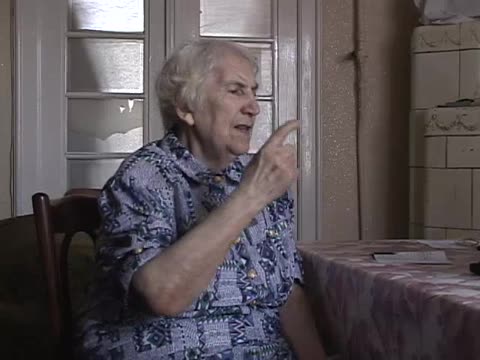
Shternberg provides personal information and discusses childhood memories. She then talks about food customs and life today, before talking about her education. A Yiddish teacher came to her Romanian school twice a week and taught them reading, writing, and singing. Shternberg sings a number of Yiddish songs she learned from her teacher. They include themes about mothers and their children and grandparents.
Shternberg is asked about her Yiddish name and tells a story about being called Reyzele at work. She recalls a visiting Yiddish teacher at her Romanian school, who came twice a week and taught reading, writing and singing, and she mentions letter-writing and cooking today. She sings songs she learned from him: a sick child and his mother, a boy and a captured little bird, and a short grandparents song. She also talks about concerts she took part in.
The transcript shows letter-writing and cooking today, and the grandparents song; the teacher's name is unclear.
Shternberg talks about her education at the Romanian school, in particular her Yiddish teacher. He hosted the students at home and taught Yiddish songs, in addition to the regular lessons twice a week. She then talks about her family and recalls singing at home. Shternberg sings a song in lashon kodesh, she remembers from her father. She recalls a number of holiday songs in Yiddish, in particular Purim shpiels. Another song deals with an unemployed religious teacher (melamed) who tried his luck in America and fell in love.
Shternberg describes the Romanian school, where the Yiddish teacher took pupils to his home for extra lessons. She recalls her grandmother, family singing at Simchat Torah and her father's Rosh Chodesh and Sabbath songs. She also talks about recording cassettes with a composer at the Hesed. She sings Passover songs, a Purim play song and a melamed-in-America song.
The transcript adds the Rosh Chodesh blessing and the recording of cassettes at the Hesed.
Shternberg talks about food customs and prewar cultural life. She mentions the Moldavian cantor Fushman and his singing about “Papirendike kinder” (children made of paper), as well as wedding and love.
Shternberg describes preparing the kitchen and baking for Passover, and is asked about Passover songs. She recalls the visiting cantor and singer Fushman and the songs he sang, including one about paper children and a comic song about marriage. She also sings a wedding-related song and answers Lemster's question about the phrase 'Moshe, kum arayn'. Kerler explains the archive's purpose.
The transcript adds Passover preparations, other songs Fushman sang, and the explanation of the phrase 'Moshe, kum arayn'.
Shternberg talks about a video interview made for a Ukrainian project, in which she sang two camp songs, and mentions Spielberg. She and Kerler look at a newspaper clipping about her late husband, a cantor at the synagogue, and about the Hesed. She then sings a song about childhood years and the house where she was born, and Lemster asks about the camp songs again.
The transcript shows a video interview, a newspaper clipping about her husband, and a song about childhood years.
Shternberg talks about her life in the Kopayhorod ghetto during the war. She then sings the well-known melody from Tumbalalaika with a text Shternberg remembers from her childhood.
Lemster asks where she was during the war, and Shternberg says Kopaihorod, where people were housed in a ruined building. She recalls singing songs there and sings a Tumbalalaika-type song with a text she knew from childhood. She then talks about Sabbath dances.