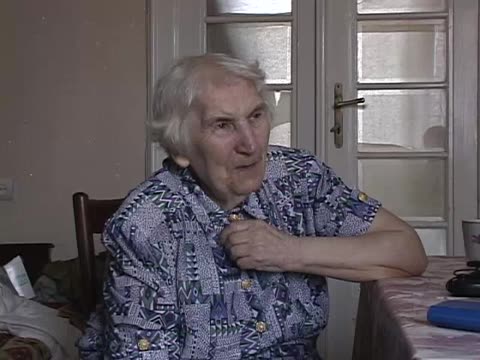
Shternberg talks about her family and her hometown Khotyn, including a non-Jewish tailor who spoke Yiddish. Shternberg then sings a number of Yiddish songs about drinking in the tavern, living a Jewish life, and life in the Kopayhorod ghetto Shternberg wrote herself. The ghetto song deals with a girl who sits next to her dying mother.
Shternberg answers questions about her grandparents and relatives. She says she lived in Khotyn before the war and remembers it as a large Jewish town. She recalls a non-Jewish cobbler who spoke Yiddish. She then sings several songs, among them a drinking song and a song about a Jew in the house of study. She finishes with a song she says she wrote herself about a girl beside her dying mother in the ghetto.
Also covers her grandmothers, relatives and the tavern songs she sings.
Shternberg talks about her life in the Kopayhorod ghetto. She was forced into military barracks next to the railway station. Shternberg then sings another song in Russian she wrote during her imprisonment in the ghetto, before she again sings a different version of Tumbalalaika.
Shternberg recalls the Kopaihorod ghetto. She says the prisoners were driven into former military barracks by the station, where Romanians were present. She describes hunger there and her mother's trading for food. She then sings a Russian song about Jews being despised and thrown alive into pits, and a Yiddish version. She also sings a ghetto song about sitting beside her mother in rags, and a version of Tumbalalaika with riddles.
The passage includes the Russian text and the Tumbalalaika riddle verses.
Shternberg sings a different version of the well-known Yiddish song “Vu bistu geven” (where were you), dealing with the kibbutz. She discusses Yiddish cultural life before the war and recalls how her brother and sister used the local library.
Shternberg sings a parody of "Vu bistu geven" about a kibbutz hakhshara. In it a mother questions her daughter about food and sleeping arrangements. The interviewers explain who they are. She says she read little because of school and preferred dancing and singing. She is asked about a poet named Shternberg, about visiting troupes in Khotyn, about Purim plays, and about the Jewish library, which her mother and siblings used. She also speaks of an old man in Chernivtsi who was shown on television.
Also covers reading habits, visiting theater troupes and Purim plays, and a man seen on television.
Shternberg talks about her family and discusses her father’s work as a merchant. She then talks about the Rabbi of Stefanesti and how her mother went to see him, as well as Sabbath celebrations at home. Shternberg then sings a Sabbath song she remembers from her childhood, as well as reciting sayings and poems. She also discusses folk remedies.
Shternberg says her father was a merchant who took partners and traded goods. She recalls her mother visiting a rabbi to ask for blessings and describes the Sabbath at home: blessing the candles, two loaves, charity money, a non-Jewish woman who heated the stove and the cholent kept warm. She sings a Friday-night song. The talk turns to taking a piece of dough, the God of Abraham prayer, Yiddish writers, Purim players going from house to house, water carriers, and folk remedies against the evil eye.
Also covers Purim players, water carriers, the village well, Yiddish writers and the evil-eye cure.
Shternberg sings a Yiddish song about marriage, before she shows photographs. The camera then records Shternberg singing from a tape about Jewish life of the past and distant lands.
Shternberg sings a comic song about a bride and groom and a dowry, and Kerler identifies it as coming from a Purim play. The interviewers then try to copy her cassette and discuss it, partly in Russian. She is shown photographs and asked to tell more. Talk about visitors from the Czech Republic and a rabbi is followed by a long stretch of garbled speech. A second voice then sings or recites songs about Jewish life of the past, covering the synagogue, Sabbath, girls and a cottage with smoke, as well as songs about a bird and a boy.
Most of the passage is a dispute over copying the cassette, plus a second voice singing.