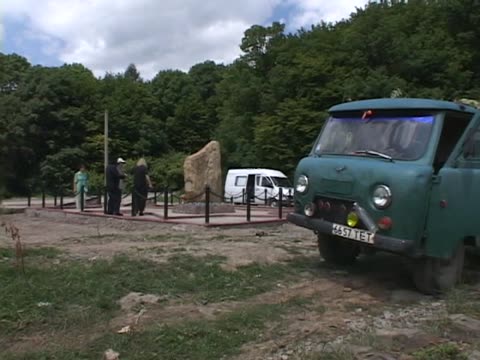
This tape begins with the research team at a Holocaust memorial in Chortkiv, where they say “kaddish,” a Jewish memorial prayer for the dead.
From the machine transcript
The team is at the Holocaust memorial in Chortkiv. After some English-language side talk, Katz and Kerler recite Kaddish, which is only partly legible in the transcript.
Opens with English side talk before the prayer.
Formal interview begins with Asya (Esye) Petrovna Srulova (b. 1928 in Novohrad-Volyns’kyy (Zvil)) (part 1 of 2. See MDV 426). She describes her family life before the war, noting that her parents, a shoemaker named Peysekh (b. 1888) and his wife Feyge, had thirteen children, of which Srulova is one. She also had many maternal relatives who moved from Poland to the Soviet Union during the war between those two countries after the First World War. Listing her many siblings, Srulova states that of the twelve other children in her family, only three others, besides herself, are now alive. They live in Novohrad-Volyns’kyy, in Israel and in the United States.
From the machine transcript
The interview begins with introductions, the date and place, and Srulova's Russian name and address. She was born in Zvil in 1928. Her father Peysekh was a shoemaker and her mother Feyge came from Poland. There were thirteen children, and she lists her siblings and says which are still alive, in Israel, America and Zvil. The family lived on the milk of their cow.
Includes the siblings' names and the maternal grandfather's coming from Poland.
Srulova describes the poverty of her family life before the war, stating that her large family lived in a one room house. During the war, her family was evacuated and those who were not sent to the front worked on a kolkhoz. She then talks about Jewish life in Novohrad-Volyns’kyy. She mentions that in her shtetl before the war there were many non-Jews who spoke Yiddish, including many of her father’s coworkers. Srulova moved to Chortkiv in 1953, at which time there were many Jews in the town, although now most of them have emigrated. Srulova describes a few sites of Jewish interest in the town, including an old, non-operational synagogue, a Tsadik’s (righteous holy man's) grave (which many people have come to visit from abroad) and several mass graves.
From the machine transcript
Srulova describes the family's poverty in a one-room house, evacuation to Tataria, and the older brothers going to the front. She says that many non-Jews in Zvil spoke Yiddish, including her father's colleagues. She came to Chortkiv in 1953 and describes Jewish sites there: the former synagogue, the old cemetery, a tsadik's grave and the mass graves in the forest.
Adds the Yiddish-speaking non-Jews and the sites of Chortkiv.
Srulova speaks briefly about Jewish religious life in Novohrad-Volyns’kyy and Chortkiv. She also talks about the poverty she experienced in her childhood and during the war. Srulova details her contemporary family situation. She was widowed about twenty years ago and has two daughters. Srulova completed six grades in a Soviet Yiddish school before the war, and then attended Russian schools thereafter. She briefly describes what she remembers of the Yiddish school curriculum and recites some poetry in Russian and Yiddish.
From the machine transcript
Srulova talks about religious life in Zvil after the war and about hardship in childhood and wartime. She was widowed and has two daughters, and worked many years in a mill laboratory. She attended a Yiddish school for six grades before the war, then Russian schools; she describes the subjects and recites Russian poetry. Kerler prompts her for Yiddish verse.
The Russian poem and Yiddish school curriculum are described, as in the catalogue.
Srulova describes how Passover was strictly observed in her childhood, detailing the process by which her mother made the house and dishes kosher with boiling water and hot stones. She also discusses food and customs associated with other holidays, such as Yom Kippur, Chanukah and Purim, and shares a recipe for "gefilte fish".
From the machine transcript
Srulova describes Passover at home: her mother koshered the dishes with hot water and stones. She mentions beating kapores before Yom Kippur, Purim noisemakers, the dreidel and Hanukkah foods such as latkes and doughnuts. She also gives her way of making gefilte fish and recalls asking the four questions at the seder.
Adds Purim noisemakers and the four questions at the seder.
In her youth, Srulova’s family would make dairy products with the milk from their cow Mashka. While her brothers did not receive any formal religious schooling before the war, Srulova does recall that they went to the synagogue in the postwar period to say “kaddish” for their parents. Srulova comments on the place of anti-Semitism (or lack thereof) in the Soviet Union and briefly explains some of the politics surrounding the recent building of the Holocaust memorial in Chortkiv.
From the machine transcript
Srulova describes the dairy products made from the cow's milk. She says her brothers did not attend cheder, but that they went to the synagogue to say Kaddish for their parents. She says there was no antisemitism or religious restriction at school or work, and that she was a Pioneer. Kerler and Katz question her about the delayed memorial in Chortkiv, which she says was funded from abroad.
Adds the exchange on why the memorial was so late.
Srulova describes how shabes (the Sabbath) was celebrated in her childhood home, demonstrating how her mother would light candles and say a blessing. The interviewee also notes how her daughter lights shabes candles today. Srulova briefly describes prewar Yiddish culture in her hometown, mentioning visiting theater troupes and Communist Yiddish newspapers. She also talks about religious Jews in the town, remembering a rabbi who lived in Novohrad-Volyns’kyy both before and after the war. Srulova also briefly describes the prewar Jewish weddings she recalls, and how they were celebrated with fiddle music and a “khipe,” or canopy. According to Srulova, there was also a Yiddish library in Novohrad-Volyns’kyy before the war.
From the machine transcript
Srulova describes her mother lighting Sabbath candles, and that her daughters do so today. Katz asks about prewar Jewish culture in Zvil: visiting Yiddish theatre troupes, Yiddish and Soviet newspapers, a Yiddish library and school. She recalls the rabbi who stayed through the war, the Jewish street, and weddings with a canopy, breaking of a glass and a fiddle.
Adds the Jewish street, the Yiddish library and non-Jews speaking Yiddish.
Srulova answers questions from the team’s dialectological and sociolinguistic survey. Cities and towns mentioned on this tape: Chortkiv, Novohrad-Volyns’kyy (Zvil), Kiev
From the machine transcript
Srulova answers dialectological and sociolinguistic questions. Items include the words dibek, golem, graveyard, funeral, greetings and thanks, expressions for a cat chasing a mouse, bird names (pigeon), skin, and the cross. She often says she has forgotten Yiddish words and notes that nobody of her generation in Chortkiv speaks Yiddish.