Recordings › Chortkiv, Kolomyya

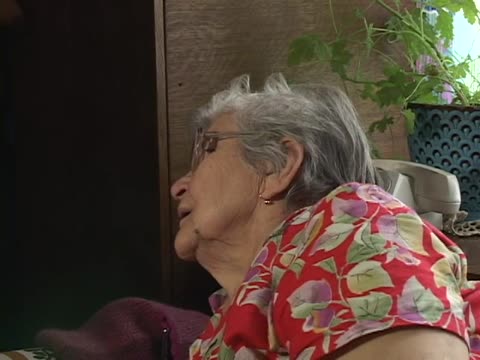
MDV 426 · Asya (Esye) Petrovna Srulova

Chortkiv, Kolomyya, Ukraine 1 July 2005 Interviewed by Dov-Ber Kerler, Dovid Katz, Jeffrey Veidlinger Part 2 of 2 62 min · 5 passages

One conversation with Asya (Esye) Petrovna Srulova, continuing over MDV 425, MDV 426.

This tape is not yet on the project's channels.
Watch it on Media Collections Online — the time links below open the player there at the right moment.
Passages

0:00

This tape is a continuation of a formal interview with Asya (Esye) Petrovna Srulova (b. 1928 in Novohrad-Volyns’kyy (Zvil)) (part 2 of 2. See MDV 425). She answers questions from the research team’s dialectological and sociolinguistic survey, briefly discussing traditional Jewish foodways from her youth.

Questionnaire Yiddish language and dialectFood · MCO
From the machine transcript

Srulova answers the interviewers' dialectological questionnaire, giving how she says words and phrases in the Yiddish of Zvil. Items include words for window panes, the colour of the sky, building a house, kissing, cold, fast, near, living, ill and weak, running away from the Germans, an honest or pious person, and the second-person form 'you are right'. They continue with the bed, well, potato, shop, vodka, 'back', cross, Zvil's non-Jewish name, midwife, 'what does he want', attic, wagon, a rich man, and sudden and many guests. In between she talks about food: Passover potato puddings, the Sabbath cholent and braided challah, and the family's poverty. She also recalls a taxin (?) in Zvil where relatives in America sent dollars, and Kerler explains the purpose of the archive.

The passage also contains talk about Passover and Sabbath food, the local shops, and the interviewers' account of the archive's purpose.

43:26

At the request of the interviewers, Srulova gives a brief summary of those autobiographical details she finds most relevant, including the poverty she experienced her whole life, before, during and after the war. She also describes some of the games she would play as a child and talks about her contemporary economic and family situation.

before the warduring the warafter the warlife today Personal informationPoverty and economic conditionsChildhoodLife todayFamily history · MCO
From the machine transcript

Asked by Kerler to tell something of the war and postwar years, Srulova says her older brothers were killed in the war. The family returned to no home, and her father worked as a shoemaker. Older sisters married and took her to live with them. She describes the children's games with a bench and a doll made from her father's shirt. She says her father's brothers in America stopped writing after the war, and that relatives' dollars were exchanged for flour and sugar in the shop. She mentions that the poverty continued and that her daughter and grandchildren abroad bought a refrigerator and a washing machine. The passage ends with mutual thanks.

The passage also covers her relatives in America and how dollars were exchanged, as well as the closing exchange of thanks.

48:10

The camera cuts to scenes of the town of Chortkiv. The team visits the grave of Rebbe Dovid Moyshe of Chortkiv as well as an old synagogue in the town.

Footage · MCO
From the machine transcript

Camera cutaway of Chortkiv, with the team at the grave of the Chortkiv rebbe and an old synagogue; the speech is mostly garbled or inaudible. Only fragments about the rebbe, a gravestone and a Russian remark are legible, so what was said cannot be described.

The transcript supports only the Chortkiv rebbe and gravestone references; the rest is unclear.

57:21

The camera cuts to the research team in Kolomyya searching for David Abramovich Vider, a previous AHEYM interviewee.

Footage · MCO
From the machine transcript

The team in Kolomyya, driving or walking while looking for Vider's home. The transcript is almost entirely garbled, with a brief Russian remark about filming a house.

The transcript shows only a few garbled words and a Russian remark about filming.

58:39

The team finally meets with Vider, and after a brief moment in his apartment, Vider leads the team to the local synagogue. Once there, he describes contemporary community celebrations and begins to relate the story of a “pirim-shpil” (Purim play) in which he participated as a child. Cities and towns mentioned on this tape: Chortkiv, Novohrad-Volyns’kyy (Zvil).

From the machine transcript

Kerler greets a man in Russian and Yiddish, reminding him of the team's visit two years before, and the team enters his apartment. The man says four of his brothers have died. There is a short exchange about a new kitchen in the synagogue and where kiddush is made. The transcript does not show the Purim-play story the catalogue mentions.

The transcript shows a conversation about the man's brothers and the synagogue kitchen, not the Purim-play story.