Recordings › Drohobych

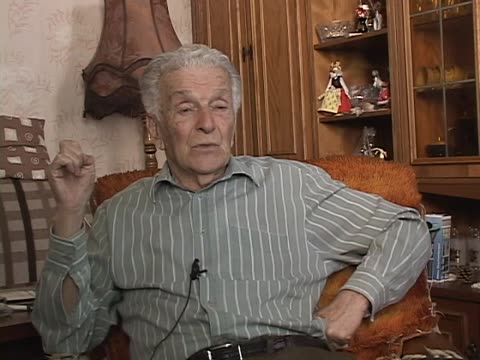
MDV 433 · Alfred Benovich Schreier

Drohobych, Ukraine 8 June 2007 Interviewed by Dov-Ber Kerler, Moisei Lemster Part 2 of 3 62 min · 8 passages

One conversation with Alfred Benovich Schreier, continuing over MDV 432, MDV 433.

This tape is not yet on the project's channels.
Watch it on Media Collections Online — the time links below open the player there at the right moment.
Passages

0:00

Schreier talks about his life after the war, when he went through several DP camps. Because of Schreier’s insistence, he became the assistant of the department store director and primarily worked as a translator until the end of 1945, when an order came in that all former prisoners had to return to the Soviet Union. Schreier never formally studied the German language at school. Schreier continues that he then went to Dresden with an officer friend from the Soviet Army. He stopped at Hellerau first and then moved further to Dresden Klotzsche. Schreier worked as a translator at the Soviet Trade Administration until fall 1946. Vasily Sokolovsky issued a decree of return. The former camp inmates were taken to the central Soviet military base in Teltow. A German driver took Schreier to the Red Cross in Berlin, where he reported on his relatives in Argentina. According to Schreier, the living conditions were so horrible there, so that he returned to Teltow instead of trying to figure out his relatives’ address, requiring Schreier to stay for a minimum of two months. Schreier then travelled to Grodno, Byelorussia, for seven days, where he stayed at former prisoner camp. Schreier, a professional musician, played at restaurants in exchange for food. Schreier explains that he had to stay in Grodno until all Soviet soldiers born 1922 were released from the army. Schreier received a notification early 1946 permitted to leave. He traveled to Vilnius, Lithuania, joining a fellow musician from Drohobych. They returned to Drohobych together.

From the machine transcript

Schreier recalls the end of the war and the years after it. He worked as a German–Russian interpreter without ever having studied German formally, was in Freiberg until the end of 1945, then went to Dresden (Hellerau, Klotzsche) as interpreter for the Soviet trade administration. He describes being gathered at Teltow near Berlin, the Red Cross in Berlin where he asked about an aunt and uncle in Argentina, and a camp in Grodno where he played in a small orchestra, until he returned to Drohobych via Vilnius with a fellow musician.

Gives the Freiberg and Dresden details, and says that his relatives in Argentina were the reason for the Red Cross visit.

7:10

Schreier talks about his life after his return to Drohobych. He found work in a dance orchestra right away, before he studied at the local music institute and then at the Lviv Conservatory. Schreier got married in 1949. Schreier finished his studies he began at the Lviv Conservatory at the music department of the Pedagogical Institute in Drohobych. Schreier continued playing in a dance orchestra and taught at the musical institute for forty-two years. Schreier then talks about his family. He was the only survivor of his family. He also recalls his uncle Rabbi Dr. Bernard Schreier who taught religious studies at the Polish Jewish school.

From the machine transcript

Schreier tells of his return to Drohobych, where he quickly found work in a large dance orchestra and played for the cinema. He studied at the music lyceum and the Lviv conservatory, finished at the music department of the pedagogical institute and taught at the music lyceum for 42 years. He says he is the sole survivor of his family and had no siblings. He mentions his father's sister, wife of Rabbi Dr. Bernard Schreier, who taught Jewish religion at the Polish gymnasium. His marriage and his wife's death are mentioned but the year is unclear.

Adds the uncle's relation by his aunt Matilda (?) and Kerler's questions about aunts and uncles.

10:22

Schreier talks about prewar Drohobych and its population structure. He recalls the positive relations among the different ethnic groups. He then talks about the religious education at the Polish school. Schreier recalls how religious instructors from different confessions came in to teach Jewish, Ukrainian, and Polish students. Schreier was taught by his uncle.

From the machine transcript

Schreier describes prewar Drohobych, with about 42,000 inhabitants, now about double, and its mix of Poles, Jews and Ukrainians. He mentions the oil industry, the many Jewish professionals and mild antisemitism such as boycott slogans. In the gymnasium the groups sat together and nobody asked who was what. For religion lessons each group had its own teacher, including his uncle Dr. Bernard Schreier for the Jews; he blames Hitlerism and Stalinism for later hostility.

Adds the antisemitism remarks and the postwar blame on totalitarian systems.

14:49

Schreier talks about contemporary life in Drohobych, as well as Jewish life. He then talks about the Choral (Great) Synagogue in Drohobych, which was built in 1865 and was the largest synagogue in prewar Poland. Schreier then talks about life and work during the Soviet period.

From the machine transcript

Schreier speaks about Drohobych today, with few Poles and about 180–190 Jews, and about the Great (Choral) Synagogue, which is being repaired but has no minyan. He gives its date as 1865 and says it was the largest in Poland; it stands on Leon Reich Street. He recalls tolerant Austro-Hungarian times and the Polish period from 1918. He also describes the Soviet influx of village people into the city to work in new factories, and the resulting change in its character.

Adds the Austro-Hungarian tolerance and the Soviet-era migration from villages.

19:29

Schreier talks about Jewish life before the war. He then talks about the languages he spoke at home, including Polish and Hebrew for Schreier’s bar mitzvah. Schreier’s father grew up in Yiddish and his mother in Polish. He studied with his uncle for his bar mitzvah, who told him to recite part of his parsha in Polish. Schreier then talks about the poor Jewish neighborhood of Drohobych. He recalls how he visited this neighborhood with his teacher Bruno Schulz, who drew sketches of the buildings there. Schulz worked at Schreier’s school since 1924 without an official teacher’s permit. Only after Schulz passed his exams in 1936 at Cracow University, he received an official permit. Schreier continues to talk about Schulz, who studied drawing and carpentry, including his life during the war and legacy.

From the machine transcript

Schreier talks about Jewish streets and houses and the languages of his home, where Polish was spoken, his father knew Yiddish well and his mother did not; he describes his bar mitzvah in his uncle's small synagogue. He then speaks at length about Bruno Schulz: his walks in the poor Jewish quarter, his teaching of drawing and carpentry without a formal permit until 1936, his family, translations of his work and Schulz festivals in Drohobych. He then describes the German occupation, the 'Black Thursday' shooting, the Gestapo officers Landau and Günther, and Schulz's murder.

Adds the home languages, the bar mitzvah, Schulz's translators and the account of the murder by a Gestapo officer.

44:07

Schreier then discusses Jewish cultural life before the war. Schreier then shows a poster, advertising a film about Bruno Schulz. His paintings were hidden during the war. Schreier shows photographs of the synagogues.

From the machine transcript

Schreier speaks about being asked to sing for a visiting group and answers Kerler's questions on Yiddish songs and newspapers in prewar Drohobych; he sings only a Yiddish song about a Kraków carpenter. He describes Schulz's murals in the villa of the Gestapo officer Landau, found by chance in a dining room, and shows photographs of them and of the Great Synagogue and other buildings. He talks about plans for a Schulz museum and a book on synagogues, and the wooden churches of the town. Kerler explains that he is a professor of Yiddish at Indiana University.

Adds the Yiddish song and newspaper questions and the finding of the Landau-house murals.

54:41

Schreier talks about his work as a musician. He plays the violin, sings, and studied conducting. He then talks about Jewish life under German occupation, in particular he addresses how the chairman of the Judenrat (Jewish Council) Dr. Izak Rozenblat successfully set up a soup kitchen for children in the Choral Synagogue. Schreier continues to tell the story, when the police barged in on the first meal organized by the soup kitchen and shot all the children.

From the machine transcript

Answering Kerler's question about his music, Schreier says he plays violin, sings and holds a conducting diploma for choir and orchestra. He then tells of the Judenrat chairman, Dr. Isaac Rosenblat, who after the August 1942 deportation of 5,000 Jews asked the Gestapo to allow a soup kitchen for the remaining small children in the synagogue. The Gestapo agreed after two days, and when the children first sat at the tables, police burst in and shot them all.

Adds the August 1942 deportation as background.

58:18

Schreier plays a Yiddish song, he sings about a Yiddishe Mame.

Singing Songs and music · MCO
From the machine transcript

Schreier talks about a recorded disc and says that more will be redone, and offers Kerler a Yiddish song. A recording or performance of a song about a mother and the golden land is then heard, mainly voiced by Lemster. Afterwards Schreier says he plays and sings it with accompanists, and that the recording is not finished.

Names Lemster as the voice heard in the song and notes that the disc is not finished.