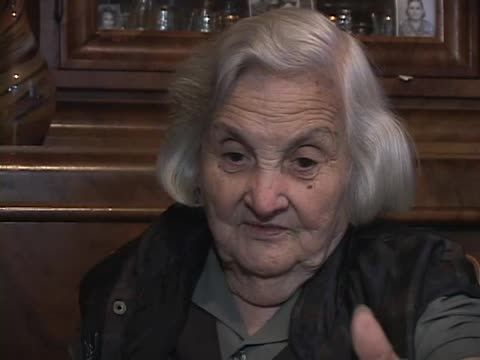
The first part of the tape is a continuation of a formal interview with Evgeniia Izrailovna Shekhovich. Shekhovich talks about religious customs and holiday celebration. She then sings a Yiddish Sabbath song. Shekhovich then talks about daughter, before she sings a couple of Yiddish song she learned from her husband. The first song includes a little girl and the second one deals with poverty and dreaming.
From the machine transcript
Lemster asks Shekhovich about holiday and Sabbath customs. She recalls Sabbath songs (zemires), Hanukkah, Purim and fasting only vaguely, and talks about Sambor. She sings a Yiddish Sabbath-eve song about a grandfather and grandmother telling a tale to children. Her daughter speaks in Russian about her schooling and about her father, and Shekhovich says she learned the next Hebrew-themed song and the song about dreaming and poverty from her husband. Lemster repeatedly asks where she heard the songs.
Adds Lemster's questions about Jewish converts in Sambor and about Hanukkah and Purim customs.
Shekhovich talks about the fate of her family during the war in Sambor. She was the only one from her immediate family who survived. Shekhovich recalls folk remedies.
From the machine transcript
Shekhovich says her father, mother, brothers and sister were taken from Sambor to Radłowice (?) and she was the only one of her family left. Lemster asks about her husband and their life together. He then asks about folk beliefs and remedies: the evil eye, charms, and putting out coals or bread crumbs. She says she cannot recall much, learned some from her mother, and knows new songs better than old ones.
Adds Lemster's questions about rebbes' tales and her husband's songs.
Shekhovich describes in Polish the Polish-language environment she lived in before the war.
From the machine transcript
Shekhovich and her companions, mostly in Polish, talk about growing up in a Polish-language environment. She went to a Polish school and kindergarten, spoke Polish in the street, and understands Polish better than Yiddish. The Polish language is dear to her, and she says that Yiddish was little spoken with children at home. Asked for Polish or Yiddish songs, poems or the Polish anthem, she cannot recall them, and says she lived through terrible things in the war.
The second part of the tape is a formal interview, recorded in Yiddish and German, with Alfred Benovich Schreier, born 1922 in Drohobych. Schreier provides personal informal and talks about his family. His parents were born in Drohobych and raised him as an only child. His father was a chemist and studied in Germany. He received his doctorate in Zurich, Switzerland. Schreier grew up in Jaslo, Poland until the age of ten. His father worked as the chief chemist at an oil refinery there. Schreier explains that his father lost his work during the Great Depression. His family moved to Drohobych in 1932. His mother was a pharmacist.
From the machine transcript
Kerler opens the interview with Schreier, giving the date and place. Schreier was born in Drohobych in 1922 and says he is the last Jew born there before the war. His father, a chemist, studied in Germany and took his doctorate in Switzerland. The family lived for ten years in Jasło, where his father was chief chemist at an oil refinery. He lost the job in the Depression and the family returned to Drohobych in 1932. His mother, Leontina, was a pharmacist's daughter. The passage ends with the great action of 1942.
Adds that the passage ends with the 1942 action.
Schreier talks about his family’s life during the war. He talks about the largest action in 1942, when 5000 Jews from Drohobych were deported. The majority was exterminated in the Belzec concentration camp and less than half were shot in the Janowska concentration and forced labor camp, according to Schreier. He lost his uncle, father, grandmother, and cousin, who were deported to Belzec. Schreier continues that his mother was saved from the mass deportation, but then shot in a mass execution in the Broniza Woods. Schreier explains that there were five forced labor camps in Drohobych. He was imprisoned in the forced labor camp in the village of Herafka. There Schreier worked as a carpenter in a lumber mill. Schreier maintains that he survived with the skills taught by his teacher Bruno Schulz. He briefly talks about the Polish-Jewish writer. He taught Schreier for four years at the Polish school. His mother was imprisoned in another forced labor camp and worked at the municipal factory. Schreier talks about the mass liquidation and shooting of prisoners of three forced labor camps. He explains that he and five other young Jews were taken away from the assembly point, from where Jews were forced to the Broniza Woods. They went to another forced labor camp, where Schreier worked at ceramics factory for one and a half months. He describes the selection by SS officers after the liquidation the forced labor camp. Schreier was sent to the last existing forced labor camp at the Drohobych town center, where he worked at an oil refinery. He explains that on April, 13, 1944 his camp and another one in Boryslav were liquidated and the prisoners were forced to go to the Plaszow Concentration Camp in Poland. Schreier was imprisoned there for six months, before being sent on a march westward as soon as the Red Army front drew closer. Schreier was sent to the Gross-Rosen concentration camp in Poland and was then selected to work further west by a German factory director. He explains that the building of the forced labor camp Schreier was supposed to go to was not yet finished and was therefore sent to Buchenwald concentration camp. In Buchenwald Schreier stayed at Barrack 59 for a short time undergoing another selection. He was then sent to the Taucha forced labor camp to work at a bazooka factory. He worked there until April 1945, before being sent on a death march. According to Schreier, the death march was organized because the Germans could not provide any food for the prisoners, as the nearby town Halle was already captured by the American army. Schreier talks about the death march with two thousand other prisoners, including Jews, Italians, and Poles. Schreier could not continue to walk after five days. Schreier recalls how he sang in the evenings, which ultimately saved him from execution when he was too exhausted to continue walking. A German prisoner helped Schreier by claiming that he was a well-known opera singer. Instead of killing Schreier, the SS officer pushed him into the trench, where he was found by a young German, who brought Schreier into a nearby village on his bicycle.
From the machine transcript
Schreier tells how in 1942 his father, uncle, grandmother and cousin were deported to Belzec, and his mother was later shot in the Bronica forest. He describes five forced-labor camps in Drohobych, working as a carpenter at a sawmill near Herafka (?), and his teacher Bruno Schulz. He was moved through several camps, then the oil refinery, and in 1944 was sent to Plaszów, Gross-Rosen, Buchenwald (Barrack 59) and Taucha, where he worked in a panzerfaust factory. He describes the April 1945 death march with Poles, Italians and Germans. At about the fifth day, too weak to walk, he was saved from being shot because a German prisoner described him as an opera singer, and a young German found him.
Adds the camps after Herafka, Plaszów, Gross-Rosen, Buchenwald and Taucha.
Schreier describes his life after the war, after he was found by a young German and taken to a nearby village, to a courtyard where the mayor lived. Schreier was then taken to a Soviet prison camp, along with other fellow Jews. He describes his life at the camp and recalls how well he slept. Upon leaving, the Soviet soldiers wanted to take Schreier with them, but had not enough strength to stay on a horse. The local farmer took Schreier to a DP camp in the town of Dobeln, which had already surrendered. Schreier stayed in the overcrowded camp for two days and had to leave. He and other displaced persons, mainly Italians, walked to Rosswein. Schreier explains that the SS officer turned them away because the Rosswein camp was already closed down and therefore no food was available. Schreier recalls how a German woman slipped him some bread. Schreier walked another 35 kilometers to the former Freiberg concentration camp. He stayed there for three days and was liberated by the Soviets on May 7, 1945. Schreier went to the town center to find work at a department store, which was opened up for Soviet officers.
From the machine transcript
Schreier tells what happened after he was found on the road. He was taken to a Soviet prisoner-of-war camp, where he slept well, and then to a town camp filled with displaced persons. He went on with the Italians toward Roßwein, where a German woman gave him bread, and then to Freiberg in Saxony, where he stayed in a former camp for a few days. He was liberated there by the Soviets around 7–8 May 1945. A French and a German doctor tried to help him. Afterwards he looked for work at the department store opened for Soviet officers.
Adds Roßwein, the German woman with bread and the French doctor.