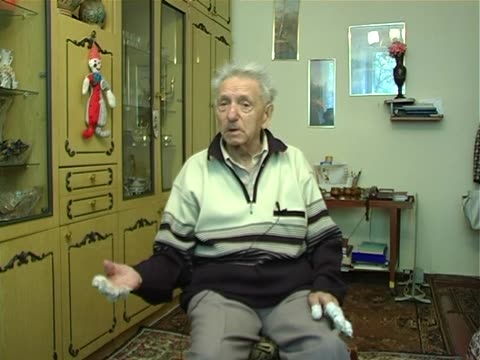
Greetings and set-up in Shekhter's apartment. A woman speaks Russian about phoning someone, and Lemster and Kerler joke about age and ask how many Jews remain in town. Kerler announces the date, the place (Fastiv) and the interviewee's name and patronymic.
Shekhter discusses his childhood memories and talks about his family. Shekhter grew with two brothers and one sister. He left his parents’ home at the age of 14 to earn his own money and worked in a factory in Ivano Frankivsk. Shekhter talks about how his was drafted for his military service two days before the outbreak of World War II. Shekhter served in the labor battalion until 1943. After his military service, Shekther worked in an artel (cooperative of workmen and peasants) in the Urals, in the city of Shverovsk* [00:03:51]. Shekhter also lived in Leningrad during the war, before he moved to the town of Zolotonosha in 1971, where he lived for twenty-five years, working in an artel.
Shekhter says he left his parents' home at 14 to earn his living and that the family was poor, with three brothers and two sisters (as the transcript has it). He worked in a factory in Ivano-Frankivsk and was taken into a labor battalion at the start of the war, where he stayed until 1943. After release he worked in an artel in the Urals, and he mentions Leningrad and a long stay in Zolotonosha.
The family size and Kerler's question about the siblings' names (unanswered here) are in the transcript.
Shekhter talks about his life after the war and his family. After his first non-Jewish wife passed away in 1969, Shekhter married a Jewish woman. His father was a cobbler.
Shekhter describes his postwar life: his first wife, a Russian, died in the 1990s, after which he looked for a Jewish wife and moved to be with her. He then answers Kerler's questions about his family. His father was a cobbler, his mother Manya did not work, and he names his brothers and sister and their birth order.
Gives the names of his mother and siblings and the paternal family name (unclear).
Shekhter talks about his life before the war. He addresses his bar mitzvah and his education at a religious school (cheder) and Polish school. He then talks about prewar Jewish life and lists different local synagogues, including cobbler, tailor, and the Great Synagogue. Shekhter also recalls non-Jews speaking Yiddish.
Answers questions about his bar mitzvah, his cheder and a Polish school in Nadvirna, which languages were used, and whether he learned to write Yiddish. He says there were no Hasidim but a rabbi and several synagogues, including a big one and a tailors' one, and that he went with his father on Sabbath. He recalls non-Jews in Nadvirna who spoke Yiddish better than he did, learned from Jews at the market.
Also covers the Polish school, language of instruction, and Yiddish-speaking non-Jews.
Talks about Sabbath and holidays at home in Nadvirna, with food such as meat and a Sabbath dish baked in the oven; his mother made the fish. He says he could pray a little and was not a reader of Yiddish books. Asked about Purim, he recalls his father teaching the children songs, which they sang for the wealthy who gave them money.
Also covers his reading of Yiddish, prayer and football as a boy.
Shekhter talks about his work. He worked at a factory and then as a cobbler with skills he learned from his father. His father, a shammes, and brother were also cobblers. Shekhter also discusses childhood memories and holiday celebrations, including Purim and Passover.
Shekhter says he worked in a factory and then trained himself as a cobbler; his father and brother were also cobblers. Asked whether his father sang cobbler's songs, he recalls a rhyme about challah and bakers, and mentions a chimney-sweep figure at Purim. He says his father led the Passover seder, but he remembers little of the four questions, and that the children collected gifts from the wealthy at Purim.
Adds the father's song, the chimney-sweep at Purim and the seder.
Shekhter explains that he was drafted before the war and so was separated from his parents; his father was a synagogue shammes. He never saw his parents or siblings again, and he is the only survivor of his family, with no children from either marriage. Kerler asks about Yiddish speakers in Fastiv; a woman present mentions a few people, including a man who speaks a little Yiddish.
Shekther talks about Jewish life after the war, when he lived in Zolotonosha from 1971 to 1998. Before he moved to Zolotonosha, Shekhter lived in Artyomovsk (Russia).
Shekhter says he lived in Zolotonosha from 1971 to 1998. About ten Jews gathered there on Sabbath, some of them knew Yiddish, and they prayed in Yiddish. Before that he lived in a place that sounds like Artyomovsk; Kerler asks about his earlier residences.
Shekhter discusses his childhood memories and remembers an itinerant Yiddish theater troupe in his hometown. He then briefly addresses contemporary antisemitism, before he answers questions about cultural terminology and recalls sports clubs.
Asked about early memories of Nadvirna, Shekhter recalls a Jewish town with a river (the Bystritsa), girls and games by the water. He answers Lemster's questions about Yiddish writers (Sholem Aleichem a little, Hersh Polianker not at all) and recalls an amateur Yiddish theater and a club. He briefly says he fears traveling there now because of antisemitism, answers questions on terms (dybbuk, golem) and Purim songs, and recalls a sports club and football. At the end a woman and Lemster discuss in Russian and Yiddish who in town still speaks Yiddish.
Adds Yiddish writers, the club, terms such as dybbuk and golem, and a discussion of local Yiddish speakers.
Shekhter talks about his life during the war, when he served in a labor battalion of the Red Army. Shekhter worked as a cobbler in the military. He was drafted in Ivano Frankivsk, then moved through and lived in a number of places, including Kyiv, Omsk, Sverdlovsk, Svorovski* (1943 – 1947), and Leningrad.
Shekhter describes the war years in a labor battalion: he was taken in Ivano-Frankivsk and moved on foot toward Kyiv under German bombing. He was later in Omsk with a Polish army unit and in Sverdlovsk, where he fell ill, and then worked as a cobbler, self-taught beside his father and brother. He met a Russian woman there in 1943, and he spoke Yiddish with Jews he met; later he moved on to another place (unclear).
Shekhter talks about Jewish books and his regret at not studying, his pension and work in a clothing combine, where there were few Jewish cobblers but many tailors. He answers questions about words for a cemetery and for a pious or honest man, and about Kaddish, the Shema and morning prayers. He names his best years (Sverdlovsk and Zolotonosha) and says he believes in God, who saved him from the war.
Adds pension, trade, prayers, faith and several terminology questions.
Shekhter answers a dialectological questionnaire from Kerler and Lemster. Items include words for pious or honest, sick, and the 'good Jew' to whom people traveled, and terms for house parts (window, door, entry hall, belly, skin), a pigeon, deaf and blind. He also gives greetings with their replies and a word for thanks. Several items he does not remember.