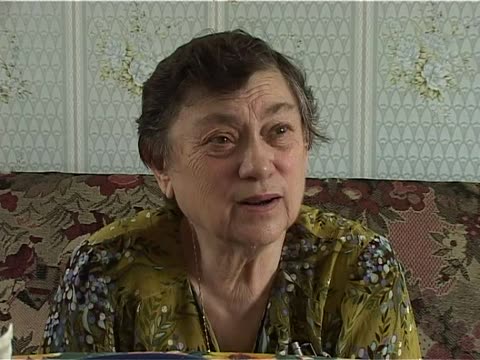
Murovanaia answers Kerler's dialectological questions: how particular Yiddish words are said, including words for a pigeon, a mouse, stuffed cabbage, breathing and a deaf person. She also describes baking matzo and a spinning toy, and begins to speak about Hanukkah.
Includes talk of matzo baking and the Hanukkah toy.
Murovanaia sings the Hanukkah song "Khanike Oy Khanike," before she addresses postwar Hanukkah celebrations, including food customs. Murovanaia then continues answer dialectological questions from the AHEYM Yiddish linguistic questionnaire.
Murovanaia recites or sings the Hanukkah song she learned from her aunts. She recalls Hanukkah money, the latkes, and Hanukkah with children and neighbours. Kerler then continues the questionnaire with words such as tsadik, hell, face, and a few others.
Kerler's questionnaire items follow, and she recalls Hanukkah in her own childhood as well as the postwar period.
Asked about the Horovitz and Kerler families of prewar Haysyn, Murovanaia talks about a Horovitz born in the same year as her husband, a relative who writes from Brooklyn, and what she knows of the Kerler family. She then gives her husband's name, his work at a factory warehouse, his religious family and his parents' names.
Adds her husband's work and religious family, and the contact in Brooklyn.
Murovanaia speaks about her life today, as well as the contemporary local community. She has relatives in Israel. Murovanaia also talks about her travels to Israel.
Murovanaia speaks about her life today in Haysyn, her pension and her children's help. She mentions the few remaining Jewish friends and says she has relatives in Israel and does not wish to leave. She describes her roughly 45-day visit to Israel, her impressions of it and the climate, and children who live in Germany.
Adds why she stays, her pension and the question of Germany.
Murovanaia talks about her life during World War II, which she spent in evacuation. Murovanaia mentions how she walked seventy kilometers in the Caucasus region. She then talks about her family, before addressing her return to Haysyn. Murovanaia raised two daughters, one of whom lives in Germany. Murovanaia briefly explains how she moved into her childhood home after the war, which was originally her grandfather's. The team then concludes the formal interview with Murovanaia.
Murovanaia talks about her children and about moving back into her grandfather's house after the war, though the war and evacuation material is largely garbled. Kerler thanks her, mentions the vareniki she served, and the formal interview ends.
The transcript supports little of the evacuation account in the catalogue entry.
At Burshtein's house, the interviewers are greeted by him and his wife Fanye, mostly in Russian. Kerler then explains the project in Yiddish, saying that it collects material on the language, folklore and history of Yiddish, and introduces the team.
The formal interview with Burshtein begins. He addresses his childhood memories and education in prewar Sobolivka. Burshtein attended a Yiddish school for four years. He explains that his class received a new teacher in grade three, who did not know how to write and read in Yiddish. Burshtein attended a Ukrainian school from fifth grade onward.
Burshtein explains that Jews no longer read or write Yiddish. He attended a Yiddish school for four years. A new teacher, who knew only Ukrainian, then turned the class into a Ukrainian school, and in fifth grade he moved to the Ukrainian school.
Burshtein gives his birthplace, Sobolivka in the Teplyk district, and his birth year, 1928, and says his passport name is Arkadii Libovich Burshtein. He says the family is of German origin, an ancestor having come from Germany, and names his grandfather Mendel. He gives his address in Haysyn in Russian.
Burshtein says he lived in Sobolivka with his parents until the Germans came. His father, Leyb Mendels, was born in Sobolivka and worked as a tailor, and his grandfather was also from Sobolivka. Kerler's explanations of the project and chat in Russian and English interrupt the account.
Much of the passage is side talk about the project and the interviewers.
Burshtein addresses his return to Haysyn after the war. According to him, it was embarrasing to speak Yiddish. He then mentions non-Jews who spoke Yiddish in Sobolivka before the war; particularly his grandfather's friend.
Burshtein explains that after the war Jews were embarrassed to speak Yiddish in public, though they spoke it privately and with a colleague at work. Asked why, he compares it to hearing a foreign language spoken in public. He contrasts this with prewar Sobolivka, where Jews and non-Jews spoke Yiddish openly, and recalls a non-Jewish neighbour of his grandfather who spoke it and whom he remembers. He also mentions the porch at each Jewish home where people sat and talked in the evening.
Adds the prewar porch custom and the contrast with the postwar embarrassment.
Burshtein speaks about prewar Jewish life and emigration from Sobolivka. According to him, five hundred Jews lived there. He then addresses postwar Jewish life in Sobolivka, as well as contemporary Jewish life in Teplyk.
Burshtein says that many young Jews left Sobolivka after the revolution, and that about four hundred remained, of whom he says three hundred were shot in the war. After the war a few elderly Jews returned, and now no Jews are left in Sobolivka. He gives the number of people in Teplyk and the distances between the places, and mentions a woman from Sobolivka who works as a teacher.
Gives his figure of about four hundred who stayed and three hundred shot, which the catalogue entry puts differently.