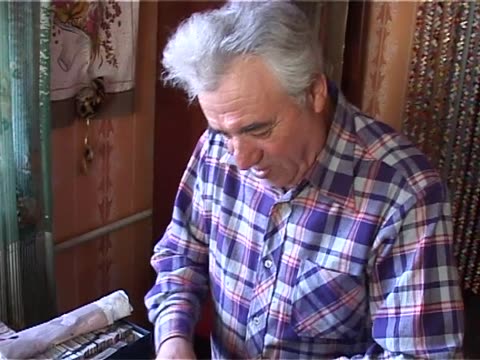
Geller demonstrates how he makes decorative curtains from paper, cutting out and fitting together pieces from different kinds of paper while Kerler comments. Geller then asks the visitors where they come from, and Kerler explains that he and a second man live in Bloomington in America, the second man being originally from Canada.
Shows the exchange about where the visitors come from.
Geller gives his birth year (1923), birthplace Kuzmin in the Krasyliv district, and his parents' and grandparents' names; both parents were from Chisinau. His father was a cobbler and his mother a seamstress who worked in a kolkhoz kindergarten; she was admitted to the Russian school because of her father's carpentry. He recounts at length episodes from his father's tsarist army service, including a conflict over spoiled meat, a fight, imprisonment, and later service with Kotovsky's army.
Gives the parents' and grandparents' names and details of the father's army episodes beyond the general mention of World War I.
Geller describes Kuzmin as a large Jewish shtetl where most Jews were rope-twisters and only two families were well off. He explains the word for a trader who collected old rags and scraps, then begins a story about a business trip in his police work, remarking that he has no one to speak Yiddish with.
Geller tells how, on a trip to a village with a Russian investigator and a police chief, he told a joke in Yiddish, and says he picked up Yiddish on his own. He says that throughout the war he never concealed being a Jew. He then tells how in 1940 his father was away visiting his mother's relatives in Moldova.
Geller recounts the outbreak of war in 1941 and the family's evacuation. At the station his mother, a former partisan with Kotovsky, secured a cart by force for the family. His father came back and missed them; he later sent two men with boots. The father then disappeared at the front and was never found, and Geller speaks of how he was missed in Kuzmin.
Shows the father's disappearance at the front and the mother's partisan past.
Geller mentions a childhood friend from Kuzmin with whom he went to school in the same class. He met him again in 1944 at the staff, after his hospital discharge. He tells how the friend's father was killed before the war and buried under a threshold, and was found when a new owner dug there.
Geller recounts his return from the army and his search for work in Kuzmin, where he turned down low-paid jobs, including a mill job, because of his war wounds. A school friend suggested the police, and he passed the medical commission after telling the Jewish woman doctor he could manage. He then describes working his way up from district officer to chief of criminal investigation, and later head of the Izyaslav department, ending as a lieutenant colonel.
Gives details of his wounds, medical commission and police promotions.
Answering Kerler's questions about police work, Geller says he dealt with ordinary crimes such as murder, rape, theft and robbery, not with war criminals or Communists, which were left to the KGB. Asked for an interesting case, he says only that he caught many criminals.
Geller speaks of a nephew in Chisinau, whose family now lives in Israel. A relative's wife and son drowned in a shipwreck, and Geller mentions a Yiddish newspaper (Yiddish 'Vek'(?)) article about a man who grew up Jewish. Kerler and Geller then read a document granting Geller a pension supplement for special service to Ukraine.
Shows the shipwreck story and the pension document in place of 'life today'.
Geller sings, or recites in part, a song his father used to sing about being lost and bound with coarse ropes, which Kerler says dates from before the revolution. Kerler had first asked whether he knew a word for a certain term.
Asked about Sabbath at home, Geller says his mother observed it but his father did not, and describes what she cooked for Sabbath, such as soup and roast meat. They discuss the term for roast meat and gefilte fish. Geller recalls the Sluch river at Kuzmin, where fish were plentiful, and the mildly sweet taste of his mother's fish, which was eaten with horseradish; he adds that his wife later made good gefilte fish.
Geller talks about his wife Feyge: a Kyiv university student evacuated to Tashkent, she volunteered for the army and served as an artilleryman and then radio operator. Her mother, siblings and grandparents were shot by the Germans, while her father and elder sister hid, the father surviving a pit during the shooting.
Kerler asks about Geller's grandparents; he never met them, as his paternal grandfather died under Romanian rule, and he knew only a paternal aunt, whom he has photographs of. He recalls Passover in Kuzmin in the 1930s, when matzo was secretly available from a widow, and says the large synagogue stayed open until the Germans arrived. His father visited relatives in Chisinau before the war.
Covers the grandparents, whom he never met, and the synagogue in Kuzmin.
Geller explains a prewar kolkhoz brigade term and sugar beet quotas, naming several non-Jewish kolkhoz workers in Kuzmin. He then tells about the Jews of Kuzmin being driven into a ghetto and shot in a village nearby, where a memorial now stands; he no longer has relatives there and he and his wife visited several times.
Adds the Kuzmin ghetto, the shooting and the memorial, besides prewar kolkhoz life.
Geller says he attended a Ukrainian school and his Yiddish came from speaking at home; he taught himself to read handwritten Yiddish, but print is hard. He describes the family's life in Starokostiantyniv(?) during the hunger of 1933, and how a teacher struck his fingers with a whip when he got the letters wrong, so he hid under the bed until he learned the alphabet.
Shows the hunger year 1933 and learning to read Yiddish by himself.
Kerler asks about Hanukkah and Purim foods and customs. Geller recalls Hanukkah money for children and potato latkes, poppy-seed pastries and Purim gifts (shlekhmones), and Passover matzo, noting the use of matzo meal in baking at a memorial meal.
Geller remembers his religious paternal grandfather, a carter and porter at the railway station, who prayed while waiting for customers and used a large samovar. He describes him as a Talner Hasid who wore two pairs of tefillin. Kerler then asks whether religion was taught against in school.
Shows the grandfather as a carter and Talner Hasid with a samovar.
Geller says he became a Communist, then recalls his childhood hunger in school: his mother promised to bring him food, did not come, and he ate grass in the schoolyard and was mocked by the children, so he stayed away for a week out of shame. He concludes that he never had enough to eat, even bread, in those years.