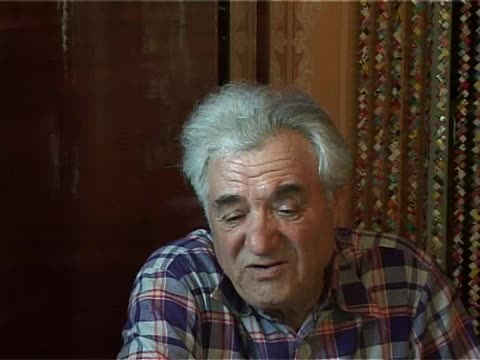
Kerler asks about anti-religious propaganda in Kuz'myn and whether people could still go to the synagogue. Geller recalls that his father could neither read nor write, and that his grandfather would drag the boy to the synagogue. Geller describes the sukkah, with eating and drinking in it, and says he remembers Jewish weddings with music. Kerler asks about the badkhn (wedding jester) and klezmer.
Also covers Sukkot and the sukkah, Jewish weddings and the badkhn, and the father's illiteracy.
Geller answers Kerler's questions about prewar Jewish cultural life in Kuz'myn. There were only Russian clubs and no Yiddish activities. He remembers no visiting actors, and mentions a Russian-language circle or sewing workshop. He does not remember a bar mitzvah of his own. He says that a nephew in Israel was recently given one, according to a letter, and that his sister's children and others in Israel are relatives.
Also covers a bar mitzvah in Israel and relatives there.
Geller says each person observes as he wishes, and recounts the visit the day before with his wife to the village of Klymbovka, where her parents and a sister are buried. He tells, mostly in Russian, of a church caretaker and a priest, and of his own challenge to belief in God. He recalls a local female healer. Kerler asks about spells against the evil eye, wishes for the dead, the custom of visiting graves and leaving food, and the words for 'field' and a holy place. They discuss visiting graves before the New Year and saying Kaddish.
Adds the Russian-language stretch about a priest and church caretaker, a healer, and cemetery customs and terms.
Kerler puts the dialectological questionnaire to Geller, covering words for a good or holy place, a pious person, a good Jew, hasidim, 'dybbuk', 'golem' and 'goyets'. They go through Russian-prompted words and sentences: politeness phrases, cold, high, fast, near, early and late, and being ill. They also take body parts, house and building terms, the days and numbers, and words for a rabbi. Geller's idiom for 'Lithuanian Jews' and a story from his work after retirement appear in the course of it. A few religious terms he does not know.
Adds the anecdote about his post-retirement job and the questionnaire items on Lithuanian Jews, Galicians, Belarusians and rabbis.
Geller sings a Yiddish song in answer to Kerler's request for a song. It is a ballad about a girl called Khazkl and a factory, partly mixed with Russian, and the words are garbled in places.