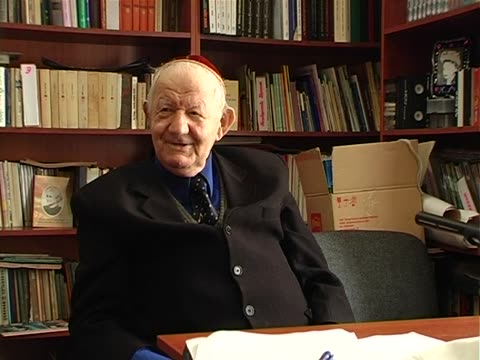
This tape is a continuation of a formal interview with Semyon (Yisrul) Aronovich Vaisblai (b. 1930 in Chemerivtsi). He discusses his family life, work and education in the postwar period and shares his views on Jewish emigration to Germany.
Vaisblai talks about helping an aunt, his father's sister, and her daughter. The daughter now lives in Germany with her husband and family and is content there. He explains why he himself did not want to emigrate to Germany: he does not know German, and he has a German pension and a good life where he is. His first wife died some years ago and his present wife comes from Uman'; she understands Yiddish.
Also covers the relatives who emigrated to Germany, his reasons for staying, and his present wife from Uman'.
He sings “Tsen kopeks” (“Ten Kopeks”) and then recites the words again for clarity. He states that he learned this song and others from demobilized Jewish soldiers after the war.
Vaisblai sings a Yiddish song about ten kopeks, and Kerler has him repeat it line by line so the words can be understood. He then explains in Russian and Yiddish that he learned such songs from Jewish officers who came back from the front. He says he did not understand them at the time but learned them anyway. He adds that no one in Khmel'nyts'kyy is left who could tell these things.
Vaisblai briefly talks about the four grades he completed in a Soviet Yiddish school. He also comments on the state of the contemporary Jewish community and the Yiddish language in Khmel'nyts'kyy. He considers himself a unique interviewee because he remembers so much so clearly and was old enough to understand what was going on during the war.
Vaisblai says he is a unique informant because he was old enough to see and remember everything during the war. He mentions Hungarians and Romanians in the Vinnytsia region. Kerler asks whether anyone else has interviewed him; he says yes, in Russian, and that this is the first video recording.
Also covers earlier interviews done in Russian and this being his first video interview.
He sings “Rebe Reb Shneyer” (“Rebbe Reb Shneyer”), recalling that he learned many Yiddish songs from Jewish soldiers and from his older sister. He then talks about his sister’s life, the hardships she faced, and about her children in Israel and the US.
Vaisblai sings a song about a rabbi and a ritual-purity episode, and says he learned such songs from Jewish soldiers. He also learned them from his older sister, who was a secretary. He then describes her two marriages, the second to a blind man, and her children, two sons in Israel and daughters in America. One of the daughters is ill and another works as a hairdresser. Kerler then asks when he came to Proskurov (Khmel'nyts'kyy).
The sister's life is described in detail, including her two marriages and children abroad.
Vaisblai came to Khmel'nyts'kyy in 1977. Before that, he lived in the town of Horodok where, he explains, there were many Jews after the war. Vaisblai then describes postwar Jewish life in this town and the postwar period in the Soviet Union in general, focusing specifically on the housing troubles with which he dealt.
Vaisblai says he came to Khmel'nyts'kyy in 1977 after living in Horodok from 1945. He says there were more Jews in Horodok than in Chemerivtsi after the war, and recalls praying at his father's house in Chemerivtsi. He tells long stories about a miserly man named Khaim Bronshtein and a thief named Yozye Stoharski. Kerler then asks about his sister Gitl's songs, and Vaisblai sings a short rhyme.
Includes the stories of Khaim the miser and the thief, and his sister Gitl's songs, which the catalogue does not mention.
Vaisblai recites fragments from a few songs, including “Sapozhkelekh” (“Little Boots”) and sings several songs, including: “Nokhemke mayn zin” (“Nokhemke My Son”), “Oy iz dus a Rebenyu” (“Oh is that a Rabbi”) and “Vi azoy s’iz nisht git tsi geyn zibn vokhn in eyn hemd” (“How Bad It Is to Go On Wearing the Same Shirt for Seven Weeks in a Row”). He mentions that the last song was often sung by his friend Avrom, a man who did not drink liquor, but rather eau de cologne.
Vaisblai recites and sings several Yiddish songs: a song about Nokhemke and his son, a hasidic rebbe song, and the comic song about seven weeks in one shirt. He says the last was often sung by his friend Avrom, a tailor who drank eau de cologne rather than liquor. Kerler asks him to continue between songs.
At Kerler's request, Vaisblai sings a Sabbath-eve song slowly so the words can be heard, and Kerler asks him to repeat another song. He says he copied songs into a notebook and that rabbis used to enjoy his singing. He says Yiddish is dying because no one knows it, and talks about Israel, its president and Shimon Peres as an artist, and what he sees of Israel on television.
Adds his remarks on Israel, its president and television coverage.
Vaisblai sings the song about leaving home at six o'clock with a headache again, this time more slowly. He then sings a song in which a man takes leave of his in-laws and entrusts his daughter to them. Afterwards he speaks about his health and a recent illness of two weeks earlier, when he was taken to hospital.
After briefly discussing his contemporary health problems, Vaisblai shares his work history in the postwar period, consisting of many different jobs in several towns. He also explains how he met and married his first wife Fania, and how they had a wedding with klezmer musicians.
Kerler asks what work he did in Horodok after the war, and Vaisblai tells a long story of poverty and many jobs: porter, trading in spirits from Chernivtsi, shop and warehouse work, work in a village (Zakupne), and in a store. He describes the risk of shortages and prosecution, and a clerk whose boss helped him. He also tells how he met Fania, an orphan from Zin'kov, and how Jews collected money for a wedding with klezmer musicians from Donetsk (?).
Gives the work history in much detail, with stories of shortages and fraud charges, and tells how he met his first wife.
Vaisblai describes his postwar working life as a storekeeper and restaurant worker, and a job buying plums. He also tells of running into trouble with the militia and of building a house in Horodok. He then explains that he moved to Khmel'nyts'kyy and worked as a restaurant director. He says he spoke Yiddish with his wife throughout. The wife came from Zin'kov (the transcript is unclear). His children live in Israel and Germany. Much of this part is in Russian.
Adds the story of building a house in Horodok and the move to Khmel'nyts'kyy; the transcript does not clearly show how the children's countries are divided.
Asked about the best years of his life, Vaisblai says they are the present. He recalls always having been afraid, and reflects on wealth and inheritance. Kerler thanks him for the interview and praises his Yiddish.