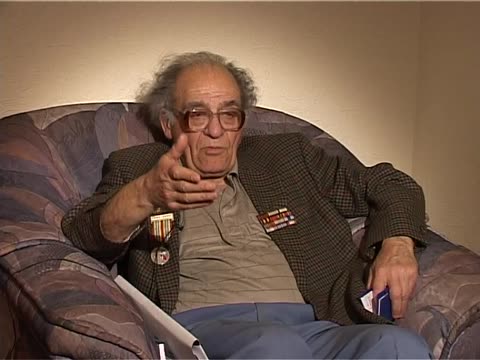
Khandros says the Yiddish school opened his eyes to the world. He describes meeting Bratslav Hasidic pilgrims in Uman (?), who understand Yiddish. One of them sat with him for hours and wrote down the songs his father sang. These Hasidim read no Sholem Aleichem or other Yiddish literature. Kerler comments on the writing-down of the songs and asks which kind of Hasid he was, and the answer is Bratslav. The Hasid gave Khandros his address and invited him to Jerusalem.
Answering Kerler's questions, Khandros says Hasidim lived in Ozarintsy in the early 1900s, but the tzaddik died when he was a child and the community declined. He remembers praying with the tanner Hershl Koyfman and Koyfman's old mother Rachel, who told him and his cousin Lusia Bible stories. He wrote these down in his booklet. He recalls the mikveh near the mill, where his father's elder brother Itsik Khandros, who lived in Mohyliv, took him as a boy. He also describes the town's three prayer houses, among them the beys-medresh, whose walls still stand.
Khandros describes the first day of the German occupation of Ozarintsy, which he did not witness himself. The Germans drove the Jews of the town into the synagogue, and a German on a motorcycle brought petrol to burn it. Villagers took belongings from the houses and later brought some back. A maid in his family's house took their sewing machine and returned it in October 1941. Kerler asks whether she spoke Yiddish, and Khandros says she did not.
Khandros speaks of a non-Jewish Sabbath helper who grew up in the town and spoke good Yiddish. The Jews had helped his family in a famine, yet he was the only villager who took part in the action against the Jews on the first day. He was later imprisoned for ten years. Khandros says he wrote about this in his book and that the man's son told the story in front of the camera when a film was made in the early 1990s. He mentions that he has made more than thirty documentary films, including one on the history of the town.
Khandros shows a photograph of a gravestone about two hundred years old, taken for his film and book. Kerler asks whether a copy of the film can be bought. Khandros talks about the film's reviews, the English version he hopes to obtain, and his friend Borys Zabarko, a Yiddish-speaking man from Sharhorod. He says he has made more than thirty documentary films and has two feature-film projects that the actor Bohdan Stupka liked. Jerzy Hoffman is mentioned.
Asked by Kerler, Khandros recalls the blacksmith Kive Roznblit, a long-armed, very poor Jew and friend of Khandros's parents. His daughters studied in Khandros's father's school. Khandros recounts Kive's sayings and his habit of raising his hands in curses and questions. He recalls Kive's last words, which became his own motto: go, stand, or die. Kive died in a ghetto, in a place the transcript renders as Dashinets (?). Khandros ends by introducing a friend he met in Kyiv on the day the American president came.
Khandros tells how he and other Jewish war veterans were bused to Babi Yar when the American president and his wife visited Kyiv in 1991. Afterwards he met in the Jewish library a man who had survived five camps and learned Yiddish in them. He wrote an article about him, and in the mid-1990s took it and his film about his town to Israel, where a Sokhnut official recorded him. Kerler then says it is late and proposes another meeting. Khandros ends with a story of a New York foundation director who did not answer about the film.
The speaker is now Derbaremdiker, who lived in Berdychiv and studied in Kyiv. He explains that his father, Levi Yitskhok, advised him to enter a technical institute rather than the humanities, given the times. He arrived in Kyiv in 1936. Kerler remarks that it is the second day of the expedition.
Derbaremdiker gives his personal data while Kerler fills in the form. He fled Berdychiv in early July 1941, and the Germans entered the next day and seized documents, among them his birth record in Yiddish and Hebrew. He names himself as Mordkhe, son of Levi Yitskhok, and his mother as Perl. His birthplace was the Kachanivka district of Berdychiv. He also tells what his younger brother in New York recalled of a house where Mendele Moykher Sforim once lived.
Derbaremdiker recalls childhood in Berdychiv. He describes Kachanivska Street, the Carmelite monastery fortress with a museum that had rooms for Shevchenko, Sholem Aleichem and Balzac, and the church where Balzac married. At about four he was carried in his father's tallis to cheder, where he studied only a few years, as the cheders were closed in 1927. That year he entered a Yiddish school. He says he now speaks Russian most of the time and has hardly anyone to speak Yiddish with.
Derbaremdiker names his Yiddish school as School No. 13, in a former commercial-school building on the central street. The Russian school was on the second floor and a pedagogical institute on the third. After seven grades he moved to a model school. He went on to a technical school in Kyiv in 1936 and received his engineering diploma on 20 June 1941, two days before the war. He answers Kerler's questions on his cheder years: two synagogues in the Kachanivka district, a melamed of the Golyetski (?) family, and a younger brother now in New York.
Derbaremdiker names his brothers: an elder brother born in 1913, now in New York and about to turn ninety, and a younger one, Yontl (Yontev). Yontev was named after the grandmother Yente, his mother's mother. The elder brother, Avrom, went to a Ukrainian school because no Yiddish schools existed in 1921, then studied in Berdychiv's Yiddish technical school and later at the Progress machine factory and in Kyiv. Derbaremdiker says he had a bar mitzvah in a secret prayer house in 1933, because officially it was impossible.
Derbaremdiker describes his secret bar mitzvah, for which he was taught by a melamed, and explains why it had to be hidden: parents risked losing the bread ration and work. He then speaks of the famine of the early 1930s, which struck the Ukrainian population and the Jews of the small towns. Jews survived by relatives sending parcels from Moscow and Leningrad. He recalls his father working as a soap boiler, a friend's tailor father who had no work, and his school friend Avrom Goldenberg, killed in the war. Kerler asks the melamed's name and which Torah portion he learned.
Derbaremdiker describes his cheder lessons: Chumash beginning with Vayikra, the letters, and the prayers. He says he can still read the siddur fluently but does not understand every word. He now goes to the synagogue because it is the only place to speak Yiddish, with the rabbi Yakov Dublikh (?). He mentions the languages he studied: English, German and French. He adds that after the war relatives in Canada found the family's address, which was in the Urals, through the evacuation centre.
Derbaremdiker tells how, once he was in postgraduate study in Kyiv and his brother had come back from the war, he wrote to relatives in Canada in English. They were surprised that anyone knew English so well, and he says his English is only fairly simple. Kerler then asks about Jewish holidays.
Derbaremdiker says Passover was observed in his family despite pressure, and that groups from the school were sent to check homes, though the Jews kept silent. He describes matzo from flour, a hidden box of Passover dishes, strict kashrut kept by his mother, and his father's search for hametz. After the war the family baked matzo in Kyiv themselves, and later queued for it. He then recalls a favourite mathematics teacher whose surname was Lemberg.
Derbaremdiker continues about his teachers: a gravestone of the mathematics teacher Lemberg, which he found in Kyiv, and the director of the fifth school, a Jew from Poland named Yarman who taught Yiddish language and literature. Yarman once read the class Peretz's "Three Gifts". He says he now teaches at a Sunday school, where he recently recited this story from memory to students. He then begins to retell it.
Derbaremdiker retells Peretz's story "Three Gifts" in Yiddish from memory. The soul of a dead Jew is weighed in the heavenly scales, with an angel in white holding his mitzvot and an angel in black holding his sins. The scales stand level, so the soul may enter neither paradise nor Gehenna and is condemned to fly between heaven and earth, until the tale reaches the soul's long flight. The retelling breaks off as the soul sees a light below.