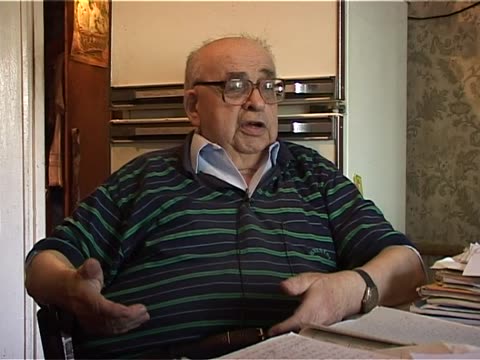
Derbaremdiker finishes retelling Peretz's story of the little soul that must bring three gifts to heaven. The three gifts are a bit of blood-stained earth from a murdered Jew, a drop of blood from a Jewish girl in a German town, and a thread from a skullcap spattered with a Jew's blood in Russia. He then says he has reread the story and comments on it.
Derbaremdiker names a Yiddish teacher, evidently from Poland, who was taken away in the 1930s, and other teachers and classmates who studied in Yiddish. He says he spoke only Yiddish as a child and knew a little Ukrainian from the market. He explains how he taught himself Russian at about fifteen by reading Pushkin aloud, and that he could soon take exams in mathematics and physics. He also notes that children from the new town were more Russified.
Adds a Yiddish teacher taken away in the 1930s and the Pushkin method of learning Russian.
Derbaremdiker recalls Yiddish school textbooks translated from Russian for physics, arithmetic, algebra and geometry, many printed in Berdychiv. He mentions a history textbook and says he tutored others from it. He says he still does arithmetic in Yiddish, and introduces the literary circle at the Berdychiv city library.
Adds Yiddish-language textbooks and printing in Berdychiv.
Derbaremdiker remembers a brother of Sholem Aleichem visiting the Berdychiv library literary circle when he was about fifteen, and the circle's leader. He talks about teaching Yiddish at an institute and a colleague who learned it. Kerler asks what Yiddish literature was taught in school, and he says Soviet-era Yiddish literature. He mentions a poem he wrote and where it was printed.
Adds Kerler's questions about the Yiddish literature taught and Derbaremdiker's pension and teaching of Yiddish.
Derbaremdiker speaks about his published folklore series and the translation work he did for the son of a Yiddish writer. He recites at length his poem dedicated to the memory of Dovid Hofshteyn, about Russian fields. He then answers Kerler's questions about Yiddish readers and discusses writers such as Peretz, Markish and Gildin, reciting lines from a poem he learned in school.
Adds the poem recitations and the discussion of Markish, Peretz and the school readers.
Derbaremdiker describes the Berdychiv city library's many Yiddish books and the world literature he first read in Yiddish translation. He recalls seeing Mikhoels in Berdychiv in 1935 and later in Leningrad on tour. S2 asks about the performance, and he talks about a Mendele character and a mixed-up language joke.
Adds the world literature read in Yiddish and the discussion of a Mendele performance.
Derbaremdiker talks about Mendele and Sholem Aleichem in school and at home. He describes how his father kept a collection of Yiddish periodicals from 1912 and later newspapers, and mentions his own articles and another Yiddish teacher. He then recites two of his own poems, one about the cow and the rope, answering Kerler's questions about his father's reading.
Adds his father's Yiddish periodicals and the recitation of his own poems.
At Kerler's request Derbaremdiker talks about his family and the origin of his surname, naming his paternal great-grandfather (?) and tracing the Berdychiv Derbaremdikers back to Levi Yitskhok. He tells the legend of an official asking the rabbi his family name while he was praying, which led to the name. He also mentions relatives in the United States and a poem by an ancestor.
Adds the genealogy and legends of his surname, and that the antireligious campaign is deferred.
Derbaremdiker describes the Club of the Heretics in Kyiv, a former synagogue building, and its Yiddish library and drama circles, and recalls the Berdychiv theatre built before the revolution. He mentions klezmer musicians at weddings and prewar prayer in secret. He says that in 1933 a rabbi secretly prepared him and his brother for bar mitzvah.
Adds the Club of the Heretics, its library, and klezmer musicians at weddings, with the bar mitzvah taking place in secret.
Derbaremdiker answers Kerler's questions about cinemas in prewar Berdychiv, naming a summer and a winter cinema and one in the fortress monastery. He recalls a silent film with Yiddish inter-titles in which Mikhoels acted.