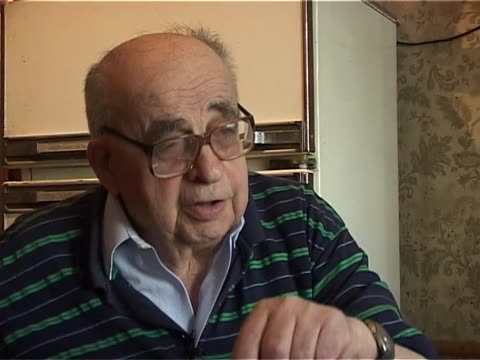
Derbaremdiker explains why he speaks Berdychiv Yiddish yet tried to speak literary Yiddish after reading a lot. He says the Berdychiv dialect differed from Zhytomyr's. He mentions articles on dialects and conferences in Weinberg's collections, his work on a history of the Berdychiv Jewish community, and an article of his on Yiddish after the revolution. He and Kerler also discuss the fate of Yiddish and Hebrew in Soviet times and the Spanish forced converts.
Also covers his own writing on Berdychiv history and Soviet-era Yiddish, not only the language today.
Kerler puts dialectological questions on Berdychiv Yiddish to Derbaremdiker, who often answers with a literary form and recalls what was said at home. Items include greetings and the phrase 'God help', polite requests and thanks, the bat, adverbs of time and degree, 'very ill', 'beautiful', 'to run away', 'stone wall', sour, 'little', the headache, the street, mill, 'all people', numbers of people, bread, vodka, sugar sweets, praying, and 'taste'. The last part turns to rabbi/rebbe terms. Derbaremdiker also mentions a Stolin Hasid, Dov Bleich, whose children speak Yiddish.
The Kyiv interview wraps up as Derbaremdiker introduces his wife, née Rabinovich, and gives his address for the archive. He mentions his brother, his correspondence with a professor, the Vilnius institute, and the plan that parts of the interviews might later go online. Kerler thanks him and takes leave.
Also covers addresses, the archive's plans and goodbyes.
In Polonne, Kerler introduces the recording, giving the date and place, and asks the woman for her name and details. She gives her maiden name Goldenberg, her Russian name Frida Leizerovna, and says she was born in Polonne in 1920. Kerler starts to ask her address.
Zak says she finished ten grades at a Jewish secondary school in Polonne, with instruction in Yiddish including physics, mathematics and chemistry. She then took courses and worked in a Jewish orphanage in Letychiv. She begins telling how the war started while she was on vacation and the family fled fifteen kilometers on foot to Miropol'.
Zak continues her wartime account: the family caught the last train out of Miropol' and ended up in evacuation, working in a kolkhoz with little to eat. Her father died of hunger there. They returned to Polonne in 1944, where she worked in an orphanage speaking Yiddish with the children, and in 1945 she was asked to organize a children's library, where she worked until her retirement in 1988.