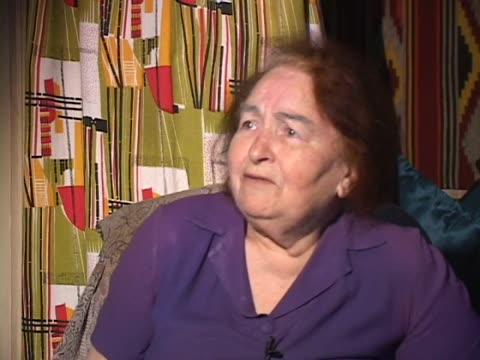
Rusakovskaia explains that she has two first names, Rakhil (Rokhl) and Raisa. At work, among non-Jewish colleagues and clients, she was called Raisa, while her passport says Rakhil. She says her parents called her Rakhilke or Rakhele, gives her patronymic and surname, and states that she was born in Chornobyl'.
Also gives her birthplace and the form of her name used at home.
Rusakovskaia describes her parents. Her father went to the synagogue daily and on Sabbath and holidays, and her mother went on holidays. After the war the synagogue was taken away, Jews gathered in private homes, and the police fined them for it. She describes the prewar synagogue with its two floors, with men below and women above reading from prayer books. She gives her father's name as Isaak (Shloyme) and her mother's maiden name as Shepelski, with her first name given as Malke. Her father was a carpenter and her mother a housewife who raised three daughters.
Gives the parents' names and trades and the building of the synagogue.
Rusakovskaia talks about the family house with its garden and her mother, who ran the household. She names her two sisters and tells what became of them. The eldest, Polia, became a dentist in Kyiv and died in a hospital in 1975 (?). Beba worked as a bookkeeper and has been dead for some years. Rusakovskaia mentions her own illness and operation, and the family's cow Manke.
Covers the sisters' fates, her illness and the cow, beyond early childhood and school.
Rusakovskaia describes preparing for evacuation at the start of the war. She led the cow Manke out to the field. A barge loaded with salt was dumped into the Prypiat river so that people could leave Chornobyl', and her father hung the key on the house, expecting to return. Almost all their things stayed behind.
At the request of a second voice for more about the synagogue, Rusakovskaia describes how Jews went to synagogue on all holidays and how her mother prepared for them at home. At Passover her father led the seder from the prayer book and neighbors without a husband joined the family at the table. Kerler asks about the four questions, but her father read alone.
Rusakovskaia says she finished four classes of the Yiddish school in Chornobyl', which was then closed, probably in 1936–37. The pupils were transferred to a Ukrainian school, where they studied until the war. She says her older sister finished seven classes in the Yiddish school. She can still read, write and speak Yiddish, and reads Yiddish booklets from her library. Kerler then asks about the Chornobyl' rebbe, about whom she remembers little.
Rusakovskaia answers questions about what makes a 'good Jew'. She recalls her mother helping people in need and collecting money for them at the synagogue. She describes the separate Jewish and non-Jewish cemetery fields in Chornobyl', where her parents are buried. Only gravestones with Hebrew inscriptions remained after the war. Visitors from Kyiv came to the graves of their parents, and Jews gave money for memorial prayers. She describes women reading in the upstairs part of the synagogue and shows her father's handwritten copy of the prayer book.
Adds the cemetery, memorial visits and her father's handwritten prayer book.
Rusakovskaia talks about her childhood friends from the street, whose names she gives. They spoke Russian when small, and in kindergarten there was no Yiddish. In the Yiddish school they spoke Yiddish. She describes the club, where schoolchildren recited, told stories and sang in Yiddish. She cannot recall poems from school.
Asked by Kerler which Yiddish writers were studied, Rusakovskaia remembers Sholem Aleichem and Peretz and agrees about Markish but recalls no others. She says Yiddish actors came from Kyiv to perform at the club. Her friends were taught in the Russian school, so after the transfer the children spoke Russian, which was hard at first.
Names the writers studied and adds the language the children spoke.
Rusakovskaia says her father the carpenter made windows and doors with fine decoration. She then describes Passover food, especially fish, and discusses with Kerler the terms for fried, chopped and stuffed fish (gefilte). In Chornobyl' fish was made without sugar. At Passover the shoykhet came, and after the war, when he died, one came from Ovruch.
Adds the fish terminology and the kosher slaughter of chickens.
Rusakovskaia talks about the shoykhet before and after the war, and about the 'Khabne seer' (?) whom people visited. Kerler asks about Hanukkah, and she recalls gifts of Hanukkah money from relatives, latkes, and her mother's fattening geese. She also describes Friday night with Sabbath candles and cholent in the Russian oven. Kerler asks for terms such as 'believer' and 'honest', and she tells about Tisha b'Av and children's games, including nuts at Hanukkah.
Kerler asks about converts to Judaism. Rusakovskaia says she did not hear of any before the war, since mixed marriages did not occur in the town. On Purim she recalls the baking of hamantaschen. Asked about a Purim play, she says only that the Yiddish school staged performances while it existed.
Rusakovskaia says the school celebrated Soviet holidays rather than Jewish ones, and was open on Sabbath, with Sunday as the day off. She says many non-Jews in Chornobyl' spoke Yiddish freely, because Jews and non-Jews lived mixed together on one street. Jewish women spoke Russian poorly. She also describes a street of Jewish families.
Adds Soviet holidays at school and the Jewish street.
Kerler asks about the word 'Litvak', and Rusakovskaia describes her father's speech, from Ivankovtsy, and her mother's, from Chornobyl'. She gives examples of their pronunciation, such as the word for feathers, and says they could understand each other, and that in school she was taught to say 'kumen'. Kerler begins to ask words for translation and moves on to relations with non-Jews.
Rusakovskaia says relations between Jews and non-Jews were normal and friendly, though her close friends were all Jewish, from her street. At school pupils from the Yiddish and Russian schools mixed. After the war there were fewer Jews. She worked in a bank as the only Jewish employee and used the name Raisa, and later as a bookkeeper in a collective with a Jewish director and mostly Jewish staff, where Yiddish was sometimes spoken.
Asked about folk remedies, Rusakovskaia says medicine was in hospitals and polyclinics. She then describes Jewish old women healers in Chornobyl'. She recalls a healer curing an erysipelas of her leg after the war with black berries, which doctors had failed to cure. Kerler and others then ask the meaning of the words dybbuk and golem, and whether she knows stories about them.