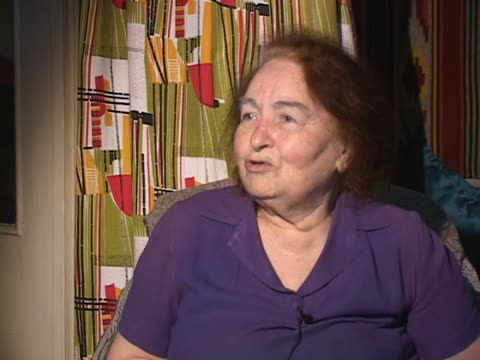
Kerler asks about customs for remembering the dead: yahrzeit, charity given in memory of a parent, and set wishes such as that the deceased be a good advocate (beter) in heaven. Rusakovskaia answers which of these she knows and says she gives money at the synagogue. He then asks where she was during the war.
The passage is largely a questionnaire on mourning formulas and wishes, and ends with the lead-in to the war question.
Rusakovskaia recounts the family's evacuation. They left Chornobyl' and were turned back at Kyiv by the crowds, but her father insisted on going on with the children. In Dnipropetrovsk a friend related to Kaganovich took them on a special train. They worked on a kolkhoz near Stalingrad, left when the planes began shooting, and her father repaired another family's wagon. They were then sent east to a town with a military factory in the Chkalov region (Sol'-Iletsk), where they worked until the war ended. She also says when they came back to Ukraine.
Gives the Chkalov region and a town name (spelling uncertain) as the place of evacuation, and says they returned straight to Chornobyl'.
Rusakovskaia describes the return to Chornobyl', where their own house was no longer standing and the family lived with others. Her father, a carpenter, then bought a ruined house (the word is explained to Kerler) and rebuilt it into a fine one. She says she moved to Kyiv in 1967.
Kerler puts a few questionnaire items: greeting expressions such as 'good morning' and 'good day', the phrase for asking someone to hand over a book, and the word for 'please'. Rusakovskaia gives her forms, sometimes after hesitating and with Russian asides.
Asked about Jewish weddings in Chornobyl', Rusakovskaia recalls a Jewish wedding after the war, where her father brought in a few Jewish boys to say a prayer. She also remembers a childhood wedding where the children were kept in another room, with games and a guitar and fiddle for music. Kerler then asks for congratulation formulas and for the word 'thanks'.
Contrasts a wedding after the war with her childhood memory, and ends with greeting words put by Kerler.
A long dialectological questionnaire led by Kerler, with Rusakovskaia giving her Yiddish equivalents and often commenting in Russian. The items include animal and everyday words (mouse, house, window glass, dove), colors and adjectives, comparatives and adverbs of time, verb forms and short sentences to translate, numbers, kinship and family terms, words about faith and the countryside, 'honest', 'sick', 'beautiful', 'all/everybody', and terms from the synagogue and house. She also comments that she misses having anyone to speak Yiddish with.