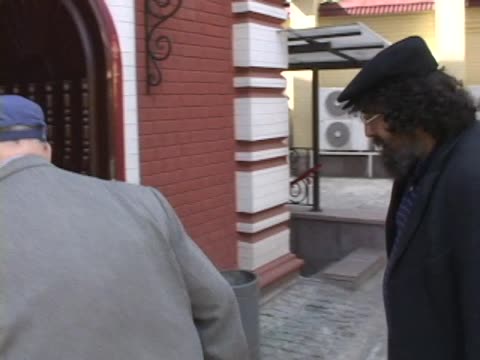
At the synagogue, Kerler and Katz introduce themselves to a man there, and someone remarks on his good Yiddish. They try to find a place to sit and talk, and there is some confusion about who has been or has not been recorded. The talk is largely garbled.
The transcript shows the team's introductions and the search for a place to sit, rather than footage alone.
The team arranges the interview. Someone relays that Rabbi Bleich said they could sit in the synagogue. A person is said to be ill or in hospital, and it is unclear who. A woman from Kyiv is mentioned in connection with a film project for Moscow's Kultura channel.
The transcript adds the mention of a Kultura film project and an unclear illness.
Derbaremdiker talks about a film on Yiddish culture, apparently made for the Moscow Kultura channel. He gave the filmmakers cassettes and sent one to his brother in New York, who had it converted to the American format. He offers the brother's phone number and a Russian text. He then speaks of Rabbi Yaakov Bleich, chief rabbi of Kyiv for about fifteen years, whom he met around 1991, and of how his work as a laboratory head kept him from the synagogue.
Derbaremdiker describes his career in chemical technology for leather: laboratory head at a large plant, work at a scientific institute, and chief engineer at a plant in the Urals during the war. After Bleich arrived he cut back his work and began attending the synagogue. He mentions teaching a Yiddish course at the Sholem Aleichem university, now closed, and his Sunday school. He also describes a Jewish school on the left bank of the Dnipro and the other Yiddish teachers and groups in Kyiv.
The transcript adds his own work history (chemistry, a plant in the Urals) and the other Yiddish teachers in Kyiv.
Derbaremdiker explains the history of the synagogue. It was founded over a hundred years ago by a wealthy Jew, who built it beneath another building because synagogues could not be built openly, and it was renovated a few years ago. He mentions the yeshiva students who study there, how he travels there, and that he does not travel on the Sabbath. He then moves to the Sunday school, which starts in October.
Derbaremdiker describes how he runs the Sunday school. It lasts eight months, and the students read and review grammar. He wanted to translate a Yiddish grammar into Russian but found a published book. He mentions reading material from the Forverts and Paris Yiddish journals, and articles on Warsaw Ghetto and Sobibor commemoration, including a Sutzkever interview. He explains the Yiddish letters used as numerals (the number 36). He ends with his own cheder schooling until age seven.
Beyond the Sunday school, it includes his reading material and his own cheder schooling.
Derbaremdiker recalls his cheder and the Yiddish school he attended afterwards. He writes memoirs for a journal about Jewish education in the Soviet Union between the wars, and mentions an old teacher whose grave he found in Kyiv. He names other Yiddish teachers and acquaintances in Kyiv, among them a teacher called Shaykin who is ill in hospital, and notes that the Sunday school is almost the only Yiddish teaching in the city. He also talks about his contact with another man who may be from Berdychiv, and his own Berdychiv ties.
Adds his memoir writing, the grave of an old teacher and the names of other Yiddish teachers.
Derbaremdiker says he went to Berdychiv once, when his brother from New York visited and Rabbi Yaakov lent them a car. He knows the Berdychiv rabbi. He describes his life now: he cannot leave his sick daughter, only goes to the synagogue, and gets some help from the Hesed organization. The talk turns to the team's coming travels in Podolia, to a Yiddish folklore and proverbs course he once gave, to his brother's work for the Russian Forverts, and to the Yiddish forms of family names such as Yente and Yontl.
Adds his sick daughter and the Hesed help, the Berdychiv trip, and the talk of proverbs and family names.
The interviewers and Derbaremdiker exchange contact information, including his brother's address in Brooklyn and phone numbers. He says no university in Kyiv teaches Yiddish at present. He says he will turn 85 in July (?) and mentions that he has a copy of his Jewish birth record. They talk about visiting Rabbi Bleich briefly.
Adds his age and birthday, the absence of university Yiddish in Kyiv, and the plan to visit Rabbi Bleich.
Derbaremdiker shows a copy of his birth certificate, written only in Yiddish and Hebrew by the Berdychiv Jewish community. He gives his parents' names, his father's patronymic and his mother Perl, and the street, Kachenovka, where the family lived near the town centre, and mentions the monastery torn down in 1934/35. He says he left Berdychiv at sixteen for Kyiv. He also mentions that the parents fled a day before the Germans came, and that someone has the original.
Adds his parents' names, the street in Berdychiv, the demolished monastery, and the note about the parents fleeing.
Katz and Kerler chat with a man, probably Yokhanan Reyzn (?), about Jewish life in Ukraine today. Katz mentions working with Jewish food products and that his young son spoke Yiddish. They say they are building an archive of interviews and will soon travel to Podolia. Russian and Ukrainian exchanges with a photograph seller follow, and the Yiddish there is mostly garbled.
Adds the informal talk with Reyzn about food products and the archive, and the exchanges with a photograph seller.
Katz and others chat in and near the van. They talk about Vilnius, Lithuania, and a man from Vilnius, and about where Jews come from. There is talk of rabbis, of Chabad people praying in the synagogue's upper floor, and of volunteers praying in the Jewish community. The talk is mostly garbled.
Return to the van is not visible, but the transcript shows Katz in conversation about Vilnius, Chabad and prayer.