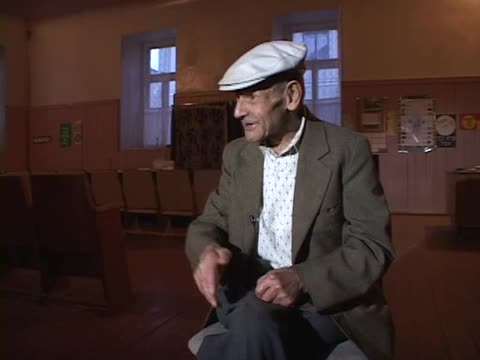
This tape is a continuation of a formal interview with David Abramovich Vider (b. 1922 in Sighetu Marmatiei). He describes the Yiddish books he read in his youth and after the war, including translations of Robinson Crusoe, fiction by Shmuel Gordon, and the stories of Hershele Ostropolyer. He then tells a few Hershele stories.
Vider talks about a visitor he spoke with about Yiddish and Russian and about books he read in Yiddish: Robinson Crusoe (Der alter leyb), Shmuel Gordon. Kerler asks what he read at the Yiddish school. He then retells several Hershele Ostropolyer stories, including the one about dumplings in the pot and the eggs in the coat-tail.
Opens with Vider's account of a visitor who spoke Yiddish and Russian, and of reading Robinson Crusoe in Yiddish.
Vider recalls Khelm stories he read, such as the townspeople hiding the moon in a barrel and carrying people to services on their shoulders so as not to spoil the snow. Kerler prompts with questions.
Vider recalls finding a Yiddish book in a Soviet bookshop or library on a trip from Chervonohrad to Kolomyya, and how people were astonished at a Jew reading it. Kerler asks about his reading in Romanian, history lessons and romances. He mentions Romanian historical songs.
Also covers his Romanian-language reading and schooling.
Vider tells a story about his friend Semyon Semyonovich Krotsh (b. 1922 in Stefanesti; another AHEYM interviewee) who in Soviet times would use his knowledge of Romanian and songs based on the poetry of Mihai Eminescu to illegally obtain fresh fruit and other produce from traders across the border. Vider then sings a Romanian love song.
Vider speaks of a friend from Iași, Shloyme (Krotsh), who also speaks Romanian and in Soviet times got fruit from sellers from Moldova by speaking Romanian and quoting a poem on the beauty of the language. He then sings a Romanian love song, naming the singer Tamara Ceaban (?), after Kerler asks for a favourite.
Vider's own singing of the song is on the tape, and the Romanian poem is quoted.
Vider talks about how he studied to be a tailor, and shares his memories of the Botoshaner Rebbe, who lived in a neighboring courtyard from his family’s home. He also tells a joke about a man who was tricked into paying extra donations to his synagogue.
Vider tells how he left the yeshiva in Iași to learn tailoring with a neighbour, against his father's wishes (his father was a shoykhet, his mother Nekhama), and went to the USSR at seventeen as a communist. He recalls the Botoshaner Rebbe, who lived in the neighbouring courtyard, selikhes, the rebbe's table, notes and wedding of his sister. He ends with a joke about a man tricked into paying yortsayt money three times.
Adds his father's wishes, leaving for the USSR as a communist, and rebbe's role at his sister's wedding.
Vider briefly describes how the Kolomyya synagogue works now: few regular worshippers, a minyan expected the next morning, and people who come for yortsayt. Kerler arranges to meet the next day and speaks of Krotsh and Greyf. Others joke about cooking and Sabbath.
Camera footage of a Sabbath service in the Kolomyya synagogue, chiefly prayer and chant with a few remarks between, hardly recognisable in the transcript. Katz and Kerler are heard now and then.