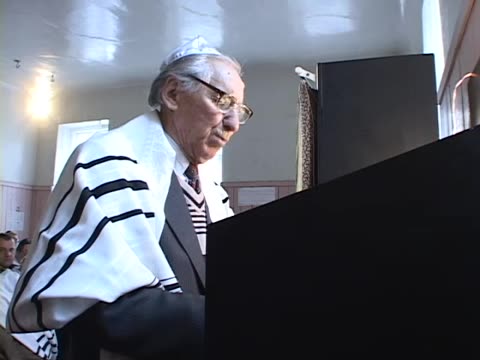
Continuation of the Sabbath service in the Kolomyya synagogue. Prayers, blessings and singing by the congregants are heard, with brief spoken exchanges. The transcript is largely garbled, so little detail can be made out.
The AHEYM team speaks informally with Semyon Semyonovich Krotsh (b. 1922 in Stefanesti), who speaks about the Rebbe of Stefanesti. David Abramovich Vider (b. 1922 in Sighetu Marmatiei) explains that the synagogue has no one who can "leyn toyre” (read/chant the Torah portion) and therefore it is not read on shabes.
Informal conversation with the congregants. Krotsh speaks of the Rebbe of Stefanesti, named as Matisyohu Friedman (?), a great tsadik taken to the Land of Israel and buried there. Kerler says the interviewers want to interview people later. A second man explains that no one is present who can read the Torah, so it is not read at this service. Plans are made to talk later or the next morning.
A second man's remark on the missing Torah reader and plans for an interview.
The AHEYM team has a "kidish” (Kiddush) lunch with the congregation and speaks in Yiddish with everyone. The congregation collectively makes the "shehakoyl” blessing (a generic blessing said over foods and drinks without a specific blessing associated with them). The congregants also sing many Yiddish and Russian songs.
Kiddush lunch with the congregation. Kerler, Katz and others talk in Yiddish and Russian, and the congregants make the kiddush. A woman from Soroca and a man who lived in America speak of their origins. Kerler asks for Yiddish songs, including lullabies, and several people sing. The transcript is partly garbled and mixed with Russian.
The kiddush lunch is joined by talk about where people come from and requests for Yiddish songs.
The research team begins a formal interview with Krotsh, speaking first about the interviewers and the AHEYM project in general. Krotsh shares his basic biographical information and speaks about his family life in his childhood. He also speaks about the Stefanester Rebbe, recalling how overcrowded his shtetl (town) became when people came from all over the world to attend his funeral. Krotsh discusses his many siblings and the poverty that characterized their youth. Krotsh was educated in a "kheyder” (traditional religious boys’ school), a Romanian-Modern Hebrew Jewish school, and a yeshiva, where he studied Talmud and other traditional texts. Although Krotsh was an excellent student and remembers everything he once learned in yeshiva, he also studied to be a tailor in order to make a living.
Formal interview with Krotsh begins. Kerler introduces himself and the project, and Krotsh gives his name, birth in 1922 in Stefanesti, and the names of his parents and siblings. His father was a shoemaker and his mother a housewife. He recalls the huge crowds that came for the funeral of the Stefanesti Rebbe, Matisyohu Friedman (?). He speaks of the family's hard life, of his cheder, school and yeshiva studies, and of learning tailoring because there was no money. The town committee is explained as the body that paid the shoykhets and the rabbi.
Adds the names of his siblings, a sister in Nahariyya, and the town committee.
Krotsh recalls his cheder years and school studies in Stefanesti. He was the best pupil in the four-class school and remembers what he learned. He talks of his teachers and of studying Mishnah and Gemara. Kerler and Katz ask about the Yiddish word for 'grass' and an expression about writing, and a second man tells an anecdote about writing.
Krotsh shares a fragment of "taytsh” (rote translation) accompanied by its traditional nign (melody) from kheyder, as well as a Lag B’oymer rhyme and song in Modern Hebrew that he learned in his secular school. Sitting next to Krotsh, Vider sings HaTivka. Vider then sings another Hebrew song and Krotsh recites a Hebrew poem.
Krotsh recites or sings a fragment of rote translation learned in cheder, a Lag BaOmer rhyme and Hebrew songs from his school. Vider (S2) sings HaTikvah and another Hebrew song, and Krotsh recites a Hebrew poem. They discuss Bialik and other Yiddish and Hebrew writers learned in school, with a poem by Gordon (?) recalled in part.
Krotsh then describes a typical day in his secular school, noting that Yiddish was never a formal subject there, but that he spoke this language at home. Like many others, Krotsh states that he could not speak Romanian until he started attending government schools.
Krotsh describes a typical day in the Hebrew school in Stefanesti. Romanian subjects were taught first, then Hebrew, and Yiddish was not taught as a subject, though he knew it from home and cheder. He did not know Romanian until he attended the state school. He tells of his employer, the tailor Yude Leyb, who refused to speak Romanian with his non-Jewish clients, and of poor children being given bread and milk by the committee.