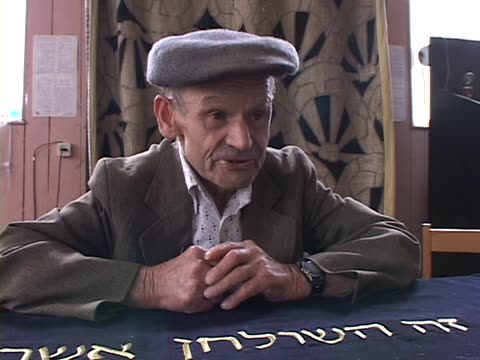
This tape is a continuation of a formal interview with David Abramovich Vider (b. 1922 in Sighetu Marmatiei). He answers questions from the AHEYM dialectological and sociolinguistic questionnaire.
Vider answers questionnaire items on how his Transylvanian-born parents spoke, contrasting Sighet usage with that of Iași and Hîrlău. Items include the words for potatoes, honest, pious, cross, sick, sleep, breath, dove, house, groats, mouse, luck, wife, and non-Jew or Christian, along with greetings and thanks. He also names the trades of Hîrlău and tells of the midwife.
Also covers Hîrlău trades and the midwife, beyond the questionnaire.
Vider speaks briefly about folk remedies for a "git oyg” (the "Evil Eye,” lit. "A Good Eye”) including "leyshn koyln” ("extinguishing coals”). He then continues with the linguistic questionnaire.
Vider says he does not believe in the evil eye, but recalls that his mother extinguished coals to drive it away. The questionnaire continues with words for shop, flowers, well, attic, scaffolding or beam and corpse, with answers distinguishing Transylvanian and Iași usage. Kerler then asks him to repeat the song his sister sang.
Includes further questionnaire words on shop, well and attic.
Vider sings a song that he has performed in previous AHEYM interviews that he heard from his sister. The song consists of a dialogue between a mother and daughter.
Vider sings a song he learned from his sister, a dialogue between a daughter at her mother's door and the mother. Kerler asks about its origin and has him repeat part of it.
Vider sings the song about Jacob lying on the stone, with an orphan boy asking the cantor to say kaddish with him. Kerler thanks him, and Vider then begins telling a joke about a worker who drinks before going in to see the factory director.
The camera cuts to a formal interview with Semyon Semyonovich Krotsh (b. 1922 in Stefanesti). Krotsh answers questions from the AHEYM dialectological and sociolinguistic questionnaire and speaks about the influence of Romanian and other languages in Yiddish.
At the start of his interview, Krotsh answers Kerler's questions on language differences between towns and on Romanian loanwords used in Yiddish. He names the word for the wash tub (magalnitsa), the pharmacy, the railway station and the word for certainly (?), and explains that flowers were not brought as gifts. At a wedding the gift was money.
Krotsh briefly discusses prewar Jewish weddings that he remembers from his youth and describes his shtetl’s various synagogues. He also shares memories of religious life and particular customs, such "leygn tfiln” (putting on phylacteries) and going to the "mikve” (ritual baths).
Krotsh describes a prewar wedding canopy set up in the middle of town near the synagogue. He talks about the town's synagogues, including a two-storey high synagogue, and the nearby mikveh. His father taught him to put on tefillin, and his bar mitzvah took place in a synagogue with cake and brandy.
Krotsh recites the words from a song entitled "In a kleyn shteytele” (In a Small Shtetl) that he heard from Ukrainian Jews. He then sings a short fragment of the song.
Krotsh recalls the words of a song about a small shtetl, a tailor and his beautiful daughter, attacked by bandits, and recites its plea to God. He says he heard the song in Ukraine and learned it from Vider's performance the day before. He sings a short fragment.
Krotsh answers other questions related to Yiddish linguistics, discussing religious customs, such as "tashlikh” (going to the river on the Jewish New Year to rid oneself of sins). He also speaks about his visit to his hometown in Romania in the postwar period and begins to detail his family’s wartime experiences.
Krotsh answers questions on old words and tashlikh, and names the small river at Ștefănești. He describes visiting his hometown at the Prut border in the early 1960s, after 17 years away, and the paperwork problems he had getting a passport. He begins his wartime account: in 1940 he and a brother crossed to the Soviets while his father and mother stayed.